Thursday, February 26, 2009

Learning to Identify and Classify the Fishes


Over the next three months I am certain that you will learn more fishes than you have known in your lifetime. In addition to the preserved specimens that you will study in lab, we will supplement our teaching materials with high quality photographs - those with sufficient resolution to see key characteristics. The photo at the left is the central stoneroller Campostoma anomalum captured by Ichthyology students in 2007. Many museums have digitized photographs of holotypes of species that you will need to learn. The Harvard Museum of Comparative Zoology is one of the best. Go to their website and you can search their collections for specimens with images.

We have many thousands of preserved specimens and many thousands of color photographs or detailed drawings to assist your learning the fishes. The more you look at the more you will build the confidence to identify orders, then families, and finally genera and species.

In 2006, Nelson reported that there were 27,977 valid species of fishes and there is a net increase in species show every year as new species are described and classifications change. The living fishes represent 62 orders and you will learn most of these. There are 515 families, too many to master in one semester. The families with the most species are Cyprinidae, Gobiidae, Cichlidae, Characidae, Loricariidae, Ballitoridae, Serranidae, Labridae, and Scorpaenidae -- you should know these families. We will learn more.

At the end of the semester I will ask you to reflect on your progress toward learning to identify and classify the fishes. Keep track of how many fish you know today, keep accurate notecards of new specimens you describe and learn, learn to sketch and take good quality photographs of fish and key characteristics.

Finally, share your discoveries with the rest of us. When you encounter an interesting and accurate image of a fish species that is new to you, post the photo on the blog and write what you have learned. The more you learn the better, especially if you share this with other students.

I continue to learn new fishes all the time. It is not just in the unexplored parts of the world where new species are discovered. Dr. Richard Mayden discovered a new species of darter, the Chickasaw darter Etheostoma cervus, in a stream just an hour and half from Memphis. If I live to be 100 years old and learn one new fish each day I just might be able to keep up with the new fishes described each year.

Fish are fascinating and learning about fish is fun!

Monday, February 2, 2009

In order to create a post you will need to sign in (upper right corner of the window). You will need a google account (www.google.com) in order to sign in to Blogger. or an AIM or AOL prfile will work too.
So get your credentials so you can log in and then

Comment below about the special adaptations of the FYWBIYCBAF (fish you would be if you could be a fish).

Thursday, January 22, 2009

Look at your fish!!


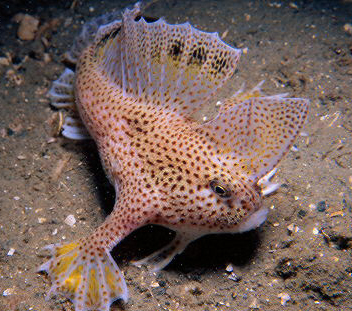
Next week we will explore the diversity of forms in the fish world. The more you study fishes you will see that some fish look so strange to us that it's hard to believe they're real. As you read Chapter 2 on Form and Movement, keep in mind the fundamental premise that all species persist because what they look like and what they do help them to survive, avoid getting eaten before they can attract mates. So what you see when you observe a fish is a unique set of traits that are part of a whole strategy to maximize fitness of individuals in a particular place and time. The photo at the right is a Handfish (Brachionichthys hirsutus).

We study anatomy because it is fundamental to how we classify and name fishes. However, if you remember that form relates to function it will be easier to apply your knowledge of anatomy to new fishes that you encounter. Our current classification system for fishes (from Nelson's Fishes of the World, Fourth Edition 2006) uses many character traits and numerous studies. Louis Agassiz (1807-1873) first classified fishes based on scale type alone: Placodermi had placoid scales, Ganoidei had ganoid scales, Cycloidei had cycloid scales, and Ctenoidei had ctenoid scales. Today we recognize groups of Chondrichthyes (placoid) and Osteichthyes, which contain Chondrostei and Holostei (ganoid scales), and Teleostei (cycloid and ctenoid scales).

Louis Agassiz would evaluate a student's potential for science by placing the student alone in a room with a single fish for a day and periodically pop in to quiz the student about what he had learned. The stories from the paleontologist Nathanael Shaler and Samuel Scudder illustrate this premise that "you can learn a great deal about a fish from its exterior traits."

Read Chapter 2 to learn more. Or if you prefer I will leave you alone in the lab for a week with a single fish. Click on the Comment button below and share with us your thoughts about the unique adaptations of the fish that you would be if you could be a fish. What do the exterior traits of this fish tell you about its habits or habitats?


Tuesday, January 20, 2009

Welcome to Ichthyology


If you are viewing this blog then you are most likely a student newly enrolled in my class, Stream Habitat ManagementIchthyology.  You have reviewed the syllabus, assignments, and read the first few  book chapters, and started dissecting the lamprey.  

 This blog is a place for all students to come together and share their perspectives on learning all about the fishes. Every day many news stories on the plight of our fishes and the conflicts that arise as humans use fish in unsustainable or inappropriate ways, often with little understanding of the complexity.    We can learn better by sharing our knowledge and expertise in and out of class.   

Some days I may just post a photograph that is meaningful to the topics we are exploring.  This image is part of a project to digitize early volumes of the Chicago Field Museum.  This emphasizes the lasting importance of quality scientific illustration.

Other days I may  post questions and issues via the blog and expect that you will respond to these questions based on your reading the assignments and studies.   At other times I will point you to interesting stories.

In the spirit of "Students Quizzing Students" I hope that you will use this blog to post questions about the topics we are studying.