Wednesday, May 11, 2016

Fish Can't Travel Like We Can, by Don Orth

You can walk or bike the New River trail from Pulaski to Galax, Virginia; the trail parallels 39 miles of the New River and 12 miles of Chestnut Creek, a tributary stream.  The New River Trail State Park was created from an abandoned Norfolk & Western rail line.  This historic trail line was built in the 1800s and a spur line to the town of Fries was built around 1900.  The trail now ends where the railroad stopped. While you can travel the many miles of the trail, fish cannot travel the New River corridor due to the dams that halt their migration. 

New River between Eggleston and Pembroke, Virginia.  Photo by D.J. Orth.

The New River is one of the world's oldest rivers and it's course was established before the uplift of the Appalachian mountains and dissects those very mountains. New River today flows 320 miles from the source in Ashe County, North Carolina, to the confluence with the Gauley River, Gauley Bridge, West Virginia, where it becomes the Kanawha River. The upper New River drainage was a refugia for coolwater fishes during the Pleistocene glacial advance and now supports eight endemic species of fishes.   The erosive force of water, resistant rock formations, and long history combined to create beautiful palisades, natural impassable falls (Kanawha and Sandstone) and many passable falls and rapids that provide numerous opportunities for whitewater enthusiasts. 
 
On May 21, 2016, we recognize World Fish Migration Day in order to enhance awareness of the human connections to rivers and migratory fishes.  Although we are frequently reminded of the long migrations of salmon, eel, shad, and striped bass in North American rivers, fish migrations are much more commonplace than previously assumed. Disruption of fish migrations are a world wide concern.  In the US, 74,000 dams block the rivers and streams.  These structures impede passage of fish, degrade water quality, trap sediments, and reduce river-based recreation and economic opportunities for local communities.  Building dams is long-term, irreversible decision, at least in terms of human life spans. The US Fish and Wildlife Service and other federal agencies have programs to promote fish passage around barriers.   All dams on the New River were built with no fish passage structures and there are no imminent plans for removal.

Most people divide the New River in three major segments: (1) upper New River above Claytor dam; (2) lower New River from Claytor Dam to West Virginia; (2) New River Gorge from Bluestone dam to the confluence with the Gauley.  Moving from the upper New River downstream, the dams include Fields, Fries, Byllesby, Buck, Claytor, Bluestone, and Hawks Nest.  None of these structures permit upstream fish passage.    Fields Dam is an old woolen mill dam. 

Fields Dam, Mouth of Wilson, Virginia. Source Panoramio
Fries Dam is a 41-foot high, rock masonry dam that was built in 1902 to power a textile mill.  Today the textile mill is gone and the project produces hydro power with four turbines.  The impoundment is filled with accumulated sediments and average depth is less than 4-6 feet.   For a slide show of photos around the Fries Hydroelectric project, click here.   Only when flow exceeds the hydraulic capacity of the turbines does water spill over the dam; at these times the water carries a high sediment load.  See video of Fries dam spilling. 
New River impounded by Fries Dam.  Island (upper right) was formed since the Dam was constructed.
Historically, Walleye ran through this reach of the river upstream to Fields Dam. Palmer et al. (2006) contends that the New River supports a unique southern strain and the current Walleye stocking program has increased abundance and angling effort for Walleye (Palmer et al. 2007).  This strain is regionally significant as they are adapted for riverine spawning and grow to an impressive size (Virginia’s record was 15 pound, 15 ounces, caught by Anthony P. Duncan in 2000).     

Byllesby and Buck Dams are only 2.7 miles apart and were constructed from 2011-2012 in one of the steepest gradient sections of the New River; historical photos are available hereTo view a flyover of Byllesby, click here. Each dam is a constructed 44-foot high concrete dam;  the two dams operate as one joint hydroelectric project with 30.1 MW capacity.  Byllesby-Buck powerhouses are operated by Appalachian Power Company.  There are no fish passage facilities and walleye fingerlings must be stocked above Byllesby in order to restore a native walleye population in the reach between Byllesby and Fries dams. Further, there are no minimum releases, other than leakage, in the Buck Dam bypass reach.
  
New River, Byllesby Impoundment, near Crooked Creek inflow.

Aerial view of Byllesby Dam
Buck Dam with no minimum flow release. Source
Claytor Dam is 137-foot high concrete dam built by Appalachian Power Company in 1938.  The Claytor Hydroelectric project has four generating unit with a total capacity of 75 MW.  It began operation in 1943 under a license from the Federal Energy Regulatory Commission.    Claytor Lake is a 4,363 acre lake impounded by the dam and provides numerous water-based opportunities along its 21-mile length.  Fish cannot pass upstream though some downstream passage does occur. 
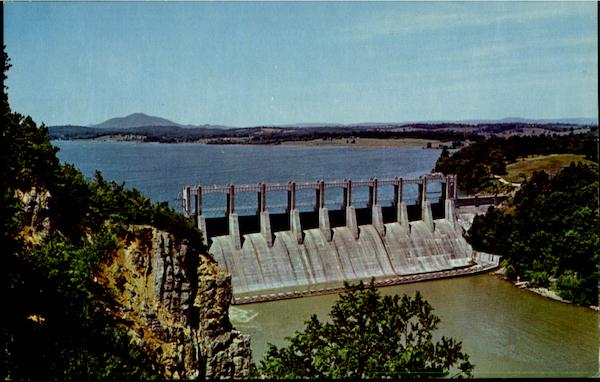
Claytor Dam  Source CardCow.com
Bluestone dam, near Hinton, West Virginia, impounds a 10.7 mile stretch of the river, creating Bluestone Lake, a flood control impoundment.  During times of flooding the river backs up to the Virginia line.  Construction of the dam began in 1941and, due to suspension of work during world war II, it was not completed until 1949.  There are no fish passage structures on the Bluestone Dam.
Bluestone Dam Source
Hawks Nest Dam was completed in 1933.  It created a 250-acre lake and during much of the year all river flow is diverted through a tunnel to power a metals plant at Alloy, West Virginia.  The diversion creates a 5-mile reach called "the Dries" that consists of large bedrock and boulders amidst a frequently dewatered river.  The tunnel construction began in 1930 and was one of the worst occupational disasters in US history.  Over 700 mostly black, mostly migrant workers died from acute silicosis from work in the tunnel (Chermiack 1986).  
Hawks Nest Dam.  Photo by Duncan. source

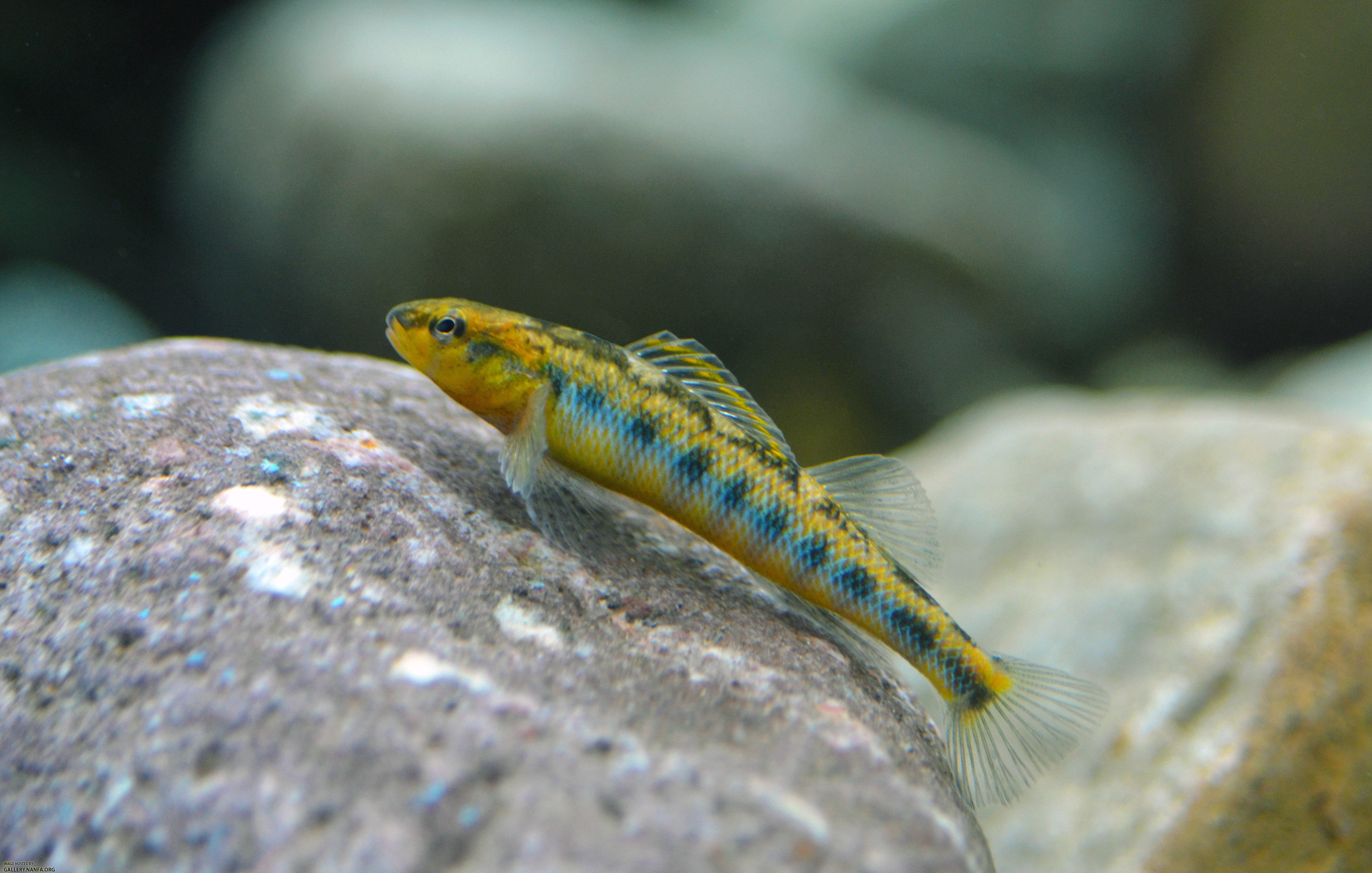
Eight endemic species of fish live in the upper New River; these include the Appalachia Darter, Bigmouth Chub, Candy Darter, Bluestone Sculpin, Kanawha Darter, Kanawha Minnow, Kanawha Sculpin, and New River Shiner.  These and other fishes, such as the Flathead Catfish, Channel Catfish, White Sucker, Northern Hogsucker, Smallmouth Bass, persist in the New River but are unable to migrate very far.    They are also blocked from entering large tributaries, such as the Little River and Wolf Creek, due to dams that block passage into these tributary waters. 
Flathead Catfish are the largest native fish in the New River. Photo by Jason Emmel
The Flathead Catfish can and do migrate long distances to find suitable summer habitats and overwintering habitats (Vokoun and Rabeni 2005).  Channel catfish are also a highly mobile fish, moving upstream during spring and seeking deepwater refugia during winter (Butler and Wahl 2010).
White sucker and Northern Hogsucker migrate into small, shallow tributaries during spawning, where they are easily observed by local citizens.  Walleye in the New River are restricted to movements between Claytor Lake and Buck Dam.  The net effect of these barriers to migration is fragmentation of fish populations into smaller, perhaps less viable, units that are less able to move and adapt to future climate changes. 
Northern Hogsucker Photo by Ben Cantrell
Fish are not the only creatures influenced by this string of impassable dams.  Freshwater mussels are unable to move far on their own; consequently they rely on a host fish to transport and disperse their glochidia.  In the New River, the Pistolgrip, Quadrula verrucosa, is a state endangered mussel that relies on catfishes for a host. 
Pistolgrip, Quadrula verrucosa, Endangered in Virginia.  source
After the dams were built, sediment loads were trapped upstream and not replenished immediately downstream.  Land disturbance and sediment inputs are now far greater than in pre-settlement times.Large reservoirs, in particular, are very efficient at trapping much of the annual sediment loads.  As the reservoirs age, the fine sediments create new bedforms, such as dunes, deltas and midchannel islands, while the channel immediately downstream from the dam degrades and sediments are armored. Conditions we observe in the New River today are the result of the legacy effect of past land use, dam operations, and dam constructions.  The legacy of dam construction means that we will forever be dealing with reservoir changes, in particular formation of more shallow flats and coves.    Sediments move with river flows until they are incorporated into new bedforms or floodplains.   
Fries Dam and dewatered intake canal showing fine sediments filling reservoir and canal. Source p 128.
Take a moment to remember that fish can't travel like we can.  Further, remember that the many fishes, mussels, and crayfishes that make the New River home are blocked from moving into or out of the river fragments.  We do not fully understand the long term effects of fragmentation; however, we know that fish have to move in order to adapt to changing climate and thermal regimes.    Support local conservation activities in the New River, by joining the New River Conservancy. Explore the many areas of the New River that can be paddled through (Trout 2003).   Perhaps, organize an event to link people to the river on or around World Fish Migration DayTake a river float and enjoy your ability to move along the river! Fish for trophy size Smallmouth Bass and Muskellunge.  Plan your trip using access maps available from the National Park Service and Department of Game and Inland Fisheries.  Refer to the New River Guide by Bruce Ingram to assist in selecting segments to paddle or fish.  
References


Butler, S.E., and D.H. Wahl. 2011.  Distribution, movements and habitat use of channel catfish in a river with multiple low-head dams.  River Research and Applications 27:1182-1191.
Chermiack, M. 1986. The Hawk's Nest Incident. Yale University Press. 224 pp. 

Copeland, J.R., D.J. Orth and G.C. Palmer. 2006. Smallmouth bass management in the New River, Virginia: A case study of population trends with lessons learned.  Proceeding of the Southeastern Association of Fish and Wildlife Agencies 60:180-187.


Easton, R. S., and D. J. Orth.  1994. Fishes of the main channel New River, West Virginia. Virginia Journal of Science 45:265-277.
Ingram, B. 2014.  New river guide: paddling and fishing in North Carolina, Virginia, and West      Virginia.  Secant Publishing, Salisbury, Maryland. 
Palmer, G.C., J. Williams, M. Scott, K. Finne, N. Johnson, D. Dutton, B.R. Murphy, and E.M. Hallerman.  2007.  Genetic marker-assisted restoration of the presumptive native walleye fishery in the New River, Virginia and West Virginia. Proceeding of the Southeastern Association of Fish and Wildlife Agencies 61:17-22.
Trout, W.E.  2003.  The New River atlas: rediscovering the history of the New and Greenbrier rivers.  Virginia Canals and Navigation Society, Lexington, VA.
Vokoun, J.C., and C.F. Rabeni. 2005.  Variation in an annual movement cycle of flathead catfish within and between two Missouri watersheds.  North American Journal of Fisheries Management 25:563-572.  


Friday, May 6, 2016

Groupers Threatened Globally, by Don Orth

Groupers are in big trouble.  What is a grouper?  Grouper is a common name given to fishes in the tribe Epinephelini (Family Serranidae: subfamily Epinephelinae).  In other parts of the world, groupers are cabrillas, garropas, gropers, lapu-lapu, pugapo, hapuku, or hammour.   The name, grouper, is believed to derive from the Portugese, garoupa. There are fifteen genera of groupers, the most diverse being Epinephelus with 87 species and Mycteroperca with 15 species.  All groupers are large fish with a stout body, large head, and large mouth. The body form allows them to act as rover predators or ambush predators.  The large mouth has impressive suction volume and, hence, the grouper usually swallows a single large prey whole. These superbly adapted fishes, however, are threatened with extinction throughout the world and action is needed to begin a long recovery.

Groupers are a biologically diverse group of reef fishes and at least 35 different species are harvested around the world.  They typically support small-scale, localized commercial and recreational fisheries. The flesh is a firm, lean white meat with large flake and a mild flavor that blends well with light seasoning or fresh herbs. Groupers are sold fresh in local seafood markets where they are often the highest priced fish. Catches of many groupers have declined and there is "no sign of any slowing down" of declines (Sadovy de Mitcheson et al. 2013).  In response to reduced grouper supplies, restaurants often serve some other, less expensive fish.  Some restaurants have even admitted to serving basa fish (Pangasius bocourti), labeled as "grouper's cousin."  It's a catfish, hardly a "cousin!" A handheld assay was developed to counter the extensive mislabeling of groupers (Ulrich et al. 2015).   There is no question that fishing is the major factor driving stocks on the downward spiral, but the several characteristics of their habitat use and life history make groupers particularly vulnerable.

Color phases of black grouper Mycteroperca bonaci in Belize, including (A) blotched, (B) light, (C) dark, and (D) white-headed.  source: Paz et al. 2007.
Groupers are long-lived, late maturing fishes that rely on coral reefs to provide shelter and abundant food.  They exceed 1 m in length as adults and, as opportunistic predators, they moderate the abundance of multiple prey species.  Many, but not all, groupers are sequential hermaphrodites and are born female and transition to males later.  Consequently, the sex ratio is skewed in favor of females. Theories on sex change in groupers will be a subject for a later post. Large males maintain territories on the reef and may have a harem of multiple female mates.  Young groupers typically have a different color pattern and occupy different habitats than adult groupers.  Adult groupers have multiple color patterns to communicate mating readiness (see color phases in photo).
 
Young color phase of the Giant Grouper Epinephelus lanceolatus  By © Citron  source
Why are so many groupers threatened with extinction?   One fourth of all grouper species are either near threatened or at risk of extinction if current trends continue (Sadovy de Mitcheson et al. 2013).  Many more species (33%) are data deficient, which makes assessment of fisheries status and extinction risk impossible and management interventions unlikely (Luiz et al. 2016).  Several aspects of the life history of groupers helps to explain the prevalence of overharvest.
 
Grouper Head On  Photo by Craig O'Neal.  Source

First, adult and juvenile groupers often use very different habitats and in many cases ecosystems that support juveniles and adults are threatened from human modification.  Coral reefs throughout the world are changing due to climate change, ocean acidification and coral bleaching (Arundsen et al. 2003).  Coral reef fish declines directly limit the food base for adult groupers.   Eggs and larval groupers are pelagic and are transported via currents to juvenile habitats.  Juveniles often settle in different shallow water habitats.   The juvenile habitats are essential to maintain steady recruitment of new adults to the coral reefs.  However, these shallow water habitats are often degraded or transformed to less productive habitats.   

Kite-shaped Epinephelus larvae. Photo courtesy National Marine Fisheries Service source
The Goliath Grouper Epinephelus itajara is the largest grouper in the Atlantic Ocean and one of the two largest species of groupers in the world, exceeding 2 m (6 feet) in total length. Florida is the only place in the world where Goliath Groupers can be found on a regular basis throughout the year, and in their spawning aggregation sites in late summer.  Although we fish for Goliath Grouper near reefs and structures, the species is mangrove-dependent, and shows a distinct size-related habitat shift. Juvenile goliaths (up to 1.1 m or 3 feet in total length) are found exclusively in spatially complex, fringing red mangrove (Rhizophora mangle) shorelines (Frias-Torres 2006).  The mangrove forests support high diversity of fish and invertebrates and are threatened  worldwide.  Mangroves create a narrow fringe habitat between land and sea, between latitudes 25ºN and 30ºS.  Since 1980, at least 35% of mangrove forests were lost (Valiela et al.  2001).  

During spawning the groupers aggregate at specific spawning locations. Here they are vulnerable to overexploitation. Especially where large aggregations exist, large grouper may be quickly reduced in abundance; the first fisherman to find the aggregations hit the bonanza and can’t reel them in fast enough.  Their gears are fully saturated.  It’s a phenomenon that fisheries professionals have named hyperstability  (Erisman et al. 2011). Because fisherman can’t catch them fast enough, the catch per unit effort remains high even as populations plummet.  In the case of the Nassau Grouper Epinephelus striatus, declines were first noticed when spawners failed to show at historical spawning aggregation sites (Coleman et al. 1996; Aguilar-Perera et al. 2014).   
Hyperstable relationship between catch per unit effort (cpue) and population size (N)  (Erisman et al. 2011).
Groupers are extremely vulnerable to overfishing due to a combination of life history traits that include slow growth, long life (exceeding 4 decades), late sexual maturity (up to 8 years), and strong site fidelity. Males are usually larger, older and less numerous than females.  Capture fisheries are biased toward large adults.  The larger species of groupers that also had smaller geographic ranges were most likely to be endangered or critically endangered (Luiz et al. 2016).
Photographs from the 'Gulf Stream' charter boat on (A) 14 April 1957,
(B) 9 March 1958, and (C, D) between 1965 and 1979 Source: McClenachan 2009.
Another new development that particularly threatens the groupers is the live reef food fish trade (LRFFT).  LRFFT involves the capture of reef fish that are kept alive for sale and consumption as a luxury food item, primarily in the coral triangle region.  Some small groupers are raised in cages (Pierre et al. 2008).   However, this form of mariculture depends on harvest of juvenile groupers as seed stock and the resulting fisheries are likely to be unsustainable (To and Sadovy de Mitcheson 2009).  The unfortunate reality for the groupers is that the demand for live groupers for international trade far outstrips the sustainable supply (Sadovy et al. 2003).

One allure of the grouper is the massive size reached by some species. The Giant Grouper (Epinephelus lanceolatus) grows up to 2.7 m (8.9 ft) in length and 400 kg (880 lb) in weight.   The larger grouper species are more likely to be threatened or critically endangered (Ruiz et al. 2016).       

Atlantic Goliath Grouper  Photo by Brett Seymour -  source   
In November 2013, a 310-kg (686-lb) grouper had been caught and sold to a hotel in Dongyuan, China.  The largest grouper ever caught and certified by IGFA was a 680 pound Atlantic Goliath Grouper Epinephelus itajara.   The Goliath Grouper has been severely overfished throughout its range and a fishing moratorium has been in place since 1990 (McClenachan 2009).
Largest Goliath Grouper  source
The extreme size alone, adds to the interest and pressure by fisherman. In fact, the sport anglers in Florida want the current harvest moratorium on Goliath Grouper lifted. Fisherman are willing to pay between $34 and $79 for a single harvest permit (Shideler et al. 2015).

The story of the grouper is similar in all regions where they exist.  Fish are quickly overharvested and fishers move from aggregation to aggregation until the grouper population is unable to recover.  The efforts to recover Goliath Grouper and Nassau Grouper are longterm efforts that benefit from recent studies of population structure (Jackson et al. 2014).  For more background on the Nassau Grouper efforts, view the Groupers Last Stand.  The lessons from management of groupers indicates that recovery will not be quick nor easy.   Length or creel limits are often ineffective if fish are released with barotrauma after deepwater capture.  Successful efforts will most likely rely on community based management and adoption of principles from Ostrom's Governing the Commons, so that local knowledge is incorporated to match rules to local conditions and customs and community members monitor users and enforce the sanctions.  Other local management interventions may include bans on sale of grouper during reproductive seasons, wise implementation of marine protected areas, shift to grouper tourism via SCUBA diving (Rudd and Tupper 2002), and adopting international standards for the trade in international live reef food fish.  Protective management actions will take decades to evaluate because of the long time to maturity and long recovery times for groupers.  Consequently, a precautionary approach to harvest management is advisable for the many data-deficient species of groupers.

References
Aronson, R.B., et al.  2003. Causes of coral reef degradation. Science 302(5650)1502-1504.
Coleman, F.C., C. C. Koenig, and L.A. Collins.  1996.  Reproductive styles of shallow-water groupers (Pisces: Serranidae) in the eastern Gulf of Mexico and the consequences of fishing spawning aggregations. Environmental Biology of Fishes 47(2)129-141.
Erisman, B.E., L.G. Allen, J.T. Claisse, D.J. Pondella II, E.F. Miller, and J.H. Murray.  2011. The illusion of plenty: hyperstability masks collapses in two recreational fisheries that target fish spawning aggregations. Canadian Journal of Aquatic Sciences 68:1705–1716.
Frias-Torres, S. 2006.  Habitat use of juvenile goliath grouper Epinephelus itajara in the Florida Keys, USA. Endangered Species Research 2:1-6.  
Jackson, A.M., B.X. Semmens, Y. Sadovy de Mitcheson, R.S. Nemeth, S.A. Heppell, P.G. Bush, A. Aguilar-Perera, J.A.B. Claydon, M.C. Calosso, K.S. Sealey, M.T. Schärer, G. Bernardi. 2014. Population structure and phylogeography in Nassau Grouper (Epinephelus striatus), a mass-aggregating marine fish. PLoS ONE. DOI: 10.1371/journal.pone.0097508
Luiz et al 2016. Predicting IUCN Extinction Risk Categories for the World’s Data Deficient Groupers (Teleostei: Epinephelidae) Conservation Letters. doi: 10.1111/conl.12230
McClenachan, L. 2009. Historical declines of goliath grouper populations in south Florida, USA.  Endangered Species Research 7:175-181. 
Paz, G., and G.R. Sedberry. 2007. Identifying black grouper (Mycteroperca bonaci) spawning aggregations off Belize: conservation and management. Proceedings of the 60th Gulf and Caribbean Institute. Punta Cana, Dominican Republic.  577-584
Pierre, S., S. Gaillard, N. Prevot.  2008.  Grouper aquaculture: Asian success andMediterranean trials. Aquatic Conservation Marine and Freshwater Ecosystems 18(3):297-308. 
Rudd, M.A., and M.H. Tupper. 2002.  The impact of Nassau grouper size and abundance on scuba diver site selection and MPA economics.  Coastal Economics 30:133-151.
Sadovy, Y.J., T.J. Donaldson, T.R. Graham, F. McGilvray, G. Muldoon, M. Phillips, and M. Rimmer. 2003. While Stocks Last: The Live Reef Food Fish Trade.  Asian Development Bank, Manila. 
Sadovy, Y. and Domeier, M.  2005. Are aggregation fisheries sustainable: reef fish fisheries as a case study. Coral Reefs 24, 254–262.
Sadovy de Mitcheson,  Y., M.T. Craig, A. A . Bertoncini, K.E. Carpenter, W. W.L. Cheung, J.H. Choat, A.S. Cornish, S.T. Fennessy, B.P. Ferreira, P. C. Heemstra, M. Liu, R.F. Myers, D.A. Pollard, K. L. Rhodes, L.A. Rocha, B. C. Russell, M. A. Samoilys, and J. Sanciangco. 2013. Fishing groupers towards extinction: a global assessment of threats and extinction risks in a billion dollar fishery. Fish and Fisheries 14:119-136. DOI: 10.1111/j.1467-2979.2011.00455.x
Shideler, G.S., D.W. Carter, C. Liese, and J. E. Seafy. 2015.  Lifting the goliath grouper ban: angler perspectives and willingness to pay.  Fisheries Research   161:156-165.
To, A.W.L. and Y.J. Sadovy de Mitcheson. 2009. Shrinking baseline: the growth in juvenile fisheries, with the Hong Kong grouper fishery as a case study. Fish and Fisheries 10, 396–407.
Ulrich, R.M., D.E. John, G.W. Barton, G.S. Hendrick, D.P. Fries, and J.H. Paul. 2015.  A handheld sensor assay for the identification of grouper as a safeguard against seafood mislabeling fraud. Food Control 53:81-90.
Valiela, I., J.L. Bowen, and J.K.York. 2001.  Mangrove forests: one of the world’s threatened major tropical environments. BioScience 51(10):807-815.