Showing posts with label lutefisk. Show all posts

Wednesday, June 1, 2016

Ten fish to try when you get bored with fish and chips, by Don Orth

What is the most consumed fish in the world?  If you guessed “Tuna,” then you are correct.  I think, probably.   But beyond Tuna, the most popular fish eaten depends on where you live.   Salmon, rohu, tilapia, cod, catfish, and trout are very popular, just not worldwide favorites. If you're from the Mid-Atlantic US you have likely tried Northern Snakehead, in Florida you have eaten the lionfish, Midwestern folks are learning to like or adapt to Asian Carp, and throughout North America we've been introduced to Basa, or Swai. Even if you have eaten sashimi, fish head soup, pickled herring, or caviar, it may be time for you to be more adventurous in your fish choices.  Here are ten top choices for your new fish bucket list.

10.  Lutefisk (LEWD-uh-fisk) is dried cod that has been soaked in a lye solution for several days.  This traditional dish is from Norway, Sweden, and parts of Finland.  But those in the old country do not eat it anymore. Rather it’s become a holiday treat for Scandinavian-Americans. In Scandinavia, cod were dried to preserve them for later consumption. The lutefisk origin story says that a drying rack filled with dried cod caught fire, leaving wood ashes (or lye) that changed the cod forever.  Lye is a caustic alkali that may raise the pH of the fish to 10!  Do not eat this.  To make the lutefisk edible, you must first soak the lutefisk in water to remove the lye. The soaked lutefisk is then gently poached or baked because of the jelly-like consistency.  It is an acquired taste, says the Norwegian bachelor farmer.  Others describe it as a foul and odiferous gooey fish with rancid oily taste.  Best served with lots of butter.  Uff da!
Lutefisk  Source

9. Surströmming.   If lutefisk is not an appealing fish for your bucket list, try Surströmming, which is soured herring, or its cousin Rakfisk a fermented trout. Herring, trout, and salmon are fatty fishes and drying is not an acceptable preservation method.  Fermentation, however, will preserve the fish indefinitely.
Surströmming  Source
Surströmming is only produced in northern Sweden where herring are harvested in spring, and gutted and salted.  They are then packed in barrels with a strong (17%) brine solution and allowed to ferment.  The pyloric caecum is left intact in the gutted fish. This provides proteolytic enzymes that facilitate a month-long fermentation.  The low temperatures (68̊ F) and brine are critical elements to the fermentation, which produces strong smelling acids.   It’s the smell of the surströmming that appeals to its proponents.  I mean, what else could there be to make this appealing?  Are you man enough to try it?  Closest I have gotten is watching others open a can; watch this video1 or this video2.  [Vomit Alert on video2!]

8.   Kusaya is similar to surstromming, but is a Japanese delicacy made by taking a fish like mackerel, soaking it in brine solution for a day, then laying it out in the sun for a few more days. Some kusaya makers pride themselves on having used the same brine over several generations to make their stinky fermented fish. Although the smell can be overpowering, the taste is actually quite mild.   Can't wait to try it. 
Kusaya is fermented mackerel.  Source
7.  Kæstur hákarl and Hongehoe are other versions of fermented fish.  The national disk of Iceland is the Kæstur hákarl, which is a fermented Greenland Shark.  The Greenland Shark has high content of urea and trimethylamine oxide, a mixture that facilitates osmoregulation.   However, after fermentation, the urea becomes ammonia and the hakarl has a fishy taste and an ammonia-rich smell. Andrew Zimmern, host of Bizzare Foods, described the smell as "some of the most horrific things I've ever breathed in my life."   In Korea, a skate is fermented to create a treat called Hongeohoe.  I’m told it’s edible as long as you don’t breathe. 
Hongeohoe is fermented skate.  Source
 6.  Shiokara is made from salted, fermented fish guts in a paste of malted rice. There are different varieties as you can imagine.  It can be made from whatever fish, squid, or other viscera were left over from the fishmongers shop.  This bucket list item must await travel to a specialized shiokara bar in Japan.  Tastes best when alternated with gulps of whiskey or sake.
Shiokara is salted, fermented fish guts in malted rice paste.  Source
5.  Salt cod is dried and salted so it will keep without refrigeration. When you take salt cod out of the box, you find it is hard and dry and covered in salt, not at all appealing. To make it edible again the salt cod is soaked in cold water—changing the water several times—for a couple of days until fully desalted and rehydrated.  Salt cod has a history in many countries. In Italy it's called baccalà, bacalao in Spain, morue in France, bacalhau in Portuguese, bakaliaro in Greece, saltfish in the Caribbean, and klippfisk in Scandinavian countries. The soaking process does work and the rehydrated cod can be used in any recipe calling for cod.  I recently made the Brandade de Morue recipe and can mark this one off my bucket list.  

4.  Gefilte fish are ground fish patties that were at one time stuffed back into the fish skin and baked. Gefilte fish is a Jewish tradition that later morphed into fish-shaped fish patties and even fish balls.  The gefilte fish, which is often carp, pike or whitefish, is poached in fish broth.  You can use the whole head of a large carp to make the jellied broth, or buy a prepared fish broth.  There are lots of options if you aren't planning to make it like your grandmother did. Gefilte fish is also available as a ready-to-eat product from Manischewitz. The Gefilte fish has morphed into many versions of fish meatballs.  Take ground fish (of any type), mixed with egg, breadcrumbs and herbs. Poach it very gently in salty water.

 3.  Shirako are cod sperm eaten in Japan. Romanians also eat carp milt, or Lapți, and the Russians eat herring milt, or Moloka.   Cooked or raw, fish sperm is also an acquired taste, so you may never know if you like it unless you try it.  
Shirako are cod sperm.  
 2.   Dried anchovy.   Ever eaten anchovies?   Anchovies are a healthy, sustainable food choice, that can be used in many recipes.   Cooking methods depend on their size.  Big ones are only a few inches long and are called "Dasi-myulchi" in Korean.  These are usually used for broth, while the small ones, called "Bokkeum-myulchi" are stir-fried for unique dishes. Dried anchovy can be also served without cooking as a snack. Try this spicy anchovies recipe for a snack, or Myeolchi-muchim  for a meal with rice and kimchi.     
Dried Anchovy.  Source
 And Number 1 on my bucket list? Fuguko Nuka-zuke is one rare delicacy that I haven't tried.  Fuguko Nuka-zuke are the pickled ovaries from the pufferfish.  Eating eggs of fish is much more commonplace than eating fish sperm, whether it's caviar or shad roe.  Nukazuke is a type of Japanese pickle, made by fermenting vegetables in rice bran (nuka) and fugu is Japanese for pufferfish.  How did anyone ever think to eat pufferfish ovaries?  Ovaries and other organs are filled with the deadly neurotoxin, tetrodotoxin!  Somehow the pickling process breaks down the deadly toxin.  Otherwise, the organs of the pufferfish can contain levels of tetrodotoxin sufficient to produce paralysis of diaphragm.  Do not try this one at home.
Fuguko Nuka-zuke, pickled ovaries from the pufferfish.  source
 
There are many more possibilities for your own bucket list.  You may wish to comment on this post to point out tasty items that I omitted.  I left off Ikizukuri, the practice of preparing sashimi from live seafood such as fish, shrimp or lobster.  Not raw, but live! I will say no more; I really cannot recommend that anyone try this.

The origins of many in the top ten are related to the fact that fish flesh spoils quickly.  Consequently, different cultures dried, salted, fermented fish between harvests before ice and refrigeration were widely available.  We don’t have to use these techniques today.  But we do because people find these foods interesting or tasty or both.

There are many good reasons to add more fish to your diet.  Eating more fish has been linked to lowered risk of depression, heart disease, and brain health in high-risk individuals (Marckmann and Grønbaek 1999; Morris et al. 2003; Li and Zhang 2015).  Fish provide the opportunity for a highly diverse, healthy, and interesting diet.  If you don’t like my fish bucket list, then write your own. Or you can eat bugs! 

References
Li, F., X. Liu, and D. Zhang. 2015.  Fish consumption and risk of depression: a meta-analysis.  Journal of Epidemiology and Community Health doi:10.1136/jech-2015-206278
Marckmann, P. and M. Grønbaek. 1999.  Fish consumption and coronary heart disease mortality. A systematic review of prospective cohort studies.  European Journal of Clinical Nutrition 53(8):585-590. DOI: 10.1038/sj.ejcn.1600832
Morris, M.C., D.A. Evans, J.L. Bienias, C.C. Tangney, D. A. Bennett, R.S. Wildon, N. Aggarwal, and J. Schneider. 2003.  Consumption of fish and n-3 fatty acids and risk of incident Alzheimer disease.  Archives Neurology 60:940-946.
Morris, M.C., J. Brockman, J.A. Schneider, Y. Wang, D.A. Bennett, C.C. Tangney, and O. van de Rest. 2016. Association of seafood consumption, brain mercury level, and APOE ε4 status with brain neuropathology in older adults.  Journal of the American Medical Association 315(5) doi:10.1001/jama.2015.19451

Tuesday, December 22, 2015

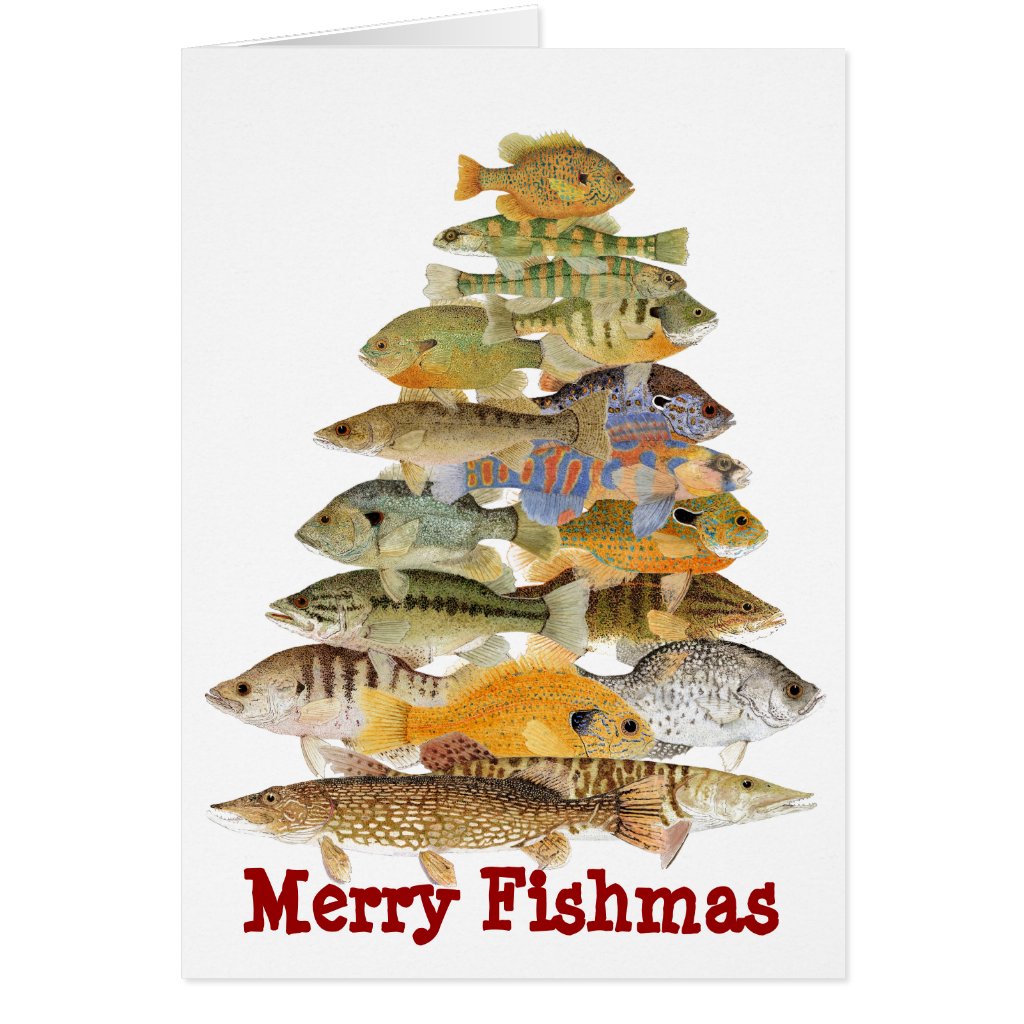
Have Yourself a Merry Fishmas! Celebrate a Christmas Darter Too, by Don Orth


During this holiday season, there are many traditions that we follow without question.  They are like memorized lyrics “chestnuts roasting on an open fire."  We bake cookies, decorate a green tree, and leave cookies and milk out for the Christmas intruder/visitor.   However, there are also some holiday traditions that involve fish.  In the The Feast of the Seven Fishes, Italian-Americans celebrate the wait for the baby Jesus by eating seven types of seafood.  We eat pickled Herring at the stroke of midnight on New Year’s Eve to bring a year of good fortune.   Eating fish is thought to bring good luck, but in some cultures it is important to serve the fish with head and tail intact to ensure a good year from beginning to end. For religiously observant Jews, Gefilte fish has become a traditional food for Shabbat and Passover.  Gefilte fish resembles a large meatball made from ground fish and matzo ball mix and cooked in fish stock.   In one Czech Christmas custom, fish scales are placed under Christmas dinner plates to bring wealth to the house and carrying a fish scale in your wallet all year ensures that money will not run out.   


Scandinavian-Americans favor Lutefisk for their holiday traditionLutefisk, the food of poor Scandinavians, came to the United States with its immigrants and the tradition lives on in holiday Lutefisk dinners  Lutefisk is a well-disguised Atlantic cod. It is not surprising that cod was a common food of Scandinavia, eaten for centuries; the northeast Atlantic has the world's largest population of cod. The traditional preserving method first air dries the cod in a cool, dry climate until it appears as hard and dark as an old shoe. This extends the shelf life by several years. Later it is reconstituted by soaking it in lye.  Yes, lye. To make the fish edible again, the lye-reconstituted fish is soaked repeatedly in cold water.  This tradition lives on despite the fact that most dislike the taste and texture of Lutefisk.   But it is a tradition, just like Lou T. Fisk, the fishy ambassador for Madison, Minnesota, the self-proclaimed Lutefisk capital of the USA.  

Given the many holiday traditions involving fish, it is surprising to me that there are so few fish named for the Christmas holiday.  The International Commission on Zoological Nomenclature is the adviser and arbiter of scientific names of animals.  However, common names are not standardized by this international code.  Why are so few fish named for Christmas?  There is a Christmas Wrasse from the western Pacific Ocean, and a Christmas Darter Etheostoma hopkinsi and a Holiday Darter Etheostoma brevirostrum from the Southeast USA  If you know of other fish named for Christmas, please post a comment below. 
Two Christmas Darters. Top by Dustin Smith and Bottom by Michael Wolfe
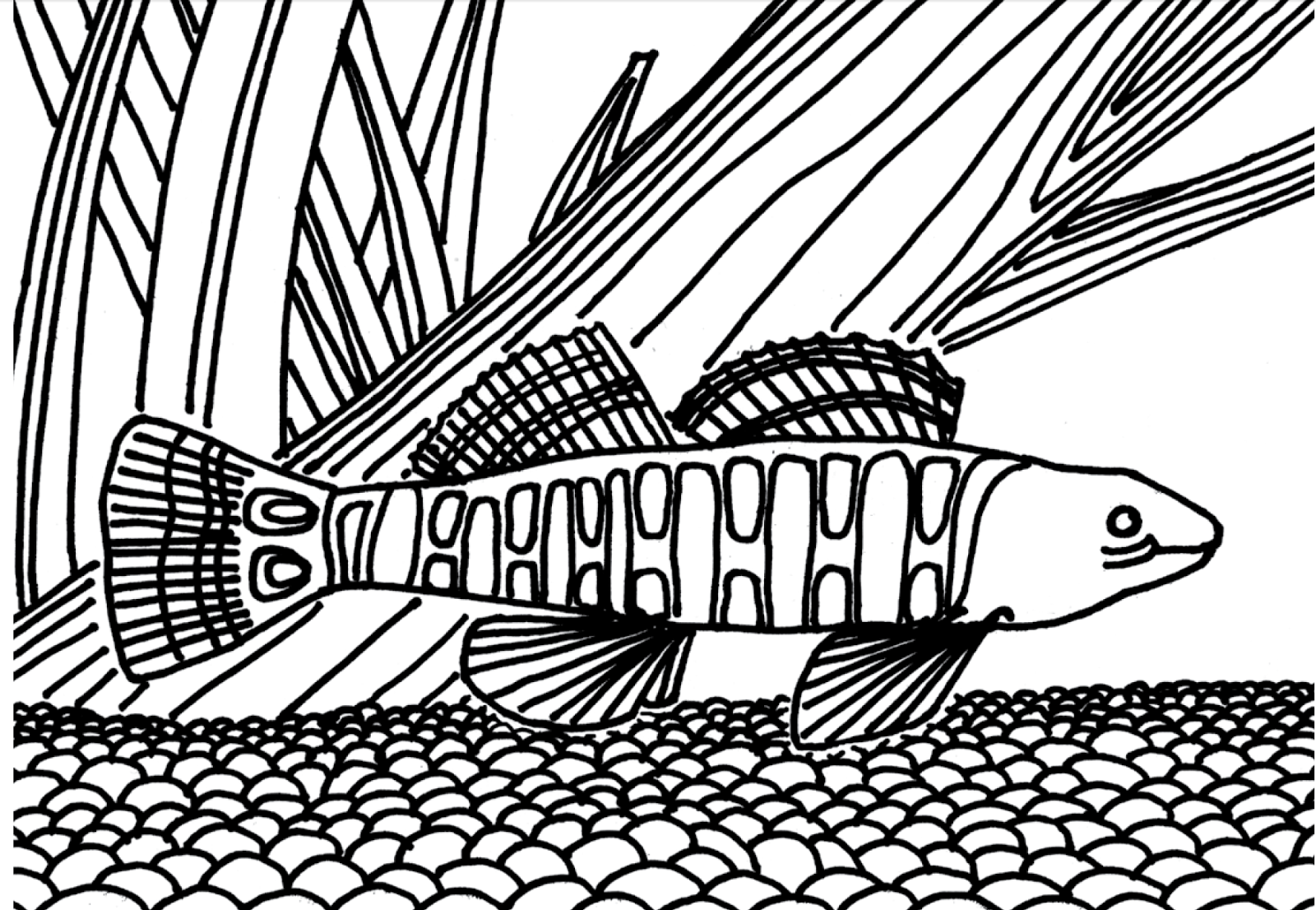
The Christmas Darter is one of the 184 small, colorful bottom dwellers in the Family Percidae.  They are small, tube-shaped fish with stiff spines on the first dorsal fin.   The Christmas Darter was named for its bright red and green breeding coloration.  Its scientific name hopkinsi was for Milton N. Hopkins, Jr., who collected the type specimen.    The Christmas Darter has a small conical shaped head, broad frenum (frenum is fleshy bridge that connects the snout and the upper jaw), and 2 anal spines.  Breeding males have a bright red submarginal band on its spiny dorsal fin.  What makes it the perfect Christmas specimen are the 10-12 dark green bars on side, separated by red in the male.  The female has yellow blotches between the green bars.   The Christmas Darter is restricted to the Savannah, Altamaha, and Ogeechee River drainages in South Carolina and Georgia     These small fish are only 1.5-2.5 inches as adults and inhabit gravel-bottom riffles of creeks and small rivers (Rohde et al. 2009 p 358-360).
Distribution of the Christmas Darter.  Fishes of Georgia website.
So consider starting a new tradition this Christmas.  Print out this sketch of the Christmas Darter and color it in with bright red and green and add it to your Christmas decorations.  Or download an app to digitally "paint" the Christmas Darter.   Perhaps decorate a few Christmas Darter cookies or shape some Gefilte fish to resemble Christmas Darters.

Christmas Darter.  From SC DNR Fishes of Concern Coloring Book   
References
Espinsosa-Pérez, H., L.T. Findley, C.R. Gilbert, R.N. Lea, N.E. Mandrak, R. L. Mayden, J.S. Nelson, and L.M. Page. 2013.  Common and Scientific Names of Fishes from the United States, Canada, and Mexico, 7th edition.  American Fisheries Society, Bethesda, Maryland. 
Knepley, M. 2014.  Fish in Focus:   Christmas Darter, Etheostoma hopkinsi  American Currents  Winter issue.

Rohde, F.C., R.G. Arndt, J.W. Foltz, and J.M. Quattro.  2009.  Freshwater fishes of South Carolina.  University of South Carolina Press, Columbia, South Carolina. 430 pp.
South Carolina Department of Natural Resources.  N.d.  SC Fishes of Concern Coloring book.    
Straight, C.A., B. Albanese, and B.J. Freeman. [Internet]. [updated 2009 March 25]. Fishes of Georgia Website, Georgia Museum of Natural History; [cited December 21, 2015]. Available from: http://fishesofgeorgia.uga.edu