When
the subject turns to teaching, I often hear “But I like to lecture. everyone is doing it.
And my students like my lectures too!” Lectures
are familiar media. Non scholae sed vitae
discimus is
Latin, which translates to “"We do not learn for school, but for life.” And in life there are thousands of things we
must do and seldom does it mean a 50- minute lecture. Rather we need to help students develop meta-skills for the 21st century (Neumeier 2013). Newsflash: note-taking and test-taking are not meta-skills needed for the workplace.
Today
social media is changing the way we communicate, share ideas, and develop
networks. It must play a role in teaching. Therefore, I advocate a holistic
approach to learning social media that is incorporated in my teaching
practices. We learn from each other,
therefore a community of practice approach can be inform better practice. Paul
Tess, in 2013, wrote that the “ubiquity
of social media is no more apparent than at the university where the technology
is transforming the ways students communicate, collaborate, and learn.” Last year I was asked to present a talk on the trials and tribulations of adopting social media in college education. It should have been titled "Damned If You Do: Adopting Social Media in Teaching."

Social
media has an low entrance fee, but it’s constantly changing. Since the beginnings of a movement toward
user-created content in the 1990’s, earliest social network sites such as Sixdegrees.com and Friendster morphed into Web 2.0 apps (Van Dijck
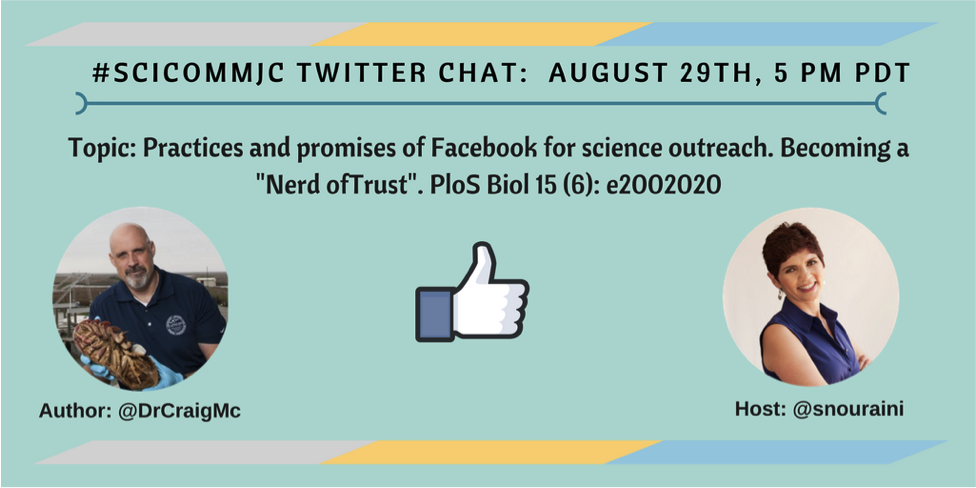
2013). My notes and manuscript were in a constant state of flux since the uses of social media in college is highly dynamic. Therefore, you should read this article now, before it gets any further out of date. My favorite article, published since this manuscript was finalized, popularized the "nerd of trust" meme in the #SciCommJC. You too can become a Nerd of Trust, just click here. Someone needs to create the emoji.
 |
| Nerd of Trust is a real thing. Read about practices of Facebook for science outreach here. |
But
Tess and others (many others, read my article) provide evidence of the positives and shortcomings of social
media. Hence it is the damned if you do
-- damned if you don't dichotomy. I make
five modest suggestions for how to begin.
The best way to get the right answer on the Internet is not to ask a
question, its to post the wrong answer (Cunningham’s Law). If I'm wrong, I'm confident that some astute reader will point it out. No
one doubts the pleasures and benefits of some aspects of social media – what
major innovation in history has had no benefits? This issue is balance, and how
we get enough distance from our own embedding in social media to assess that
balance. The
paper makes the case that some social media uses are maturing and may prove to
be useful additions to your pedagogical toolkit. If interested, read the pre-print of the article here.
We
should facilitate our students growth in their process of creating a
digital identity. Our choice of pedagogy speaks volumes to our
students. Are we communicating these messages? You
are important and you matter! Your voice
matters! Your feelings matter! Your life matters! Your story matters! (Jones and Leverenz 2017). Do
we teach our students how to protect their privacy and intellectual property while
sharing ideas via social media? Twitter’s
policy states that “By submitting, posting or displaying Content on or through
the Services, you grant us a worldwide, non-exclusive, royalty-free license
(with the right to sublicense) to use, copy, reproduce, process, adapt, modify,
publish, transmit, display and distribute such Content in any and all media or
distribution methods (now known or later developed). Facebook’s states that: “For content that is covered by intellectual
property rights, like photos and videos (IP content), you specifically give us
the following permission, subject to your privacy and application settings: you
grant us a non-exclusive, transferable, sub-licensable, royalty-free, worldwide
license to use any IP content that you post on or in connection with Facebook
(IP License).”
 |
| Elements of personal digital brand development pedagogy from Jones and Leverenz (2017). |
Seventy five percent of academics do not use social media to express their views on scholarship or politics. Do they believe you need to get through the journal pay wall or take their classes to learn from them? If you are one of these academics, I encourage you to try something new. Read this up-to-date guide on the A to Z of social media! You're damned in you do, or damned if you don't.
References
Carrigan,
M. 2016. Social Media for Academics. London: Sage.
Jones, B. and C. Leverenz. 2017.
Building personal brands with digital storytelling ePortfolios. International Journal of ePortfolio 7:67-91
Joosten,
T. 2012. Social Media for Educators:
Strategies and Best Practices.
Jossey-Bass, 144 pp.
Lipschultz,
J.H. 2017. Social Media Communication:
Concepts, Practices, Data, Law and Ethics, Second Edition. Routledge. 396 pp.
-->
McLain, C.R. 2017. Practices
and promises of Facebook for science outreach: Becoming a “Nerd of Trust.” PLoS Biology 15(6): e2002020.
https://doi.org/10.1371/journal.pbio.2002020
Neumeier, M. 2013. Meta skills: The five skills for the robotic age. New Riders, San Francisco, CA
Orth, D.J. 2017. Social
media may empower fisheries students via learning networks. Fisheries
Tess, P. 2013. The role
of social media in higher education classes (real and virtual) – A literature
review. Computers in Human Behavior 29(5):A60–A68.
van Dijck, J. 2013. The
Culture of Connectivity: A Critical History of Social Media. Oxford: Oxford
University Press.

 Posts
Posts