Tuesday, March 15, 2016

Grouper and Giant Moray are Unlikely Hunting Buddies, by Don Orth

A grouper swims into the face of a Giant Moray Eel and says, “Let’s hunt together.”  The Giant Moray says “Ok, why not?”  And such begins a cooperative hunting trip among two unlikely hunting buddies.  It's not a riddle. 

A fish must eat or it will not survive long, especially in the warm ocean waters.  We often think of a fish by its feeding strategy.  For example, the Pickerel and Barracuda are camouflaged sit-and-wait predators, the Goosefish also sits and waits, but it has a lure to attract prey, sturgeons are benthic foragers, and Menhaden, Sardines, and Whale Sharks are filter feeders.  The morphology of each fish is specialized to facilitate its dominant feeding strategies. But the Grouper and the Moray Eel often hunt together to increase prey captures.  This cooperative hunting behavior in two unrelated carnivores was first observed by Bshary and associates in the Red Sea.  It may be the first reported occurrence of cooperative hunting by unrelated species.

The Roving Coralgrouper, Plectropomus pessuliferus Fowler, 1904, is a large grouper (Serranidae, Epinephelinae, Epinephelini) that roams on the reefs in the Indo-Pacific Ocean and reaches 1.2 m.  The groupers are a highly photogenic marine fishes.  All members of this genus have the same dorsal fin formula “VIII, 11” and three antrorse spines on the lower margin of the preopercle.  All seven species of Plectropomus possess the beautiful pattern of blue spots on the head, body, and median fins (see photo).  Roving Coralgroupers usually live and hunt alone.  Only during the breeding season, do they join other Roving Coralgroupers in spawning aggregations. This grouper is most likely a protogynous hermaphrodite, like other close relatives. The Roving Coralgrouper is a diurnal predator with a large mouth. These large-bodied rover predators use their burst speed and vacuum action of the large buccal cavity to capture prey in open water.  Consequently, its prefers to eat other fishes, typically damselfishes (Pomacentridae), wrasses(Labridae), and anything else that moves too slow.
Photo of  Roving Coralgrouper Plectropomus pessuliferu.  Photo by Pere Rubio
The Giant Moray Gymnothorax javanicus (Muraenidae) is the largest of the moray eels, reaching up to 3 meters and up to 30 kg.  They are widespread in the Indo-pacific region as well as other shallow warm oceans.  Adults have black specks, which graduate into leopard-skin spots behind the head, with a black area surrounding the gill opening (see photo).   Giant Morays rest in crevices during the day and, unlike the Roving Coralgrouper, hunt nocturnally.  Because of their body form, the moray can access prey that are hiding in reef crevices.  Their wide jaws have a unique set of secondary jaws, the pharyngeal jaws; these jaws assist with holding prey.  Fish, cephalopods, molluscs, and crustaceans often fall prey to these double-jawed morays.   The Giant Moray also displays long breeding migrations, transparent leptocephalus larvae, and hermaphroditism, but it’s the cooperative hunting with the Roving Coralgrouper that illustrates this animal’s incredible intelligence. 
Giant Moray Eel Gymnothorax javanicusPhoto by Andrew Bruckner
The fascinating study by Redouan Bshary and associates, of University of Neuchâtel, Switzerland, described cooperative hunting behavior of the Roving Coralgrouper and the Giant Moray Eel.   By cooperation we mean that the two species communicate regarding their needs and cooperate to help each other capture more prey.  Further, true cooperation occurs only when individuals play different roles during a hunt. How do these two species communicate?    If the grouper is hungry, s/he will approach with head shaking (3-6 shakes/second) directly in front of the Giant Moray’s head.  This gesture has been referred to as the “shimmy signal.”  The spiny dorsal fin is always depressed. Apparently, this signal means “let’s go hunting together.”   The moray understands the signal and the two fish swim off together (58% of the observations).  The grouper does the head shake behavior while performing a headstand over the hiding place of its prey.   This signals to the moray to investigate the crevice, which they do.  Because the moray flushes the prey, the groupers caught almost five times as many prey items per unit time than when morays were absent.  Sometimes they observed moray eels catch prey when hunting with a grouper, but the two species never displayed any aggression when hunting. 

The Red Sea investigators documented many interactions between the two fish species; 35% of these were 2 minutes or longer (up to 44 minutes).   Clearly, this was not a random occurrence.  The Giant Moray stayed within 1-2 grouper body lengths during the interaction.      Both hunting buddies increased their feeding success when hunting cooperatively.   No cheating is possible because both of these fishes swallow their prey whole, leaving no trailing parts to “fight” over.

Other SCUBA divers have subsequently videotaped this cooperative hunting behavior. The behaviors of these hunting partners were videotaped by Bshary and his coauthors. See here.  However, others have also witnessed and videotaped the behavior, including FrederikW, Karel Mestdagh, and David Whitehead101

The grouper and moray are two unlikely hunting buddies that participate in true cooperative behavior, in which both partners benefit from the association.  The head-shaking and head-down behavior of the Roving Coralgrouper bears all the characteristics of an intentional “referential gesture.   It communicates the location of the hidden prey to the hunting partner.  The joint hunting expeditions are more successful because the adaptations of the two fish are complementary.  The intentionality of a gesture is a characteristic of communication among primates and has been seldom investigated in fishes (Vail et al. 2013).    However, this behavior suggests that cognitive processes may underly the gesture.  We have no simple way to ask sophisticated questions on cognition in wild, free-living fishes.

References
Bshary, R., A. Hohner, K. Ait-el-Duoudi, and H. Fricke. 2006. Interspecific communicative and coordinated hunting between groupers and Giant Moray Eels in the Red Sea. PLoS Biology 4(12): e431.    DOI: 10.1371/journal.pbio.0040431
Vail, A.L., A. Manica, and R. Bshary. 2013. Referential gestures in fish collaborative hunting. Nature Communications  4:1765  DOI: 10.1038/ncomms2781

Wednesday, March 9, 2016

Sneaky Female Mimicking Bluegill, by Don Orth

Don’t be fooled by a sneaky fish.  Life histories are not engineered nor created. Rather, life histories are a product of natural selection, which is sometimes disruptive.  Bluegill, Lepomis macrochirus, is a very popular, well-studied fish that is superbly adapted to many lentic habitats in North America; they naturally range widely from Texas and Florida into eastern Canada.  A Bluegill was the first fish I caught, cleaned, cooked, and ate. Bluegills are typically locally abundant because the female is extremely fecund.  Furthermore, the parental male provides care for the eggs and fry, reducing predation at this vulnerable life stage. Intense harvest on adult bluegill makes the truncated size-structure a pervasive management concern. But its harder to fix than you might think.
Bluegill as we want them. Male 10.5 inches.  photo by Jim Gronaw
Dr. Richard O. Anderson preached the gospel of managing for balanced fish populations in the 1970s when I was still in college.  His investigations demonstrated that Largemouth Bass, if protected from excessive harvest, could control the size structure of Bluegill populations.   His favorite line was “God must have loved the Bluegill; why else would he have made so many?” Reducing the daily bag limit from 25 to 10 could also improve the size structure of Bluegill in Wisconsin lakes (Rypel 2015).  There goes the popular myth that bag limits are not be effective.  For more about the harvesting Bluegill in pond management, read Anderson (2011).   This post is about the complexity in Bluegill life history.  Here’s a case where you cannot simply “do the math” and calculate effects of fishing. These fish are responding to selective pressure and there are many Bluegill phenotypes across the vast range of the species.   There are three types of male Bluegill – namely the parental male, sneaker male, and satellite male.    The sneaker and satellites are female mimics; their coloration resembles that of the female. They are patterned to deceive. 
Female mimic, parental male, sneaker male, and female Bluegill (Neff and Svensson 2013).
The parental male selects a nest site, constructs a circular depression, and courts a female.  The pair then releases gametes in the bottom of the circular nest depression and the male fans and guards the offspring.  That’s a lot of work!  And the Bluegill are promiscuous breeders.  The male Bluegills have alternative mating strategies that permit fertilizations.   These are sneaker and satellite males that avoid the work and steal fertilizations by fooling the parental males.  It’s called kleptogamy and those stealing fertilizations are cuckholders.   Sneakers and satellites pass on their genes at a much younger age.  Consequently, they are big testes in a small package.  
 
Alternative mating strategies in the Bluegill.
Dr. Derek Aday, now a Professor at North Carolina State, and his colleagues examined the role of the large male in creating more sneaker-type males.  Bluegill from populations with large parental males and stunted males were transferred to similar ponds to test for genetic and environmental effects.  The experiment also manipulated the social structure by controlling the presence or absence of large, mature, male bluegill.  If genetic differences were the dominant influence, then the source population effects would be most evident.  In these experiments, the differences in growth and maturation of small bluegill were small, but significant.  However, juvenile male bluegill from both populations allocated significantly more energy to reproduction in the absence of large males than in their presence.   Both genetics and social interactions of large males were at play here (Aday et al. 2008).
 
Sneaker male Bluegill, dissected to show testes. Photo by Wisconsin DNR.
Dr. Andrew Rypel, a fishery ecologist with the Wisconsin Department of Natural Resources, wrote that “The lack of life history data on parental and sneaker male Bluegills and how these strategies respond to various fishing regulations also represents a key gap in knowledge...”   I cannot believe I am writing this statement -- but, it appears that more research on Bluegill is needed!   The Bluegills are able to discern just how promiscuous their mating has been.  Males know it!  Yes, they can smell it! Chemicals are cues to nestling recognition by parental male bluegill (Neff and Sherman 2003).  In fact, the male spends more time in protective behaviors when the brood consists of more of his offspring.
 
Change in male parental investment in response to perceived paternity (Neff  and Gross 2001).
It matters who your parents were -- that seems obvious.  In the case of the Bluegill, if your male parent was a cuckholder, you are likely to be a larger fry and have a larger eye (Neff 2004).   Why?  What’s the advantage?  Many of the weedy habitats that Bluegill fry inhabit are filled with the cnidarian Hydra canadensis.  Hydra can prey on young Bluegill fry.  Therefore, the larger size and better vision (larger eye) greatly reduces predation by Hydra (Neff 2004).  Furthermore, the sneaker males confer genetic difference in early growth to their offspring.

The phenomenon of alternative mating tactics is not unique to the Bluegill.  It also occurs in Pacific Salmon (Oncorhynchus spp.), Atlantic Salmon (Salmo salar), as well as other animals. There are many questions remaining about the mechanisms for alternative mating systems.  Further, fisheries managers would like to know how to increase the number and size of parental male Bluegill, without having an explosion of small sneaker-sized Bluegill that will never grow up to an acceptable size for anglers. 

Fishing for Bluegill is the easiest type of fishing to do with kids. There are many easily learned options for bait, tackle, and techniques. Plus, the Bluegill is a great fish to eat and there are many ways to prepare your catch.   These sneaky Bluegill can be easy and fun to catch.  Take a kid fishing, for Bluegill!

References
Aday, D. D., J. J. Parkos, and D. H. Wahl. 2008. Exploring stunted body size: where have we been, what do we know, and where do we go? Pages 349–367 in M. S. Allen, S. M. Sammons, and M. J. Maceina, editors. Balancing fisheries management and water uses for impounded river systems. American Fisheries Society, Bethesda, Maryland.
Anderson, R.O. 2011.  Catch and release or selective harvest.  Pond Boss Magazine Online https://www.pondboss.com/free_articles.asp?id=36 accessed March 8, 2016.
Gross, M. R. 1982. Sneakers, satellites and parentals: polymorphic mating strategies in North American sunfishes. Zeitschrift fur Tierpsychologie 60:1–26.
Miller, M.  2015.  Big battles, big gonads: The crazy world of the Bluegill spawn. Cool Green Science.  Online Blog http://blog.nature.org/science/2015/10/14/big-battles-big-gonads-crazy-bluegill-spawn-fish-fishing/   Accessed March 8, 2016.
Neff, B.D. 2001.  Genetic paternity analysis and breeding success in Bluegill sunfish (Lepomis macrochirus).  Journal of Heredity 92:111-119.
Neff, B. D. 2003. Paternity and condition affect cannibalistic behavior in nest-tending Bluegill sunfish. Behavioral Ecology and Sociobiology 54:377–384.
Neff, B.D. 2004. Increased performance of offspring sired by parasitic males in bluegill sunfish.  Behavioral Ecology 15(2):327-331.
Neff, B.D., and M.R. Gross. 2001. Dynamic adjustment of parental care in response to perceived paternity.  Proceedings of the Royal Society of London B 268:1559-1565.
Neff, B.D., and P.W. Sherman.  2003.  Nestling recognition via direct cues by parental male bluegill sunfish (Lepomis macrochirus). Animal Cognition 6:87-92.
Neff, B.D., and E.I. Svennson.  2013. Polyandry and alternative mating tactics. Philosophical Transactions of the Royal Society B 368   http://dx.doi.org/10.1098/rstb.2012.0045
Rypel. A.L. 2015. Effects of a reduced daily bag limit on Bluegill size structure in Wisconsin lakes. North American Journal of Fisheries Management 35(2):388-397. DOI: 10.1080/02755947.2014.1001929

Tuesday, March 1, 2016

What’s in a Name? A Funny-Named Fish Teaches Us, by Don Orth

After a new museum exhibit opened on the Bony-eared Assfish (Acanthonus armatus), the story of this strange fish name went viral.   Although no one knows the origin of the name, it was a chance to laugh at the expense of the assfish.
Bony-eared Assfish (Acanthonus armatus) photo by Horn et al. (1978)
There are many appropriate common names that perfectly describe the fishes.  Consider, for examples, the Bluestriped Grunt, Vampirefish, Tigerfish, Anglerfish, Blobfish, Oarfish, Lancetfish, and other common names that aren’t so common.  Other common fish names require some explanation, such as the Sarcastic FringeheadTassel Snouted Flathead , Patagonian Toothfish, Darwin’s Slimehead, and the Slippery Dick.  Finally, some common names reflect descriptors given by indigenous people, such as the menhaden, mummichog, muskellunge, tautog, and cisco. A few common names need tutorials to learn how to pronounce it.  My favorite is the Humuhumunukunukuapua’a  (say “who-moo-who-moo-noo-koo-noo-koo-ah-pooah-ah”).   Better yet, listen to Don Ho sing about it! 
 
Science communicators missed the chance to teach about the fishes, using the hook of an unusual fish name to lure in the uninformed.  Here I briefly describe what the fishes, similar to the Bony-eared Assfish, can teach us. What matters most is what something is, not what it is called!   There is deeper meaning hidden within this fish.  If the Bony-eared Assfish could speak, it would say “I am more than my silly name!”
From Shakespeare's Romeo and Juliet, 1600, Juliet says:
'Tis but thy name that is my enemy;
Thou art thyself, though not a Montague.
What's Montague? it is nor hand, nor foot,
Nor arm, nor face, nor any other part
Belonging to a man. O, be some other name!
What's in a name? that which we call a rose
By any other name would smell as sweet;
So Romeo would, were he not Romeo call'd,
Retain that dear perfection which he owes
Without that title. Romeo, doff thy name,
And for that name which is no part of thee
Take all myself.

So let us give this fish its proper recognition.  It is a member of the Cusk-eel family (Ophidiidae). Cusk-eels are elongate fish with dorsal and anal fins that are continuous with the caudal fin and all the rays are similar in height.  The Cusk-eels possess a single chin barbell and some have small pelvic fins in throat region.  Some, like the Bony-eared Assfish have opercular spines.  This body form is well adapted for bottom dwelling.  The family has a worldwide distribution.  Other Cusk-eels burrow in sand during day or or live in permanent darkness. Most are deep-water specialists of the bathypelagic zone.  They are rarely encountered because sampling fishes at these depths is very challenging. 
The Bony-eared Assfish is a close relative to the pearl fish (aka assfish) in the family Carapidae.  These fish adapted to extreme habitats by becoming parasites of sea cucumbers and other marine invertebrates. The Pearlfish really does live in the ass of another animal. Just watch this odd behavior of the pearl fish as it enters the anus of the sea cucumber.    Some Cusk-eels are important commercial and recreational fish, others are commensal with invertebrates, others are notable sound producers, and still others have a fluid-filled cranium to facilitate buoyancy.  One Cusk-eel, called Abyssobrotula galatheae, holds the depth record for any fish at 8,370 m.   
 
Cusk-eels are rarely targeted by fisheries; rather they are typically caught as bycatch.   One Cusk-eel, has a commensal relationship with the pancake urchin. But the Cusk-eels are phenomenal sound producers. The sound producing apparatus was described in the Ophiodon rochei by Parmentier et al. (2010); it involves muscles with fast twitch fibers attached to bones that drum the swimbladder.  The  Striped Cusk-eel Ophiodon marginatum makes stereotypical calls indicative of courtship and spawning (Mann et al. 1997; Mooney et al. 2016). This discovery permits scientists to monitor the species using acoustic signals instead of invasive or extractive sampling methods. You can listen to their sounds here.  
Sound producing apparatus in Ophiodon rochei.  Source: Parmentier et al. (2010)
The Bony-eared Assfish lacks a swimbladder and maintains neutral buoyancy by means of greatly reduced muscle and bone mass and a cranium filled with a low-density fluid (Horn et al. 1978).  Because the head contains the heavier elements of the body, it makes sense to localize the low-density fluid in the enlarged cranial cavity.   The large head, especially with the opercular spines, discourages predation and expands the range of prey that can be engulfed by the Bony-eared Assfish. Bony-eared Assfish  have only been collected in the bathypelagic zone, from 1,171 to 4,415 m deepFine et al (1987) discovered that the Bony-eared Assfish have the smallest brain per unit body weight and the largest semicircular canals of any known teleost, and possibly any vertebrate. Consequently, the dominant sensory system would appear to be the fish's lateral line. The huge cranial cavity also contains heavy saccular otoliths, indicative of sensitivity to low-frequency sound. The brain is specialized for one sensory system needed for the hovering and slow movement over the deep-sea floor.     
Outline of brain and semicircular canals in Acanthonus armatus. Source: Fine et al. (1987)
The second truth about this fish is that Günther did not use the “assfish” common name (see original text below).  Perhaps that came later.  
Günther (1878) original text description of
Acanthonus armatus.
The Bony-eared Assfish does not appear to live in the ass of invertebrates. This common name is not included in the authoritative 7th edition of Common and Scientific Names of Fishes from the United States, Canada, and Mexico. This rare underwater video of the bony-eared assfish shows its slow life in the depths of the sea. What’s in a name? In this case, the name is an inaccurate source of ridicule.  It appears it’s past time to start a campaign to find a more appropriate common name for this unique fish. 

References
Fine, M.L., M.H. Horn, and B. Cox. 1987. Acanthonus armatus, a deep-sea teleost fish with a minute brain and large ears.  Proceedings of the Royal Society of London B 230:257-265.
Günther A. 1878. Preliminary notices of deep-sea fishes collected during the voyage of HMS Challenger. Annals and Magazine of Natural History, Series 5, 2:17-28. 
Günther A. 1887. Report on the deep-sea fishes collected by HMS Challenger during the years 1873-1876. In: Report on the scientific results of the voyage of HMS Challenger during the years 1873-76. Zoology, London 22:1-335.
Horn, M.H., P.W. Grimes, C.F. Phleger, and L.L. McClanahan.  1978. Buoyancy function of the enlarged fluid-filled cranium in the deep-sea Ophidiid fish Acanthonus armatus. Marine Biology 46:335-339.
Knudsen, S. 2015. Acanthonus armatus. The IUCN Red List of Threatened Species 2015: e.T190201A60796787. http://dx.doi.org/10.2305/IUCN.UK.2015-4.RLTS.T190201A60796787.en. Downloaded on 29 February 2016.
Mann DA, Bowers-Altman J, Rountree RA (1997) Sounds produced by the striped cusk-eel Ophidion marginatum (Ophidiidae) during courtship and spawning. Copeia 1997: 610−612
Mooney, T.A., M.B. Kaplan, A. Izzi, L. Lamoni, and L. Sayigh. 2016. Temporal trends in cusk eel sound production at a proposed US wind farmsite. Aquatic Biology 24:201-210. doi:10.3354/ab00650    
Parmentier E, Bouillac G, Dragi evi B, Dul i J, Fine ML (2010) Call properties and morphology of the sound-producing organ in Ophidion rochei (Ophidiidae). J Exp Biol 213: 3230−3236.


Thursday, February 25, 2016

Harvesting and the Spherical Cow: From Zebrafish to Menhaden to Red Snapper, by Don Orth

Regulating harvest is perhaps the most fundamental role for fisheries management.  The theory is far easier than the practice.  Developers of early fisheries theory (Beverton and Holt 1957) invoked the “spherical cow” in fisheries.  The spherical cow is a metaphor for mathematically describing the problem in the simplest form possible to make calculations more feasible. As we see with stories about the Zebrafish (Danio rerio), Atlantic Menhaden (Brevoortia tyrannus), and Red Snapper (Lutjanus campechanus), the simplification hinders application.  

Zebrafish female top, male bottom.  Photo by
Zebrafish is member of the minnow family (Cyprinidae); it is native to the southeastern Himalayan region.  Zebrafish readily adapt to life in aquaria and they have a fast development time and short generation time; for these reasons they have become a model fish for laboratory investigations, typically development, gene function, and toxicology.

Atlantic Menhaden is a member of the herring family (Clupeidae); it lives in estuaries and coastal waters from Nova Scotia to northern Florida.  They are filter feeders that swim with their mouth open and gill openings spread.  They travel in large schools and are preyed upon by many fish, marine mammals, and birds,  Atlantic Menhaden mature in two years at a size of 18-22 cm; females produce between 100,000 to 600,000 eggs, depending on size.  Common names include the pogy, mossbunker, bunker, fat-back, and bug-mouth.  Native Americans called them 'munnawhatteaug' (=fertilizer).
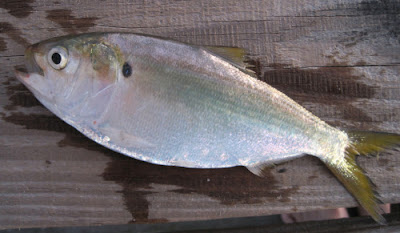
 
Atlantic Menhaden
Red Snapper is a long-lived, early-maturing fish in the family Lutjanidae.  They are broadly distributed in the Gulf of Mexico and are an important sport and commercial fish.  Red Snapper have been overfished for several decades and are one of the most controversial fisheries with high landings from both recreational and commercial fishers.
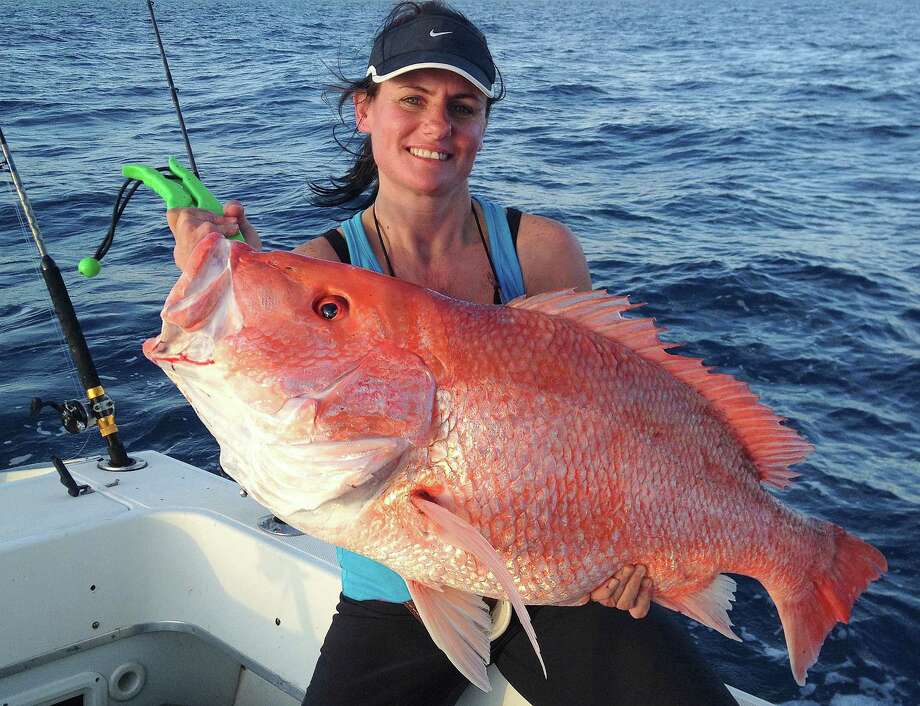
Red Snapper caught in January 2013 was 38.25 inches and was released due to closed season.
Any valuable fish will be intensely targeted by both commercial and recreational anglers.   Intense fishing pressure will remove the large and mature members of the populations.  Consequently, truncated age distributions and artificial selection are pervasive fisheries problems.  The first response of managers is to enact a minimum length for possession that allows at least one successful reproduction before first harvest.  Yet this management approach facilitates higher harvest on larger fish, often leading to recruitment overfishing and lack of large fish.   Instead of more and bigger fish, the fishing public is left with fewer and smaller fish.  

This gradual decline in the average size of fishes caught in intensely harvested populations has been documented in numerous fisheries (Silliman 1975; Ricker 1981; Sharpe and Hendry 2009; Arlinghaus et al. 2010).  Cautious managers warned that intensive size selective fishing could lower fisheries productivity over time (Hutchings 2009; Rijnsdorp et al. 2010; Heino et al. 2013).  The effects of size selective fishing are not only plausible, but potentially widespread.   
   
The mathematics of optimum size based harvesting (Reed 1980) is based on the assumptions of stationarity and identical fish in each age group.  The population is further assumed to interact with no others (as predator or prey or competitor).  The maximization of yields based on Reed’s mathematical model demonstrated that under intense levels of exploitation, harvesting restricted to two age groups maximizes yields.  The mathematical theorem does not support the application of minimum size limits as an optimal strategy.  Rather, the optimal size to harvest depends on exploitation rate.   And old, more fecund age groups, are protected from harvest.
Annual steady state yield expected at different levels of exploitation.  The numbers on line segments represent the minimum age of first harvest (A), or the range of ages harvested (C). Curve B represents no minimum age limit (Reed 1980).
Uusi-Heikilla and others (2015) recently explored the effects of intensive harvest on Zebrafish populations to address the controversy of whether harvesting causes genetic as opposed to mere phenotypic changes.  The question is critically important to fisheries manager as genetic changes are more slowly reversible.  The use of Zebrafish allowed the investigators to follow populations over 5 generations of intense size selective pressure and examine functional genomic markers related to life history traits.   The parental stock began with 1500 wild-collected Zebrafish to ensure maximum genetic variation. The design employed three experimental treatments, with two replicates per treatment, and 450 zebrafish per replicate tank.  Harvest rate was 75% per generation.  Treatments were designed to mimic random size selection, minimum size limit (size selective), and maximum size limit (large size selection).  In addition to life history traits, the investigators examined 371 single nucleotide polymorphisms to see if allelic frequencies differed among treatments.

As hypothesized, the minimum length limits had surprising undesired genetic effects. Twenty-two loci showed genetic differentiation and eight of these were statistically significant.   After just five generations of harvesting, adult body size of the Zebrafish shrunk by 7%, which also affected the egg production of the surviving fish. The now-smaller Zebrafish produced fewer and smaller eggs!   Furthermore, the large-selected Zebrafish were significantly more explorative and bolder. This experiment supports a cause-and-effect relationship between size-selective harvest practices and changes in fish life history traits and productivity.  The implications for recovery of overfished populations are important.    

There are at least three options to restore overfished fisheries: (1) moratorium on all harvest; (2) daily creel limits or restrictive size limits, or (3) protect large fecund individuals via a maximum size limit or protected area.  A harvest moratorium rebuilt populations and restored age structure in Atlantic striped bass (Morone saxatilis) (Richards and Rago 1999; Secor, 2000). A transition from minimum length limit to a protected slot limit transformed an extremely truncated size distribution in a smallmouth bass fishery to a trophy fishery (Copeland et al. 2006).  The designation of marine protected reserves is a tool for protecting species from fishing (Bohnsack et al. 2004).   Reserves permit recovery of overexploited fish populations if larval export seeds exploited habitats (Harrison et al. 2012).  

Many commercially or recreationally important fish species have high fecundity and display a weak response between parents and recruits.  Big yearclasses can still be produced by low spawning stocks.  This leaves most fish managers with doubt about strong effects of size selective harvest.  Further, not all fish have the same life history and role. Small fish species should be exploited at levels well below those producing a maximum sustainable yield.  This will provide some forage fish to survive to feed higher trophic levels  (Pikitch et al 2014).  Fishing forage fish intensely increases likelihood of collapse (Essington et al. 2015).

The Atlantic menhaden is exploited with a reduction fishery (i.e, it reduces the catch, into fishmeal and fish oil) and a bait fishery. The fishery expanded from New England after the Civil War to the rest of the coastal states and peaked by 1950, when over 20 reduction factories processed the harvest.  Since the 1960s the menhaden fluctuated and reduction factories closed and reopened, until odor abatement regulations caused most of them to close.  Today a single reduction factory in Reedville, Virginia, processes the landings; Virginia is allocated 85% of the total allowable catch.  Menhaden constitute the largest landings, by volume, along the east coast, and rank second in the U.S behind the Alaskan Pollock. The Atlantic Menhaden were once overfished and sport and commercial fisheries dependent on the Atlantic Menhaden (e.g., Menhaden Defenders) have lobbied hard to change the way this fishery is managed.  Not too many forage fish have their own lobbying group.   Yet, the total allowable catch in recent years is still managed based on single species concepts, as if the Atlantic Menhaden was not eaten by a myriad of fish, mammals, and birds.  Talk about your inappropriate spherical cow!  

Based on the latest stock assessment, the Atlantic menhaden “stock status is not overfished and overfishing is not occurring” (SEDAR 2015).   But nothing in this 643-page assessment addresses the influence of abundance of Atlantic Menhaden on striped bass, bluefish, weakfish, tuna, or other coastal fishes.  Atlantic Menhaden holds the distinction of being the only fish species controlled by the General Assembly and not the Virginia Marine Resources Commission.    The politicians, not the professionals, make decisions. 

The Red Snapper fishery in the Gulf of Mexico collapsed in the late 1980s.  Because the fish and fishery occur in all Gulf states and federal waters, the fishery is managed by the Gulf Fishery Management Council under the authority of the Magnuson-Stevens Fisheries Management Act. The council was slow to enact protections and, therefore, the Red Snapper remained overfished for several decades.  Even in an overfished state, the economic value of the fisheries is $80 million.  The Red Snapper story illustrates why the simple theory was difficult to implement (Cowan et al. 2010).  First, bycatch of juvenile Red Snapper in shrimp trawls was not regulated and caused high mortality among immature Red Snapper.  Second, management plans required the allocation of allowable catch to recreational and commercial fisheries.  Third, regulations such as minimum size limits resulted in regulatory discard mortality, that is fish that are required by law to be released due to size, season, or bag requirements.  Undersized fish had to be released, much to the distress of anglers who assumed that many of the fish, caught from deeper waters and exhibiting protruding swimbladders, would die anyway.  Finally, artificial reefs and oil and gas platforms were deployed in the 1970s and 1980s and used as a red herring, as if the artificial structures would increase Red Snapper abundance (Galloway et al. 2009).   

The Red Snapper is a long-lived species that can live over 50 years, but some will mature at age 3 or 4. The large old fish are highly fecund.  Red Snapper have been called “bet hedgers” as an evolutionary strategy – females produce millions of very small eggs over her lifetime, with an infinitesimally small chance of surviving to be an adult Red Snapper.
Concept Map depicting cause and effect relationships of big old fat fecund female fish (BOFFF; Hixon et al. 2013)
Intense exploitation in the Gulf fishery truncates the age distribution such that few fish over 5 years old survive.  Fish are gaining weight at a very high rate at this age range from 5 to 20 years.  Also the fecundity is much higher for these big old fat fecund female fish  (BOFFFF; Hixon et al. 2013).  Older red snapper also spawn more frequently and a 32-inch female produces 24 times as many eggs as a 16-inch female (Porch et al. 2013).  
Growth and age distribution of Red Snapper in the Gulf of Mexico (Cowan et al. 2010).

One major factor affecting recruitment of Red Snapper is periodic occurrence of hypoxia, which caused the loss of all red snapper and most of the invertebrates on and around the reefs in 2001 (Workman and Foster 2002).   Since this periodic recruitment failure is an expected occurrence, it makes sense to maintain a larger spawning stock biomass so that large year classes of Red Snapper may be produced in good years.
Texas State record Red Snapper (40 pounds) caught June 1, 2014. Source
Yet the Red Snapper population has not recovered.  It took a long time to implement bycatch reduction in the shrimp trawlers.  Then many years later gear restrictions were implemented to limit hooking mortality and require gas bladder venting.  Yet only 72% of discarded Red Snapper survived after being released (Curtis et al. 2015).   Area closures in zones occupied by BOFFF Red Snapper have never been used; yet the closure of the area to fishing would reduce wasteful discards and discard mortality.  Yet the trend in fish biomass indicates only minor recent recovery.  The SEDAR Update (Gulf Fishery Management Council 2015) revealed that the stocks remain at historical lows and the age distribution is truncated.   Decisions made by the council have had a very high opportunity cost in terms of loss of fishery values over the past decades.

These three fishes teach us a lot about exploited populations of fish.  Any assessment of the status of an exploited fish population and evaluation of alternative management strategies requires certain assumptions.  However, sometimes I feel like choking on the spherical cow.   As we move forward we need to apply lessons learned from other fisheries and follow common sense (KISS) principles.

·      Little fish feed the world. Total allowable catch should be adjusted based on needs of predators or ecosystem services provided.
·      Protect the BOFFFF -- they survive unfavorable recruitment times and facilitate resilience.
·      Size-selective harvesting causes changes in key life-history traits, leading to low maximum body size and poor reproductive output.
·      Intense fishing selects for shy behaviors.
·      Effects of fishing proceed at a faster pace than the scientific approach to evaluating actions. The best available science often adopts simplifying assumptions.

References
Arlinghaus, R., S. Matsumura, and U. Dieckmann 2010. The conservation and fishery benefits of protecting large pike (Esox lucius L.) by harvest regulations in recreational fishing. Biological Conservation 143:1444–1459.
Beverton, R.J.H., and S.J. Holt. 1957. On the Dynamics of Exploited Fish Populations. Ministry of Agriculture, Fisheries and Food, London.
Bohnsack, J.A., J.S. Ault, and B. Causey. 2004. Why have no-take marine protected areas?   
Copeland, J.R., D.J. Orth, and G.C. Palmer. 2006. Smallmouth bass management in the New River, Virginia: a case study of population trends with lessons learned. Proceedings of the Southeastern Association of Fish and Wildlife Agencies 60:180-187.
Cowan, J.H. and fourteen coauthors.  2010. Red snapper management in the Gulf of Mexico: science- or faith-based? Reviews in Fish Biology and Fisheries      DOI 10.1007/s11160-010-9165-7   
Curtis, J.M., M.W. Johnson, S.L. Diamond, and G.W. Stunz. 2015. Quantifying delayed mortality from barotrauma impairment in discarded Red Snapper using acoustic telemetry.  Marine and Coastal Fisheries 7(1):343-349.  DOI: 10.1080/19425120.2015.1074968
Essington T.E., and seven coauthors. 2015. Fishing amplifies forage fish population collapses. Proceedings of the National Academy of Science USA 112:6648–6652.    
Galloway, B.J., S.D. Szedlmayer, and W.J. Gazey. 2009.  A life history review of red snapper in the Gulf of Mexico with an evaluation of the importance of offshore petroleum platforms and other artificial reefs. Reviews in Fisheries Science 17(1):48-67.
Gulf Fishery Management Council, Science and Statistical Committee.  2015. SEDAR Red Snapper 2014 Update Assessment, Charleston, SC  242 pp. http://sedarweb.org/docs/suar/SEDARUpdateRedSnapper2014_FINAL_9.15.2015.pdf
Harrison H. B., Williamson D. H., Evans R. D., Almany G. R., Thorrold S. R., Russ G. R., Feldheim K. A., et al. 2012. Larval export from marine reserves and the recruitment benefit for fish and fisheries. Current Biology 22:1023-1028.
Heino, M., L. Baulier, D. S. Boukal, B. Ernande, F. D. Johnston, F. M. Mollet, H. Pardoe et al. 2013. Can fisheries-induced evolution shift reference points for fisheries management? ICES Journal of Marine Science 70:707–721.
Hixon, M.A., D.W. Johnson, and S.M. Sogard. 2013. BOFFFFs: on the importance of conserving old-growth age structure in fishery populations. ICES Journal of Marine Science.  doi: 10.1093/icesjms/fst200   
Hutchings, J. A. 2009. Avoidance of fisheries-induced evolution: management implications for catch selectivity and limit reference points. Evolutionary Applications 2:324–334.
Pikitch, E.K., and nineteen coauthors. 2014. The global contribution of forage fish to marine fisheries and ecosystems. Fish and Fisheries 15(1):43-64. doi:10.1111/faf.12004
Porch, C.E., G.R. Fitzhugh, and B.C. Linton.  2013.  Modeling the dependence of batch fecundity and spawning frequency on size and age for use in stock assessments of red snapper in U.S. Gulf of Mexico waters.  National Marine Fisheries Service, Southeast Fisheries Science Center, Miami, Florida.  SEDAR 31-AW report.  20 pp 
Reed, W.J. 1980. Optimum age-specific harvesting in a nonlinear population model. Biometrics 36(4):579-593.
Richards, R.A. and P.J. Rago. 1999. A case history of effective fishery management: Chesapeake Bay Striped Bass. North American Journal of Fisheries Management 19:356-375.
Ricker, W.E. 1981. Changes in the average size and average age of Pacific Salmon. Canadian Journal of Fisheries and Aquatic Sciences. 38(12): 1636-1656
Rijnsdorp A. D., C.J.G. van Damme C. J. G., and P.R. Witthames. 2010. Implications of fisheries-induced changes in stock structure and reproductive potential for stock recovery of a sex-dimorphic species, North Sea plaice. ICES Journal of Marine Science 67:1931-1938.
Secor, D.H. 2000. Longevity and resilience of Chesapeake Bay striped bass.  ICES Journal of Marine Science 57: 808–815. doi:10.1006/jmsc.2000.056
SEDAR. 2015.  SEDAR 40  - Atlantic Menhaden stock assessment report.  SEDAR, North Charleston, SC 643 pp.  available online at: http://sedarweb.org/sedar-40-stock-assessment-report-atlantic-menhaden
Sharpe, D. M. T., and A. P. Hendry 2009. Life history change in commercially exploited fish stocks: an analysis of trends across studies. Evolutionary Applications 2:260–275.
Silliman R. P. 1975. Selective and unselective exploitation of experimental populations of Tilapia mossambica. Fishery Bulletin 73:495-507
Uusi-Heikilla, S., and 13 coauthors.  2015. The evolutionary legacy of size-selective harvesting extends from genes to populations. Evolutionary Applications doi:10.1111/eva.12268

Workman, I.K., and D.G. Foster. 2002.  The webbing reef: a tool used in the study of juvenile red snapper (Lutjanus campechanus).  Oceans '02 MTS/IEEE Conference. Pp. 146-150. 10.1109/OCEANS.2002.1193262