Green Sunfish (Lepomis cyanellus Rafinesque) is a very common sunfish that may occur in streams, rivers, ponds, and shallow weedy
margins of lakes. No matter where you
find them, they will usually be in close proximity to weedy vegetation, large
boulders, or woody cover. Although
their maximum size may not be very impressive, they make up for the small size
with spunk. The world record Green Sunfish was 2 pounds, 2 ounces – that must have been one big spunky sunfish. The generic name is derived from Greek words
that refer to the scales on the operculum, while the species name is derived
from the Greek word for blue, in reference to the blue wavy lines on the cheeks.
 |
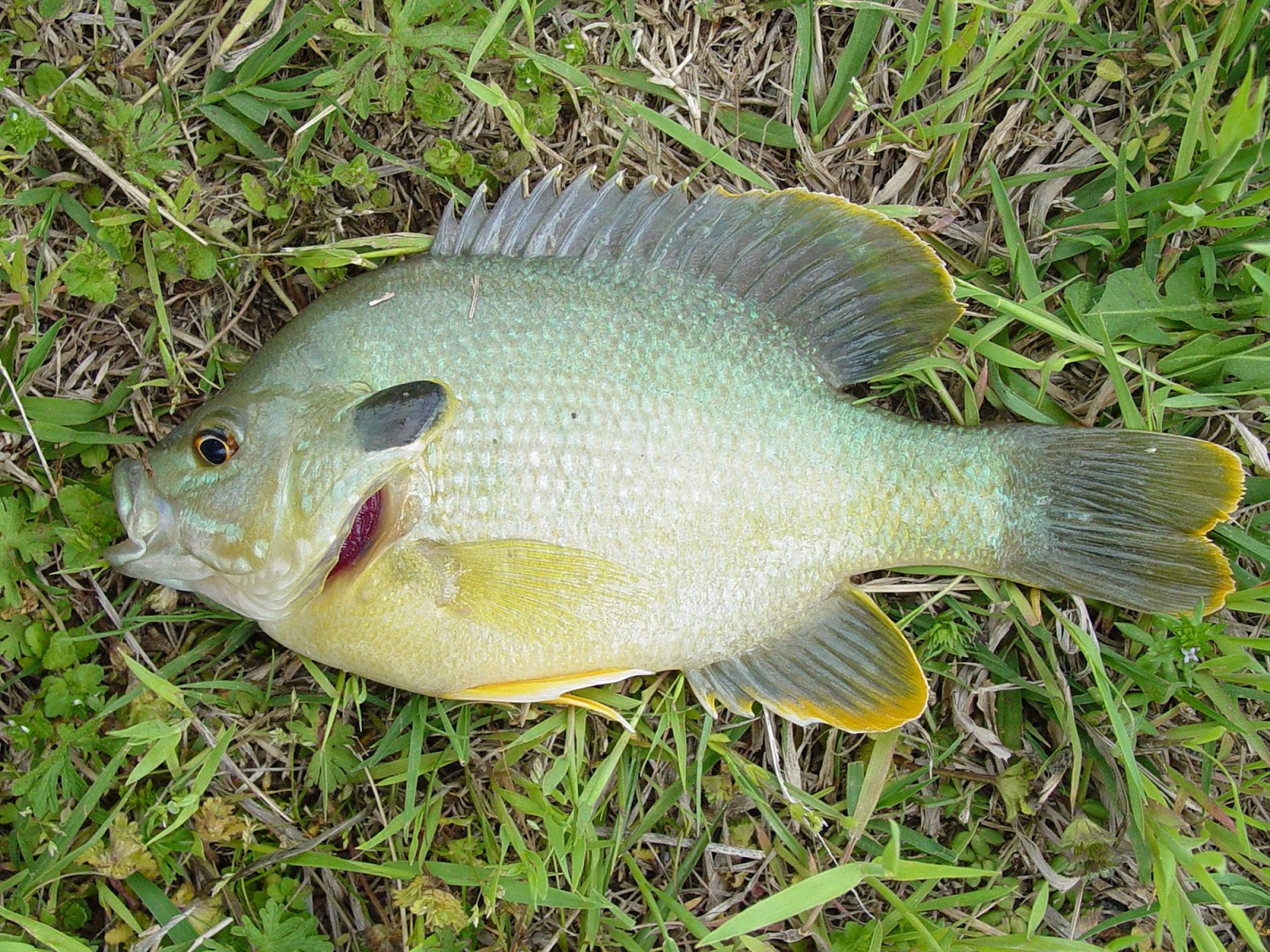
| Green Sunfish adult. Photo by Nate Tessler. Source. |
To positively identify
a Green Sunfish you will have to check a number of characteristics. Coloration is bluish-green on back and sides
with reflections of yellow and emerald.
Blue wavy streaks are present on the cheeks. The belly is pale yellow or white. The ear
flap is black with a white or yellow-orange margin; it is not elongated and the
bony margin of the gill cover is hard and inflexible. Black blotches are usually present near the
base of soft dorsal and anal fins. The
body is not as deep bodied as other Lepomis. Body depth is approximately equal to the distance
from the tip of the snout to the origin of the dorsal fin; measure to be sure! It has a large mouth for a sunfish with the upper jaw
extending to the middle of the pupil.
The pectoral fin is rounded and, when bent forward, will not extend
beyond the front of the eye. Juveniles and hybrids can be more challenging to
identify. Green Sunfish have a complete
lateral line with 41 to 52 scales, which is intermediate between
Micropterus and other Lepomis. When
breeding, the male Green Sunfish develops fringes of white or salmon or yellow
on the dorsal, caudal, anal, and pelvic fins.
Females and subordinate individuals will not develop the fringes and
have a dorsal ventral banding pattern.
 |
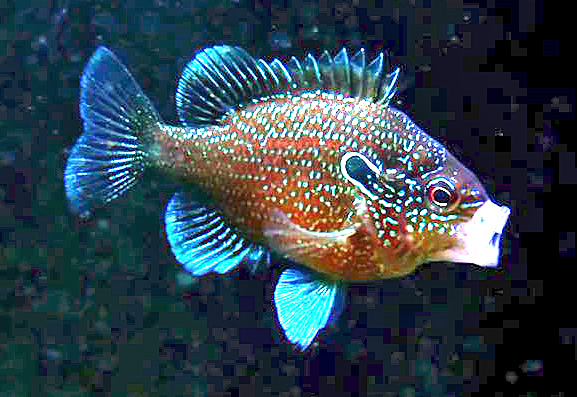
| Juvenile Green Sunfish. Photo by Dan Johnson. Source |
Why the
opercular ear flap? All Lepomis sunfishes have a dark ear
flap. Why the spots on the soft dorsal
fin? Only Bluegill, Bantam Sunfish, and
Green Sunfish have the blotches. Think
about it!
Green Sunfish is
tolerant of a wide range of environmental conditions. Therefore, it is often
found in sloughs and ditches where no other sunfish is present. It is usually one of the few sunfish that will
persist in small streams of the Great Plains along with Creek Chubs Semotilus atromaculatus, Fathead Minnows
Pimephales promelas, and Black
Bullheads Ameirus melas. Because of their broad geographic
distribution and wide environmental tolerance, the index of biotic integrity in
the Midwest USA has a Green Sunfish metric (Metric 6, Proportion of
individuals as green
sunfish). That always seemed speciesist, and the meaning of metric 6 should
reflect proportion of highly tolerant fish.
Some streams are naturally harsh and the Green Sunfish is able to
persist in harsh environments. That
should not influence the assessment of biological impairment. Harsh places are not necessarily impaired. However, Green Sunfish have become widespread
outside its native range where they may suppress native fishes (Fuller et al.
2016).
 |
| Distribution of Green Sunfish (Fuller et al. 2016) USGS |
The Green
Sunfish seldom get large enough to attract the following of recreational anglers. However, it is usually so common, especially
in intermittent creeks, that it is a good fish for young anglers to
target. Green Sunfish provided me many
an evening meal while camping during my dissertation research studies on Glover
River, Oklahoma. Here the Green Sunfish
was the dominant fish species, comprising 46% of total biomass (Orth and
Maughan 1984). Green Sunfish are also
popular as an aquarium fish for the native fish enthusiast because they feed
readily and may persist under less than ideal water quality conditions.
Sunfishes are
notorious for hybridizing in nature.
Many species overlap in range, spawning time, and share limited nesting
habitats. More than 20 Lepomis hybrids have been reported in
nature (Childers 1967). Natural hybrids are produced when one species at very
low abundance and females of rarer Lepomis
breed with an aggressive male of the dominant species (Avise and Saunders 1984).
These F1 hybrid exhibit adult sex ratios strongly biased toward males
and, consequently, hybrid sunfish have been bred specifically for pond
stocking. The Green Sunfish x Bluegill
cross is popular. Click here for photo of the F1 hybrid and parentals.
Green Sunfish
show homing tendencies and defend territories as do other sunfish and Micropterus basses. A territory is “any defended area,” and the
Green Sunfish is an aggressive defender of their territory. Bernard Greenberg first wrote about
territoriality and social hierarchies in the Green Sunfish. Hierarchies developed in groups of immature
Green Sunfish only 0.75-1.5 inches standard length and less than one year
old. Establishing a dominance hierarchy
early in life avoids wasting energy on agonistic display patterns. Rather the dominant individuals “drive their
subordinates, that is, they make quick dashes at them, and the latter swim
away, usually without being nipped”
(Greenberg 1947, p. 269). Green
Sunfish show three aggressive behaviors: (1) gill-flare threat display; (2)
weaving; and (3) nipping. Green Sunfish
pairs will occasionally test one another by a gill flare display. The
gill flare threat involves “spreading their gill-covers and moving head-on
toward each other; the threatened individual turns broadside and, with body
held rigid, vibrates in a weaving fashion” (Greenberg 1947, p 270). The gill flare shows the observer the
margined patch of black of the opercle flap, which roughly resembles an
eye. View the video of a Green Sunfish showing the
gill flare display and you will see how effective this display.
Video of Green Sunfish gill flare display. by CarpGuy Source
The spot on the
soft dorsal fin also darkens when the Green Sunfish is interacting with
another. Greenberg observed that the
fighting individual “almost always has these spots intensified, but, if it
loses the fight, the spots disappear.” Although many others have described
aggressive behavior and territorial defense and displays, the experiments of
Bernard Greenberg established that the Green Sunfish engaged in aggressive
behavior and defend territories long before they became reproductively mature.
Greenberg also
observed changes in the coloration of the eye during agonistic encounters. The iris is normally red. Hence the Green Sunfish is sometimes referred
to as a goggle eye. However, when Green Sunfish are fighting the
red becomes more prominent. In a Green
Sunfish that loses in an encounter the black pigment spreads to the rest of the
iris and the red is obscured.
Consequently the black eye signals a sign of defeat in the Green
Sunfish.
 |
| Close up of head of Green Sunfish. photo by BluegillFishing.net. Source. |
The fighting pattern
of two Green Sunfish involves one individual on the attack with gills flared
and the other weaving to avoid being nipped. The attacker may make a series of vigorous
nips at the head or body and may even lock jaws. In aquaria, groups of Green Sunfish establish a pattern of
dominance within 24 hours. Individuals learn to display subordinate patterns. Further
maze experiments by Greenberg supported the notion that dominant individuals in
groups facilitated learning among members. In an experiment comparing Green Sunfish in
isolation and in groups, the individuals in groups grew faster over the period
of study (Allee et al. 1948). Reasons
for enhanced growth are difficult to establish, although the authors did
observe fish in social groups displaying more ready feeding. Also, the high ranking fish within a social
hierarchy ate more and grew faster than low ranking ones.
The Green
Sunfish is an excellent example of a common opportunistic sunfish species that
has a rich set of social interactions that have not yet been fully
explored. What you may see as aggressive
interactions in aquaria are adaptations that will facilitate group success and
resource distribution in wild populations.
Also, Green Sunfish have double cones in their eyes that make them
sensitive to polarized light (Cameron and Easter 1993). The adaptive significance of polarized light
sensitivity has yet to be explored. We
can only speculate and devise new experiments.
References
Allee, W.C., B. Greenberg, G.M.
Rosenthal, and P. Frank. 1948. Some effects of social organization on growth
in the Green Sunfish Lepomis cyanellus. Journal
of Experimental Biology 108:1-19.
Avise, J. C., and N.C. Saunders. 1984.
Hybridization and introgression among species of sunfish (Lepomis): Analysis by mitochondrial DNA and allozyme markers. Genetics 108:237-255.
Cameron, D.A., and S.S.Easter.1993. The
cone photoreceptor mosaic of the green sunfish, Lepomis cyanellus. Visual
Neuroscience 10:375-384.
Childers, W.F. 1967. Hybridization of
four species of sunfishes (Centrarchidae).
Bulletin of the Illinois Natural
History Survey 29:159-214.
Fuller, P., M. Cannister, and M. Neilson.
2016. Lepomis cyanellus. USGS Nonindigenous Aquatic Species Database,
Gainesville, FL.
http://nas.er.usgs.gov/queries/FactSheet.aspx?speciesID=380 Revision Date:
1/20/2012
Greenberg, B. 1947. Some relations between territory,
social hierarchy, and leadership in the Green Sunfish (Lepomis cyanellus). Physiological Zoology 20:267-299.
Orth, D.J., and O.E. Maughan. 1984. Community structure and seasonal changes in
standing stocks of fish in a warm-water stream. American Midland Naturalist 112:369-378.

 Posts
Posts