Showing posts with label overfishing. Show all posts

Thursday, November 21, 2019

Aphrodisiacs are Bad for Sustainable Fisheries, by Don Orth


Why are some fish and some fish products more valuable than others?  While the news media focuses on trade bans in shark fins, and seahorses, the swim bladder (or fish maw) is also a prized fish part.  Selling fish maw may initially appear to be a win for the fishers.  However, when fish maw is believed to possess mystical qualities, the swim bladder becomes the target of a global trade network. 

Swim bladder of the Rudd Scardinius erythrophthalmus. Photo by Uwe Gille.  CC-BY-SA-3.0. Source. 

Swim bladders (also called a gas bladder) are flexible-walled, gas-filled sacs that control fish buoyancy and may aid in hearing.  Swim bladders are only present in bony fishes and are rarely saved in most fisheries. Fish swim bladders are high in collagen and can be turned into glues. Nutritionists maintain that collagen can reduce joint pain and treat skin ailments. Sturgeon swim bladders were turned isinglass for clarification of beer before other alternatives emerged.  In some Asian cultures the swim bladder, or maw, of fishes is considered a delicacy, and dried fish maw may sell from between $20,000 and $80,000 per kilogram.  Why is the price so high?  Does it have special medicinal or aphrodisiac qualities?   Fish maw is eaten to strengthen one’s qi, or internal energy.  However, there is no evidence that fish maw is an aphrodisiac. 

Display of fish maw at Singapore festival. Photo by Too Yut Shing,  Flickr

It’s difficult to study trade in fish swim bladders because of the global nature of trade and lack of reporting. The fish species harvested for the maw product is also challenging to identify. Since 2015, the fish trading in Hong Kong introduced a new commodity code, called “maw.”   Between 2015 and 2018, 3,144–3,882 tonnes of dried fish maw was imported annually to Hong Kong (Sadovy de Mitcheson et al. 2019).  These dried imports had a declared value of $264–394 million US dollars.  

Largest fresh specimen of Chinese Bahaba, caught on 30 December 1993, outside Castle Peak Bay, western Hong Kong, as incidental trawler by‐catch (Sadovy and Cheung 2003). 
Fish maw is used more for its unique texture and ability to soak up other flavors. It is almost tasteless in itself.  Consequently, fish maw is used in many soup recipes and often substitutes for shark fins. As a delicacy, demand for fish maw means that many fish stocks around the world may be at risk to overfishing in order to meet this demand. Depending on the fish, it may take 25-35 pounds of fish to yield a pound of swim bladder.  Therefore, the most prized fish maw often comes from large fish, many of which are croakers (Sciaenidae). The Chinese Bahaba Bahaba taipingensis is a critically endangered species due to unregulated fishing and harvest of immature individuals (Sadovy and Cheung 2003).  

A porpoise, vaquita (bottom) captured as bycatch along with a totoaba in Sonora, Mexico. Image by NOAA.

Among the imports to Hong Kong, most fish maw were large croakers (Sciaenidae), Nile Perch Lates niloticus, pufferfish (Tetraodontidae), catfishes (Siluriformes), and pike conger (Muraenesocidae). In many of these fisheries, the harvest of fish maw is unregulated Nile Perch Lates niloticus in Lake Victoria were harvested since first introduced in the 1950s (Ogutu-Ohwayo 1990) and locals ate fried maw until the lucrative Chinese market emerged.  In 2017, Uganda, Kenya, and Tanzania earned $86 million from trade in fish maw from Nile Perch.  Declines of fish harvested for their swimbladders have occurred in French Guyana and the Gulf of Mexico.  Without regulations, foreign fleets off Guyana throw back the fish and take only the profitable bladders. The Totoaba (Totoaba macdonaldi), a large marine fish that lives only in the Gulf of California, Mexico, is one of the most highly prized fish maws on the market. Like the Chinese Bahaba, the Totoaba can attain 2 meters and exceed 100 kg.  Consequently, Totoaba is critically endangered because of the high prices. Fishing for Totoaba has been banned since 1975 but illegal fishing continues.  The Totoaba fishery threatens a small porpoise, the vaquita Phocoena sinus, with extinction as it is captured as bycatch in gillnets (Bessesen 2018; Martinez and Martinez 2018).  

Bowl of fish maw soup.  from Soupbelly.com

High-valued fish may provide a lucrative revenue stream.  Unfortunately, the rarity of certain fish such as the Chinese Bahaba, makes its swim bladder even more valuable. The solution may lie in raising awareness of the status of rare fishes, and the illegal and unregulated fishing to produce fish maw.  Should there be a ban on trade in fish maw? That's likely overkill because of lower valued fish maw products.  The maw of the most highly valued species is valued at over $1,000 (US) per kg, and often much higher (Sadovy de Mitcheson et al. 2019). Bans do not eliminate fishing when the price for the produce is so high to produce a “gold rush” mentality.  The fisheries for the Chinese Bahaba and the Totoaba are easily overfished because the combination of high value of individual fish, restricted range, and spawning aggregations make fishing more of a gold rush than a sustainable enterprise.   

References

Bessesen, B. 2018.  Vaquita: Science, politics, and crime in the Sea of Cortez.  Island Press, Washington, D.C.  320 pp.
Martinez, I.A., and E.R. Martinez. 2018. Trafficking in Totoaba maw.  Pages 149-170 in I. Arroyo-Quiroz, and T. Wyatt, editors. Green Crime in Mexico. Palgrave Studies in Green Criminology. Palgrave Macmillan, Cham
Ogutu-Ohwayo, R. 1990. The decline of the native fishes of lakes Victoria and Kyoga (East Africa) and the impact of introduced species, especially the Nile perch, Lates niloticus, and the Nile tilapia, Oreochromis niloticus. Environmental Biology of Fishes 27:81-96.
Sadovy, Y., and W. L. Cheung. 2003.  Near extinction of a highly fecund fish: the one that nearly got away.   Fish and Fisheries 4:86-99.
Sadovy de Mitcheson, Y., A.W. To, N.W Wong, H.Y. Kwan, and W. S. Bud. 2019. Emerging from the murk: threats, challenges and opportunities for the global swim bladder trade. Reviews in Fish Biology and Fisheries   29: 809-835. https://doi.org/10.1007/s11160-019-09585-9

Tuesday, September 3, 2019

The Overfishing Problem, by Don Orth

When did our overfishing problems begin?  Hugo Grotius, a Dutch philosopher and jurist, proposed that in times of peace, high seas are open to all nations and may not be subjected to national sovereignty.  This “freedom of the seas” doctrine, first proposed as early as 1609, was eventually accepted among international freedoms, particularly laissez-faire economics in the 19thcentury.  The doctrine was vigorously supported by dominant powers at the time, especially Great Britain. In the late 19thcentury, fishermen and some fisheries biologists argued strongly against all restrictive measures on the basis of the inexhaustible nature of the fishery resources of the sea.  In 1883, Thomas Henry Huxley extended the thinking of the freedom of the seas to fisheries.   

 “I believe then, that the cod fishery, the herring fishery, the pilchard fishery, the mackerel fishery, and probably all the great sea fisheries, are inexhaustible… and any attempt to regulate these fisheries seems consequently, from the nature of the case, to be useless.”  Thomas Henry Huxley 1883. 

If the overfishing problem did not exist, there would be no need for fisheries science to develop.   However, steam-powered trawling in the 1880's and improvements in trawling technology in the early 20thcentury had an enormous, unappreciated effect on the fishing capacity. Many fish stocks were in decline, and more boats and more fisherman were fishing harder for fewer and fewer fish.    North Sea government commissions began to collect fisheries data to deal with the overfishing problem by providing better numbers. Petersen (1900-1903) first developed an approach to estimate overfishing, which eventually led to important developments in fisheries science.  The first empirical evidence to support the overfishing problem was collected during World War I, during which fishing was sharply curtailed in European waters and exploited fish populations increased dramatically. Fish marking experiments initiated by Danish biologist C. G. J. Petersen and others further showed that fishing was a major cause of fish mortality in developed fisheries. At the same time, Heincke (1913) developed the first catch-curve approach to estimate mortality.  Huntsman (1944) defined the overfishing problem as the point “Where the take in proportion to the effort fails to yield a satisfactory living to the fisherman.” Eventually, fisheries scientists proposed a Great Law of Fishing -- “Fisheries that are unlimited become unprofitable.” Graham (1943). 

Russian professor, Fedor Baranov, the “Grandfather of fisheries population dynamics”, Quinn (2003), first explained the problem in economic terms. 

“As we see, a picture is obtained which diverges radically from the hypothesis which has been favoured almost down to the present time, namely that the natural reserve of fish is an inviolable capital, of which the fishing industry must use only the interest, not touching the capital at all. Our theory says, on the contrary, that a fishery and a natural reserve of fish are incompatible, and that the exploitable stock of fish is a changeable quantity, which depends on the intensity of the fishery. The more fish we take from a body of water, the smaller is the basic stock remaining in it; and the less fish we take, the greater is the basic stock, approximating to the natural stock when the fishery approaches zero. Such is the nature of the matter.” Baranov, F. (1918, translated by W.E. Ricker 1945, mimeograph, cited in Gordon 1954).

Baranov’s seminal contribution was the solution to the catch equation.  


Baranov's catch equation, where C is catch, F is fishing mortality, M is natural mortality, T is time, N0 is cohort number at time zero, and e is Euler's constant.
Where C is annual catch, N is abundance, F is fishing mortality, and M is natural mortality.  Quinn (2003), in a review of fisheries models, writes that Baranov’s catch equation is “probably the most used in all of fisheries modeling.”

Russell (1931, 1942) developed a simple algebraic equation S2= S1+ (A + G) – (C + M) to account for changes in total weight of the catchable stock of a particular size. Here S1is the weight of the catchable stock at the beginning of year, Sis weight of the catchable stock at end of the year, and A represents additions to the catchable stock, G is growth of individuals that survive, C is catch, and M is non-fishing mortality. Russell’s theoretical contributions could now be incorporated in practical determinations of overfishing.  During the period after World War I and the acceptance of overfishing, many scientists made important development of fisheries models for fish population dynamics. Read Quinn’s (2003) review -- it will answer students' questions about where all these population dynamics equations came from. Getting better numbers for these models remains a high priority for solving the overfishing problem.

Unfortunately, what happened when we defined the overfishing problem and the Great Law of Fishing was not an end to overfishing.  Governments did initiate better data collection,  and scientists developed improved mathematical and statistical analysis. Many debates ensued over the relative importance of fishing and the environment in controlling population dynamics. The Thompson-Burkenroad debate on the Pacific Halibut is well documented (Skud 1975).  This career-time debate was eventually called a draw.  Skud's (1975) concluding sentence was “Until unknowns, particularly about growth and recruitment, are determined, one cannot properly credit the increase in abundance to either the management program or to fishery induced changes or to environmental effects.”  On the  Altantic coast, a similar debate ensured after the declines in Striped Bass in the 1970s and 1980s. Today, the Striped Bass stock is overfished and overfishing is occurring;  emergency regulations were imposed this summer. 

 "The trail of fishery science is strewn with the opinions of those who, while partly right, were wholly wrong."  Michael Graham, The Fish Gate (1943, p 129).

While managers were collected better data and scientists were debating, many governments made concerted efforts to increase fishing capacity. Catches rose from the 1950s to 1996 as fishing fleets expanded and discovered new fish stocks to exploit.  

Trends in world capture fisheries and aquaculture.  Source: FAO. 
The rise in fishery yields did not continue and recent trends suggest we’ve maxed out global fishery yields. The increase in fishery yields is due to growth of aquaculture, which is now responsible for much of the world’s fishery yields.  In the last two decades, aquaculture was China’s fastest growing food sector  (Cao et al. 2015).  Many aquacultured species require formulated feeds, which include fishmeal from wild capture fisheries.  Today’s major debate is over the effect of the burgeoning aquaculture industry on wild fisheries. Are we overfishing forage fish to feed salmon, bass, and tuna in captivity? In 2016, 88 percent of the total fish production (151 million out of 171 million tonnes) was for direct human consumption. Overfishing is a direct threat to our capacity to feed ourselves. Plenty of problems may be added to overfishing problems, and they include many issues related to the poor numbers: unreported and illegal catches, bycatch, and inland fisheries (Pauly and Zeller 2016).  There will be no shortage of opportunities for those committed to studying the overfishing problems.  

Fishers display a day's catch in Manteo, North Carolina, before limits were imposed in 1979. Striped bass were in decline in virtually every drainage area from Maine to Florida.  CC-BY-2.0 Source.
References

Cao, L., R. Naylor, P. Henriksson, D. Leadbitter, M. Metian, M. Troell, and W. Zhang. 2015.  China’s  aquaculture and the world’s wild fisheries. Science 347(6218):133-135.
Gordon, H. S. 1954.  The economic theory of a common-property resource: the fishery.  The Journal of Political Economy 62(2):124-142.
Graham, M. 1943. The Fish Gate. London.  
Heincke, F. 1913. Investigations on the plaice—general report: 1. plaice fishery and protective measures, preliminary brief summary of the most important points of the report. Rapports et Procés-Verbaux des Réunions, Conseil International pour l’Exploration de la Mer16.
Huntsman, A.G. 1944. Fishery depletion.  ScienceXCIX, 534.
Pauly, D., and D. Zeller. 2016. Catch reconstructions reveal that global marine fisheries catches are higher than reported and declining. Nature Communications 7: 10244. 
Petersen, C.G.J.  1900-1903. What Is overfishing? Journal of the Marine Biological Association 6:587-595.      
Quinn, Terrance J. II  2003. Ruminations on the development and future of population dynamics models in fisheries. Natural Resource Modeling16 (4): 341–392. 
Russell, E.S. 1931. Some theoretical Considerations on the “Overfishing” Problem.  ICES Journal of Marine Science6:3-20.
Russell, E.S. 1942.  The Overfishing Problem.  Cambridge, United Kingdom.  130 pp. 


Monday, April 2, 2018

Groping with Multiple Risks on Grouper Populations, by Don Orth

According to the FAO, fisheries provide at least 15% of the animal protein consumed directly or indirectly by humans.  As demand grows we must deal with the fact that fishing drives down fish populations leading to a global fisheries crisis. John Shepherd, a fisheries biologist, once said “Managing fisheries is hard: it’s like managing a forest, in which the trees are invisible and keep moving around.”   Fisheries on groupers are even harder to manage.

Overfishing is driven by biological and social factors.  Therefore, fisheries management must be grounded in principles of fisheries science melded with social-ecological theories.  In this post, I explore this fundamental truth as it plays out in the management of grouper fisheries throughout the world.    Groupers are fish in the subfamily Epinephelinae (Serranidae) that are widely distributed in warm seas.   Familiar genera include the Epinephelus and Mycteroperca.
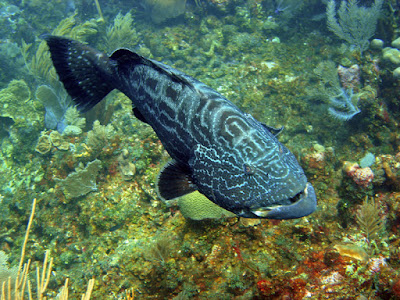
 
Black Grouper Mycteroperca bonaci  Photo by Alfonso Gonzalez   Flickr
Changing density and size structure of reef fish top predators, such as groupers, is often observed but in subtropical and tropical nations there may be no official landings records.   But local fishers are often aware of declines, reporting that grouper catches were abundant many years ago (Aguilar-Perera et al. 2009; Amorim et al 2018; Bender et al. 2014).  So managers must struggle to manage without a fair determination of baseline conditions (Pinnegar and Engelhard 2008). 
Food and Agricultural Organization of the United Nations (FAO) capture production landings data for groupers 1950–2009. (Sadovy de Mitcheson et al. 2013) 
Vulnerability and value lead to rapid depletion and overfishing in snapper and grouper (Coleman et al 2000; Sadovy de Mitcheson et al. 2013).  Groupers are highly regarded for the mild quality of their flesh. Therefore, they are most heavily exploited among other high-priced reef fishes.  Vulnerability is related to ease of capture and a slow life history.  Most species take a long time to attain high reproductive values. In shallow coral reefs many groupers can easily be approached and speared by spear fishers, hook and line, and cyanide. Fisheries target adults captured and marketed directly for food, but also juveniles for mariculture grow-out operations (Sadovy and Pet 1998). Because it takes a long time to obtain needed life history information, fisheries independent survey data, and catch history, the groupers may be overfished long before data are even available for a stock assessment. 
 
Trends in largest fish caught (a) and highest daily catch (b) for Black Grouper  (Bender et al. 2014). 

Value to humans is related to wide cultural acceptance of the grouper and other human demographics, such as distance to markets and local human population density.  Of the 163 species of groupers, 20 risk extinction if current trends continue, and an additional 22 species are considered to be Near Threatened (Sadovy de Mitcheson et al. 2013). Because of its popularity, groupers are often mislabeled or substituted with lower valued fish.  Over 50 species of groupers worldwide may be marketed and sold in the US as grouper (FDA Seafood List).  Here are tips for avoiding fake grouper.
Pan fried grouper. Photo by Kirk K. Flickr
If slow life history and high value create a double jeopardy for groupers, one additional trait adds a triple jeopardy condition.   Groupers display predictable spawning aggregations, temporary gatherings of large numbers of grouper for spawning.   These spawning aggregations make groupers extremely vulnerable at the same time when reproductive values are highest (Erisman et al. 2017).   Watch this video of a spawning rush of groupers  Groupers move around and local fishers learn their patterns and can use GPS to re-locate these locations and target the spawning aggregations. Fisher knowledge will influence the extent to which aggregations are perceived as predictable and exploited by fishers (Robinson et al 2014). In some cases, fishers have known for centuries where and when aggregations form (Erisman et al. 2017).  Therefore, effective management requires understanding and consideration of life history, and ecological and socioeconomic drivers.     
Echogram depicting the locations of spawning aggregation of Nassau Grouper (red) and Horse-eye Jacks (blue) along transect off Little Cayman Island   (Egerton et al. 2017)
The collapse of the now endangered Nassau Grouper Epinephelus striatus was due to overfishing on spawning aggregations.   The population collapse resulted in the loss of an important fishery and many spawning aggregations.  Grouper supported many Bahamians for centuries, currently providing over $1 million in landings per year,  and are part of the social fabric (Stump et al. 2017).

Spawning aggregations have indirect effects on marine ecosystems.  Eggboons are large though temporary concentrations that provide highly nutritious fatty acids that suppport multiple trophic levels. Loss of groupers translates to a loss of trophic redistribution via eggboons (Fuiman et al. 2015).
Eggboons from grouper spawning aggregations create immense redistribution of trophic resources to all lower trophic levels.  Dashed arrows represent typical trophic pathways and solid arrows represent flow through eggboons (Fuiman et al. 2015).
From numerous investigations on grouper fisheries throughout the world, we are more aware of the challenges.   In particular, we need to examine how to add the social and cultural aspects to fisheries management efforts.  Examining local fishers knowledge of local groupers may provide better understanding of historical baselines (Robinson et al. 2014).

(Top) A catch of Atlantic Goliath Grouper made on the charter boat Gulfstream in the 1950's. Photo from the Wil-Art Studio, gift of Angie Marine. Florida Keys Public library.   (Bottom) Spearfishing catches in a single day in 1972 at fishing village in southeastern Brazil (Giglio et al. 2017).

The functional extinction of the critically endangered Atlantic Goliath Grouper in many parts of the  range has attracted much attention and fishing moratoria are in place. Recovery of populations depend on conditions in nursery areas (Koenig et al. 2007; Shideler et al. 2015; Lobato et al. 2016) and at far distant spawning aggregations. Research that combines local ecological knowledge and takes advantage of technologists, such as bioacoustics, biotelemetry, sonar, and remote and autonomous underwater vehicles may lead to more accurate information on grouper spawning aggregations (Erisman et al. 2017).   Photo-identification is widely used for non-invasive mark-recapture analysis and appears to be well suited for the sedentary, large Goliath Grouper in marine parks frequented by divers (Hostim-Silva et al. 2017).

Photos and corresponding sketches of Goliath Grouper heads used for individual recognition (Hostim-Silva et al 2017)  
In closing, fishing and lack of effective management leads to rapid overfishing of many species of groupers.  Many measures are being implemented, such as minimum and slot size limits, recreational bag limits, commercial fishing quotas, gear and seasonal controls, marine protected areas, and limited entry, the effectiveness will depend on local context.  Illegal fishing continues to be a problem (Giglio et al. 2014).  In the case of the critically endangered Atlantic Goliath Grouper, we need to:  (1) protect coastal lagoons with fringing mangrove nursery areas; (2) locate spawning aggregations and learn from traditional ecological knowledge; (3) adopt large no-take protected areas and evaluate diving tourism as the presence of large, emblematic fish is an attraction (Heyman et al. 2010; Shideler and Pierce 2016); and (4) halt poaching.  However, leadership, social networks, and co-management at the local level are the glue that will make these plans successful (Gutiérrez et al. 2011).  There are signs of recovery off  Florida where a fishing moratorium on Atlantic Goliath Grouper has been in place since 1990.  Grouper are only one of many valuable residents of threatened coral reef ecosystems. Restoring coral reefs will require reducing and reversing carbon emissions that are driving global climate change (Knowlton and Jackson 2008). 
 
References
Amorim, P., P. Sousa, M. Westmeye, G.M. Menezes. 2018. Generic knowledge indicator (GKI): A tool to evaluate the state of knowledge of fisheries applied to snapper and grouper.   Marine Policy 89:40-49.
Aguilar-Perera, A., C. González-Salas, A. Tuz-Sulub, and H. Villegas-Hernández. 209.  Fishery of the Goliath grouper, Epinephelus itajara (Teleostei: Epinephelidae) based on local ecological knowledge and fishery records in Yucatan, Mexico. International Journal of Tropical Biology  57:557–566.
Bender, M.G., G.R. Machado, P.J.A. Silva, S.R. Floeter, C. Monteiro-Netto, O.J. Luiz, and C.E.L. Ferreira.  2014. Local ecological knowledge and scientific data reveal overexploitation by multigear artisanal fisheries in the southwestern Atlantic. PLoS ONE 9(10): e110332. doi:10.1371/journal.pone.0110332
Coleman, F.C., C.C. Koenig, G.R. Huntsman, J.A. Musick, A.M. Eklund, J.C. McGovern, G.R. Sedberry, R.W. Chapman, and C.B. Grimes. 2000. Long-lived reef fishes: the grouper-snapper complex. Fisheries 25:14–21.
Egerton, J.P., A.F. Johnson, L. LeVay, C.M. McCoy, B.X Semmens, S.A. Heppell, and J.R. Turner. 2017. Coral Reefs 36:589-600.
Erisman, B., W. Heyman, S. Kobara, T. Ezer, S. Pittman, O. Aburto-Oropeza, and R.S. Nemeth. 2017. Fish spawning aggregations: where well-placed management actions can yield big benefits for fisheries and conservation. Fish and Fisheries 18 128–144.
FAO. 2009. The state of world fisheries and aquaculture 2008. FAO Fisheries Department. Rome (Italy) 162 p.
Fuiman, L.A., T.L. Connelly, S.K. Lowerre-Barbieri, and J.W. McClelland. 2015. Egg boons: central components of marine fatty acid food webs. Ecology 96:362–372.
Giglio, V.J., A.A. Bertoncini, B.P. Ferreira, M. Hostim-Silva, and M.O. Freitas. 2014.  Landings of goliath grouper, Epinephelus itajara, in Brazil: despite prohibited over ten years, fishing continues.  Brazilian Journal of Nature Conservation 12:118-123.
Giglio, V.J., M.G. Bender, C. Zapelini, and C.E.L. Ferreira. 2017.  The end of the line? Rapid depletion of a large-sized grouper through spearfishing in a subtropical marginal reef. Perspectives in Ecology and Conservation 15:115-118.  
Gutiérrez, N.L. R. Hilborn, and O Defeo. 2011. Leadership, social capital and incentives promote successful fisheries. Nature DOI: 10.1038/nature09689
Heyman,W.D., Carr, L.M., Lobel, P.S., 2010. Diver ecotourism and disturbance to reef fish spawning aggregations: it is better to be disturbed than to be dead. Marine Ecology Progress Series 419, 201e210. http://dx.doi.org/10.3354/meps08831.
Hostim-Silva, M., A.A. Bertoncini, M. Borgonha, J.R. Leite, M.O. Freitas, F. A. Daros, L. S. Bueno, A. P. C. Farro, and C. C. Koenig. 2017.  The Atlantic Goliath Grouper: Conservation strategies for a critically endangered species in Brazil.   Pages 367-405 in M.R. Rossi-Santos, and C. W. Finkl, editors, Advances in Marine Verebrate Research in Latin America.  Springer.
Knowlton, N, and J.B. Jackson. 2008. Shifting baselines, local impacts, and global change on coral reefs. PLoS Biology 6: e54.
Koenig, C.C., F.C. Coleman, A.-M. Eklund, J. Schull, and J. Ueland, 2007.  Mangroves as essential nursery habitat for the goliath grouper (Epinephelus itajara).   Bulletin of Marine Science 80:567-585.
Lobato, C.M.C., B.E. Soares, T.O.R. Begot, and L.F. de Assis Montag. 2016. Tidal pools as habitat for juveniles of the goliath grouper Epinephelus itajara (Lichtenstein 1822) in the Amazonian coastal zone, Brazil.  Brazilian Journal of Nature Conservation 14:20-23. 
Sadovy, Y., and J. Pet.1998.  Wild collection of juveniles for grouper mariculture: just another capture fishery?  Live Reef Fish Information Bulletin 4:36-39
Sadovy de Mitcheson, Y., M.T. Craig, A.A. Bertoncini, K.E. Carpenter,W.W.L. Cheung, J.H. Choat, A.S. Cornish, S.T. Fennessy, B.P. Ferreira, P.C. Heemstra, M. Liu, R.F. Myers, D.A. Pollard, K.L. Rhodes, L.A. Rocha, B.C. Russell, M.A. Samoilys, and J. Sanciangco. 2013. Fishing groupers towards extinction: a global assessment of threats and extinction risks in a billion dollar fishery. Fish and Fisheries 14:119–136. http://dx.doi.org/10.1111/j.1467-2979.2011.00455.x.
Mora, C., R.A. Myers, M. Coll, S. Libralato, T.J. Pitcher, R.U. Sumaila, D. Zeller, R.Watson, K.J. Gaston, B. Worm. 2009. Management effectiveness of the world's marine fisheries, PLoS Biology 7 e1000131, http://dx.doi.org/10.1371/journal.pbio.1000131.
Pinnegar, J.K., G.H. Engelhard. 2008. The ‘shifting baseline’ phenomenon: a global perspective. Reviews in Fish Biology and Fisheries 18: 1–16.
Robinson, J., J.E. Cinner, and N.A.J. Graham. 2014.  The influence of fisher knowledge on the susceptibility of reef fish aggregations to fishing.   PLOS ONE  9(3): e91296.
Robinson, J., N.J. Graham, J.E. Cinner, G.R. Almany, P. Waldie. 2015. Fish and fisher behaviour influence the vulnerability of groupers (Epinephelidae) to fishing at a multispecies spawning aggregation site. Coral Reefs 34:371–382.
Shideler, G.S., S.R. Sagarese, W.J. Harford, J.Schull, and J.E. Serafy. 2015. Assessing the suitability of mangrove habitats for juvenile Atlantic goliath grouper. Environmental Biology of Fishes  98:2067-2082.
Shideler, G.S., and B. Pierce. 2016.  Recreational diver willingness to pay for goliath grouper encounters during the months of their spawning aggregation off eastern Florida, USA.  Ocean and Coastal Management 129:36-43.

Stump, K., C.P. Dahlgren, K.D. Sherman, C.R. Knapp. 2017. Nassau grouper migration patterns during full moon suggest collapsed historic fish spawning aggregation and evidence of an undocumented aggregation.  Bulletin of Marine Science 93:375-389.