Showing posts with label flathead catfish. Show all posts

Tuesday, July 23, 2019

How Old Do Flathead Catfish Get? by Don Orth

The recent catch of a 62-pound Flathead Catfish from the upper New River was a rarity and generated many questions.  One of these was "how old is this fish?"    Fortunately, I can answer that question, thanks to Timmy Dixon who provided me with the head.  With the help of annual rings laid down on the ear stones (i.e., otoliths) of the catfish, we can determine its age. It's not possible to estimate the age of a Flathead Catfish from it's weight alone.  There is just too much variation in growth rates among individuals.  
Lapillus ear stone from 62 pound Flathead Catfish glued to glass slide.  Lincoln penny for size reference.
 Photo by Cobin Hilling.
Otoliths are calcareous accretions that permit detection of sounds and maintenance of  equilibrium via the semicircular canals. Because the grow continuously as the fish grows and grow faster when the fish is actively growing, annual rings are discernible.   The otoliths of the Flathead Catfish are tiny compared to the size of the fish and can be a challenge to find.  There are three pairs of otoliths -- asterisci, lapilli and sagittae.  To learn how otoliths are removed from large catfish, check out this post.  In this Flathead Catfish, Corbin Hilling extracted the lapillus (above), which is the largest otolith in catfish. 

Otolith section from 62 pound Flathead Catfish.  Photo by Corbin Hilling.
In order to count all the rings, the otolith is sanded until all the rings from the nucleus to the edge can be seen.   In this otolith section, Corbin Hilling counted 25 annual rings. So the Flathead Catfish was born in 1994. The maximum age from populations of Flathead Catfish averages about 20 years and the oldest individual aged was 32 years old (Massie et al. 2018).  

Once Flathead Catfish reach about 30 inches (or ~ 75 cm), they begin to develop massive girth. To reach a 25 pound trophy mark, Flathead Catfish have to survive to at least 7 or 8 years. Once they reach that size, they have must eat a lot to grow larger and are highly vulnerable to hook-and-line or trotline fishing.   The 62 pound Flathead Catfish is clearly off the chart showing weight attained at different ages (below).
Weight of Flathead Catfish by age (years) from the James River from Hilling et al. (in press).
The Flathead Catfish was a rare trophy catch.   It's what I refer to as a BOFFFF, or a big old fat fecund female fish.   Fisheries scientists hypothesize that BOFFFFs are critically important to maintaining a large population for the future because they are experienced breeders and produce more and larger eggs per body mass than smaller females.    The BOFFFF hypothesis has never been scientifically evaluated for exploited catfish populations, so we can't know for sure.   But the 62 pound Flathead Catfish was certainly a fish of a lifetime. 

Flathead Catfish   CC BY 2.0  USFWS 
References 
Hilling, C.D., A.J. Bunch, J.A. Emmel, J.D. Schmitt, and D.J. Orth. In Press.  Growth and mortality of invasive Flathead Catfish in the tidal James River, Virginia.  Journal of Fish and Wildlife Management 10(2)
Massie, D.L., G.D. Smith, T.F. Bonvecchio, A.J. Bunch, D.O. Lucchesi, and T. Wagner. 2018. Spatial variability and macro-scale driver of growth for native and introduced Flathead Catfish populations. Transactions of the American Fisheries Society 147:554–565.

Tuesday, July 16, 2019

Flathead Catfish from the New River, by Don Orth

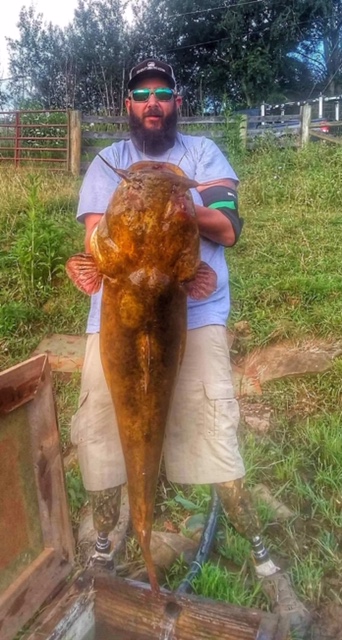
Last week I received a message and photo from Timmy Dixon, owner and operator of New River Outdoor Adventures.  His buddy caught a Flathead Catfish while fishing with a lay line in the New River.  It was a big catfish, larger than any I've seen from the New River.    The Virginia Angler Recognition Program considers a 25 pound or 40 inch Flathead Catfish a trophy.  Anglers who catch one with hook and line can apply for a certificate.
Flathead Catfish caught in July 2019 from New River near Fries, Virginia. For comparison, Timmy Dixon (pictured here) stands 6 feet, 4 inches.
Many questions arise when someone catches a monster fish.  What's the biggest flathead catfish ever caught?      The answer is clouded by mixed approaches to catching these monster catfish.  It's likely that Flathead Catfish attain six feet and exceed 150 pounds without every encountering a hook and line strong enough to bring them in.   A Flathead Catfish just under 140 pounds was harvested in 1982 by a snag line from the Arkansas River near Little Rock, Arkansas.  Flatthead Catfish larger than 100 pounds have been harvested by hook and line in five states -- Texas, Kansas, Arkansas, Georgia, Oklahoma, and Missouri.

The Virginia state record Flathead Catfish was 68 pounds and 12 ounces, caught by Jeffrey Dill in May 2018. Chad Boyce, District Biologist, Virginia Department of Game and Inland Fisheries reported that Flathead Catfish were first stocked in Lake Smith in 1996.
Virginia state record Flathead Catfish was 68 pounds, 12 ounces, from Lake Smith.   It is pictured here with Jeffrey E. Dill who caught the fish on cut shad. 
Trotliners on the New River are secretive about their spots and their gear and focused on harvesting catfish to eat (Dickinson et al. 2015).   The most dedicated trotline fishers live near or on the river itself and fish trotlines in only a small section of river, rarely interacting with other trotline users. Trot-liners grew up depending on hunting, fishing, and gardening for their food.  However, few records exist specific to New River trotline catches.   SCUBA divers who frequent large, deep pools at Peppers Ferry and Eggleston can confirm that many large flathead catfish that make their home in the New River.
Flathead Catfish hooked on a trotline.  
Ben Dickinson and Jason Emmel spent many months learning about the methods used by trot liners in the New River.     They mimicked the typical methods so they could estimate catch rates of Channel Catfish and Flathead Catfish on trotline gears.   Because the number of baited hooks varies a lot, so does the expected catch.  Experimental trotline sets on the New River indicated that a trotline fishing 100 baited hooks overnight would expect to catch between 8 and 22 catfish (Dickinson et al. 2018).  The largest Flathead Catfish caught was 35 pounds, but some baited hooks were straightened - presumably by larger catfish.

The odds of catching a 60 pound catfish from the New River are long, but they are not zero.  John Copeland, Fisheries Biologist for the New River tells me that the largest Flathead Catfish from the The Virginia Angler Recognition Program was 58 pounds.  When an angler asks me how to catch a trophy catch, I respond "release more 20 to 40 pound catfish!" Once a Flathead Catfish gets that large the only threat of mortality is from humans (see below). 

Effects of fishing on the number of catfish by age.  
This trophy catch reminds us of what lives in the New River.  Feeding a 62-pound Flathead Catfish requires productive and abundant fish life.  The recreational trotline fishing that occurs in the New River is the only fishing that targets these very large catfish.   In addition to the well known recreational fishing for Smallmouth Bass, Muskellunge, and Walleye, the Flathead Catfish are another reason to Go Fishing!

References

Dickinson, B.D., D.J. Orth, and S.L. McMullin.  2015.  Characterizing the human dimensions of a hidden fishery: riverine trotline fishers.  Fisheries 40(8):386-394.

Dickinson, B.D., S.L. McMullin, D.J. Orth, and J.R. Copeland. 2018. Trotline catch rates vary by hook and bait type in the New River, Virginia. Journal of the Southeastern Association of Fish and Wildlife Agencies.  5:46-52.

Friday, December 30, 2016

Fluvial Fishes Lab 2016

What mattered in 2016? Did we get published? Did it get read? Did it get cited? Did it make any difference? Can we make the next paper even better?   The research cycle continues as we celebrate the end of 2016.  

It never fails.  Whenever a submitted, revised, and revised and revised manuscript is finally acceptable for publication in a journal, I feel vindicated.  Sometimes I will spontaneously begin singing Queen's "We are the champions.  The process of research certainly feels like a "Hero's journey" to the authors.  There are no easy publications.  Each is a long struggle that ends in organizing a manuscript into the standard IMRAD template. This template has been used forever, but it  devalues the real process and excitement of discovery.   

In 2016, the Fluvial Fishes Lab completed papers and projects and we worked more on delivering and tailoring the message to other members of the public, hoping to make the science matter. All lab members are enthusiastic about explaining their work to members of the public.  Two noteworthy books I read this past year were Randy Olson's Houston, We Have a Narrative (Univ. Chicago Press, 2015) and Nancy Baron’s Escape from the Ivory Tower: A Guide to Making Your Science Matter  (Island Press, 2010).  Each provides many practical suggestions for making connections with the public.

In 2016,  Gary Grossman,   Jason Neuswanger, and I published  Innovative Approaches to Fisheries Education and Outreach in Fisheries.” It was an interesting collaboration, as we reflected on changes in college teaching over the past decades.   In 1995, I published an article in Fisheries entitled “Pogo Was Right, Let’s Change the Way We Teach Fisheries.”  Twenty years later we wrote,  "Despite the prescience of Orth’s (1995) article, many of the same problems remain in Fisheries education today."  This has to be the first time my name and “prescience” has been used in the same sentence.    If interested, you can read about the use of the use of music, ukulele, karaoke, ePortfolio, troutnut, and other contemporary approaches in education.  We remain hopeful that further pedagogical innovation will result in fisheries having a “signature pedagogy.”

In a paper on species distribution models (SDMs) of New River fishes, Jian Huang, Emmanual Frimpong and I examined the temporal transferability of these SDMs in terms of discrimination power and calibration with the temporarily independent datasets.   We used lasso-regularized logistic regression (LLR), boosted regression trees (BRT), MaxEnt, and ensemble models (ENS) to evaluate the habitat suitability of 16 fish species. 
Climate change is the most influential disturbance on fishes and these types of models will be more commonly employed to project future changes in species distributions.  However, biases, under-fitting, and overfitting were common issues to address in temporal transferability.  

Our analysis of catfish feeding before, during, and after the spring migration of Alosine fishes is in press in Marine and Coastal Fisheries.  The study depended on methods for identifying partially digested unidentifiable fish (PDUF) with DNA barcodes  The paper was the first to examine which species of Alosa occurred in guts of Flathead Catfish and Flathead Catfish. In this time frame, the Blue Catfish had broad, omnivorous diets, while Flathead Catfish fed solely on other fish. However, there were important spatial and temporal differences in diets.  Alosa species were consumed at higher frequency in the non-tidal, freshwater areas  than in oligohaline and mesohaline sites. Flathead Catfish are likely to have a greater per-fish impact on depleted Alosa species than the Blue Catfish. Further, dams and complex river structures appear to increase the vulnerability of alosines to predation by large catfishes.  We are now completely done with sampling catfish stomachs and busy with the analysis of data.    

Blue Catfish Ictalurus furcatus source
An opportunistic encounter with Clinch Dace during a spawning event eventually was accepted as a Note on spawning behavior  by Hunter Hatcher et al. (in press, The American Midland Naturalist) after many hours watching videos and interpreting behaviors, waiting for a brief release of gametes. 

Rock Bass recruitment in the New River has never been examined previously.  Pearce Cooper examined historic data sets and aged Rock Bass in the New River to examine major drivers of recruitment variation.   At two locations downstream from Claytor Lake Dam, high streamflow events after spawning reduced recruitment of Rock Bass at age-1.  The paper is available here

The relationship between average and maximum discharge (cm/s) in the previous year and the catch per unit effort (CPUE, # fish/h) of age-1 Rock Bass at the upstream and downstream sites during the months the relationship was found to be significant.
Michael Moore defended his Masters Thesis on the yeller finned minners in spring and began a PhD program at University of Missouri.  He'll move up from studying small, fragmented populations of a small minnow to studying small, fragmented populations of large sturgeon.  The final report to the Department of Game and Inland Fisheries,  Distribution and Population Characterizationof Clinch Dace (Chrosomus sp. cf. saylori) in the Upper Clinch River System, Virginia” provides a plan for conserving remaining populations.
 
Objectives of this project were to
(1) examine the historical changes in these watersheds to quantify features of historical Clinch dace streams; (2) confirm presence and relatedness of within-stream subpopulations separated by putative barriers; (3) identify and verify presence/absence of Clinch dace in the 125 km not previously sampled; (4) survey for spread in distribution of other Chrosomus in putative range of Clinch dace; (5) develop outreach plan landowners to protect extant populations. Clinch Dace occur at low densities in approximately 31.5 km of headwater streams. The mean estimate of global population size was 6,706 individuals. Most populations are likely influenced by low genetic diversity. Therefore, we examined 15 candidate conservation areas; ten of these areas have abandoned mine sites with $12.5M in unfunded restoration costs. The best candidate areas for conservation of Clinch Dace are: Pine Creek, Big Lick Creek, Mudlick Creek, and Hurricane Fork.
This is me after Bells Palsy paralyzed my facial nerves. Muscles on the right side of my face would not move.
In June I experienced sudden paralysis of the facial muscles on my right side. Paralysis of the facial nerve was caused by virus and inflammation and treated with antiviral and anti inflammatory medications.  The original prognosis that voluntary movement would gradually return in 3 to 6 months proved correct.  The facial nerve, or cranial nerve VII, is the nerve of facial expression. It is composed of approximately 10,000 neurons, 7,000 of which are myelinated and innervate the nerves of facial expression. That explains the slow regeneration time.

In September, I created and delivered my first Pecha Kucha presentation for Blacksburg Sustainability Week.  This concise format requires 20 slides of 20 seconds each, and makes it impossible to be spontaneous.   View it here.

Two new studies were funded in 2016.  One is a biological survey of the New River in the vicinity of the Fries Hydroelectic project; this is a collaboration with Verl Emrick and Caitlyn Carey, of the Conservation Management Institute
Google Earth photo of New River above Fries Dam. Note the mid-channel island built from the trapped river sediments.
The other new study, with Eric Hallerman, will examine genetic divergence in small populations of the Clinch Dace. This study will be led by Rebecca Bourquin, who left a position at Maryland Biological Stream Survey to begin her graduate studies last fall. 
 
The Virginia Tech Ichthyology blog had 54 posts for 2016.   The most viewed blogpost of the year was "Dammed If You Do:  Adopting Social Media in Teaching."   At the American Fisheries Society Annual Meeting in Kansas City, I was awarded the Excellence in Fisheries Education Award and named American Fisheries Society Fellow. 
 
Awarded the Excellence in Fisheries Education Award.  With Ron Essig and Jesse Trushenksi at the American Fisheries Society Meeting
Hunter Hatcher graduated in spring and sampled the New River near Fries Dam before beginning his Masters studies at Mississippi State University. 
Hunter Hatcher gets photographed at the Mudbass Classic 2016.
Hae Kim broke his own archery record with a record carp that was 45 lbs. and 7 oz.  It was taken in  Claytor Lake.
Hae Kim with his record carp.   Source.
Research on the non-native catfish is chronicled regularly in a blog, managed by PhD student, Joseph Schmitt.  You can read about our work at http://www.chesapeakecatfish.com/.
 
Recognition at 2016 Service Dinner