Showing posts with label bycatch. Show all posts

Tuesday, June 14, 2016

Common Sense to Reduce Bycatch Sharks, by Kati Wright

 Sharks are apex predators that occupy a variety of different niches in the ocean. They have an amazing sensory system, consisting of vision, hearing, lateral line, chemoreception, and electroreception. However, they make up a large amount of bycatch in the fisheries industry.  These accidental catches normally result in death.  Sharks can get caught in almost any type of fishing gear, like longlines, gillnets, and trawls. Therefore, it is important to find mechanisms to reduce the bycatch of these apex predators. Currently, there are net size limits and excluder devices that attempt to reduce the bycatch on almost every fishing gear (Jordan et al. 2013).  Therefore, this is an analysis of the sensory mechanisms, such as chemical, mechanical, visual, and electrical, in their attempt to reduce the bycatch of sharks and the successfulness of each mechanism. 
 
Sharks caught as bycatch are generally discarded at se and are rarely recorded in commercial fishery landings statistics.  Photo source
Sharks, like many fish, are sensitive to chemicals involved in taste and smell, using both the olfactory and lateral line system (Jordan et al. 2013). Many chemicals have been tested to repel sharks, like rotenone, metals, chlorine, irritants, and ink, but none have been successful. Previously, scientists thought that rotten shark flesh containing copper and acetate, along with copper acetate and dye, were effective, but recent studies show that copper acetate is actually ineffective. However, dyes have proven promising. Studies show that toxins, like paradaxin proteins, tend to either inhibit feeding or trigger retreat responses. Unfortunately, these chemicals are difficult to produce in high concentrations to actually work efficiently (Hart and Collin 2015). Necromones have also shown potential to repel sharks, but it seems to be species specific. The most effective chemical shark repellant is sodium dodecyl sulfate (SDS) and lithium dodecyl sulfate (LDS) at concentrations of 83 to 175 ppm. It is the most effective because the sharks do not habituate to the chemical, but it is not extremely practical due to the high concentration needed (Hart and Collin 2015). Unfortunately, there are numerous challenges with chemical mechanisms, like dispersion rates and how to isolate the chemicals that are non-toxic but effective at low concentrations (Jordan et al. 2013; Collin and Hart 2015).
Mechanical mechanisms include those involved with hearing and water flow.  Sharks hear using their mechanosensory system and skin receptors.  They are sensitive to sounds ranging from 20 to 1000 Hz, but are specifically attracted to low-frequency, irregular sound pulses between 25 and 50 Hz (Jordan et al. 2013).  However, sudden, high-intensity sounds at 10 m with rapid increases in loudness and medium frequency pure tones tend to repel sharks, but habituation does occur (Jordan et al. 2013; Collins and Hart 2015).  Infrasound can repel sharks as well, but it is fairly expensive and large (Hart and Collin 2015). Acoustic pingers have proven useful, yet hearing damage is a major possibility (Jordan et al. 2013). The only auditory mechanical device being used today is the Sharkstopper, which is used for both personal protection and to repel sharks from fishing gear. This portrays pulsing sounds ranging from 30-500 Hz or 200-1500 Hz, but sharks do habituate to this too so it must be used for short periods of time (Hart and Collin 2015). Water flow is detected using mechanosensory systems as well.  A sharks lateral line can detect frequencies less than 200 Hz.  Unfortunately, this sensory system is not well understood. However, in the past, water jets on trawls have proven effective at repelling sharks (Jordan et al. 2013). In the end, mechanical mechanisms of sounds do not seem to be very practical in repelling sharks.
 
 Sensory-based deterrents attached to fishing gear. (A) Illuminated gill net (photograph credit Jesse Senko). (B) Beam trawl fitted with electric pulse generator, electrodes, and raised groundrope (Hovercran shrimp pulse trawl, photograph credit ILVO, Belgium). (C) Longline gear with lanthanide metal secured near hook (photograph credit Kieran Smith). Source: Jordan et al. (2013).
Vision is a dominant sensory system in sharks.  Recent studies have shown that sharks are attracted to specific colors and have large visual fields.  Sharks are sensitive to light wavelengths ranging from 480 nm to 561 nm (Jordan et al. 2013). Visual repellants can be the most effective. The Shark Screen, one of the most efficient visual repellants, is a large impermeable bag with inflating devices to keep it afloat and open at the top. It hides the swimmer visually, does not emit bodily chemicals, and does not portray body movements. Interestingly, sharks are less attracted to low reflectance blue and black colors and more attracted to high reflectance white and silver colors. Therefore, cryptic or camouflaged patterns may also repel sharks. Another effective visual repellant is a barrier of vertical kelp-like pipes combined with magnets. Bubble curtains are currently being tested and look fairly promising, but are most likely species specific (Hart and Collin 2015).  Flicker frequencies, which changing light speeds, can also be used to deter sharks. Sharks tend to be sensitive to flicker frequencies between 16 and 25 Hz, and using flicker frequencies around 30 Hz should not attract sharks. Increasing the visibility of the fishing gear has been proven to successfully repel sharks. Ultimately, visual mechanisms seem to be very helpful in reducing the bycatch of sharks (Jordan et al. 2013). 
All sharks have Ampullae of Lorenzini, which is their electrosensory system that is extremely sensitive to electrical pulses. For instance, research shows that sharks can detect below 1 nV/cm from 40 cm away.  Sharks can detect many different types of electrical stimuli, like currents, geomagnetism, cables, and bioelectric fields.  Magnets, metals, and powered electrical devices can produce a strong enough electrical signal to over-stimulate the sharks system and repel them (Jordan et al. 2013). Active electrical repellants use a power source, like the Shark Shield, which consists of a battery with electrodes, but this tends to be very species specific. The SharkPOD (Protective Oceanic Device) uses an electrical waveform generator with electrodes that is widely used today. Anti-shark electrical cables have been attempted, but they end up being expensive with hard upkeep. Passive electrical repellents include electropositive metals and permanent magnets. Electropositive metals excite the shark’s electroreceptors, but hungry sharks tended to ignore these devices. Permanent magnets can either be ceramic or of the rare-earth type, but both have inconsistent findings. A device called SMART (Selective Magnetic and Repellent-Treated) hooks use electricity and magnets to successfully repel sharks (Hart and Collin 2015).  However, these electrical deterrents have been found to work best in coastal, benthic areas (Jordan et al. 2013).  Many things can affect these repellants, like type, sensitivity, shark biomass, and hunger level (Hart and Collin 2015). Unfortunately, there are economic and logistical challenges that need to be overcome before these tactics become fully feasible (Jordan et al. 2013). Metals are expensive, potentially toxic, and must be reapplied often (Hart and Collin 2015). 
Clearly more studies need to be done to determine which sensory mechanism is the most successful and efficient. From reading these articles, visual mechanisms seem to be the best at preventing shark bycatch. However, if more research is done, both chemical and electrical mechanisms could be very helpful when improved (Jordan et al. 2013). The most effective solution is to combine multiple repellent devices that affect different shark sensory systems, like using both visual and auditory stimuli (Hart and Collin 2015). 


References

Hart, N. S. and S. P. Collin. 2015. Shark senses and shark repellents. Integrative Zoology 10:38-64.
Jordan, L. K. et al. 2013. Linking sensory biology and fisheries bycatch reduction in elasmobranch fishes: a review with new directions for research. Conservation Physiology 1.
 

Wolffish: Preying for Help, by Rachel Villalobos

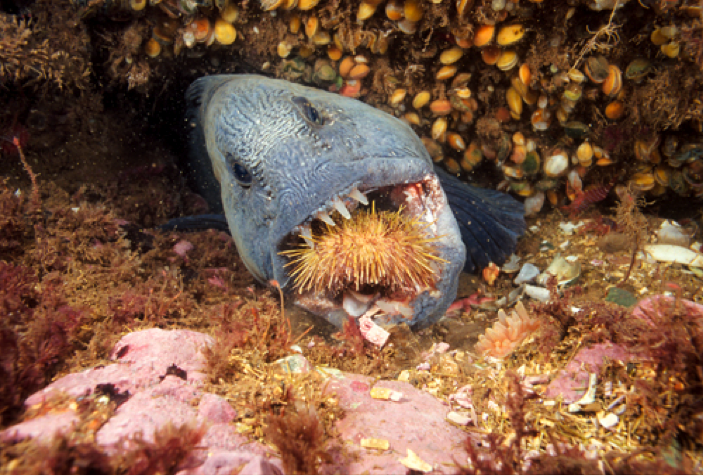
You would think having a name like “wolffish” would mean to stay away at all costs, but the Atlantic Wolffish (Anarhichas lupus) is actually not aggressive towards people and generally sedentary in nature. Their name can be attributed to the large canine teeth that protrude from their powerful jaws, used for hunting and eating hard-bodied invertebrates, including crabs, sea urchins, and snails (Figure 1). Consequently, wolffish play a vital role in the regulation of these prey species, namely sea urchins and green crab. Because the Atlantic Wolffish is generally sedentary, they prefer specific rocky habitats that allow them to hide and catch prey (Keith and Nitschke, 2008). 
 
Figure 1. Atlantic Wolffish (Anarhichas lupus) eating a sea urchin. Source 
 The fish are historically found in the deep, cold waters of the north Atlantic Ocean, and in U.S. waters throughout the Gulf of Maine and as far south as New Jersey (Rountree, 2002). Unfortunately, the range of habitat has diminished greatly over the past few decades due to habitat destruction, and the Wolffish is now only found clustered in three different areas of refuge in the Gulf of Maine, Georges Bank, and the Great South Channel (Nelson and Ross, 1992). Despite this fact, many conservation organizations and agencies list the conservation status of the Atlantic Wolffish under least concern. NOAA has denied the addition of the species onto the Endangered Species Act due to their high numbers in Canadian waters (Cosgrove, 2009). However, this is due to the fact that Canada began protecting the Atlantic Wolffish several years ago under their Species at Risk Act. Shouldn’t the U.S. then list the Atlantic Wolffish under the Endangered Species Act? Regardless of what these organizations and agencies say about the status of the Wolffish, there is solid evidence of a need for protection that is not being met by the U.S. The Atlantic Wolffish should be listed under the Endangered Species Act because it plays a vital role in the marine ecosystem and the population has been in steady decline for the past 30 years.

Although it may not be the most widely known fish in the sea, the Atlantic Wolffish is considered by many ecologists as a keystone species in the north Atlantic Ocean food webs (Dowdell, 2015). When left unchecked, sea urchins, a major prey of wolffish (Keats, 1986), create what’s known as an urchin barren. An urchin barren is an area that was once a flourishing kelp bed or kelp forest that has been grazed bare and results in hundreds of sea urchins left on the rocky platform (Andrews, 2013). Once the sea urchin population has reached this size, it’s much harder to regulate and reverse the damage that has been done, so it’s best to control the numbers before they can cause an issue as damaging as an urchin barren. By keeping the sea urchin population low, kelp forests can thrive which provides numerous benefits to marine life (Just, 2012). Many species seek shelter in the kelp forests and feed on the seaweed. Kelp also is very important to carbon sequestration, the regulation of CO2, not only in the ocean but in the atmosphere as well (Weatherall, 2014). In the face of climate change and rising atmospheric carbon dioxide levels, we can’t afford to lose such beneficial seaweed. However, if the Atlantic Wolffish population is unable to prey upon sea urchins and control their population size, kelp forests will be wiped out and negatively impact the surrounding marine world. In order to keep this from happening, the wolffish needs to be properly protected and thus should be listed under the Endangered Species Act. 
 
Figure 2. U.S. Wolffish landings from 1950-2011  Source
The Atlantic Wolffish has found itself in the middle of a sadly ironic situation; not only are humans the key to the population’s stability, but we are also the main cause of its decline. Over 1,200 metric tons (900,000 lbs) of wolffish were caught in 1983, which was the peak for U.S. landings of the Atlantic Wolffish (Figure 2). Since then, U.S. landings have decreased 97% to about 31.6 metric tons. Although there has been such a large decline in the commercial catch of wolffish, they still face a large threat by being unintentionally caught as bycatch, primarily in the otter trawl fishery (Keith and Nitschke, 2008).  They are also impacted by trawling and dredging, which tears up the seafloor and destroys their rocky habitat (Anderson, 2009). This specific habitat is important for hunting and protection for their young. Eggs are hidden in clusters under rocks and guarded by the male for 9-10 months (Fairchild, 2013). Without this specific rocky habitat they are susceptible to predation and have a decreased chance of survival. It was even estimated that practically every inch of the seafloor off the coast of New England was impacted by this form of modern fishing gear between 1984 and 1990 (Barth, 2009). While it is prohibited from being brought to shore and sold, the Atlantic Wolffish is still caught as bycatch and often thrown back into the water dead and uncounted (Keledjian, 2014). Despite being classified as a Species of Concern in 2004, and a total ban on the possession of Atlantic Wolffish by the New England Fishery Management Council (Anderson, 2009), populations are still declining due to bycatch and habitat destruction.

The only chance the Atlantic Wolffish has for survival is if the government decides to take matters into their own hands. They have allowed the decline of such an important species to go on for far too long, and it’s time that they took some responsibility for it. Current population estimates do not exist, and without stock structure studies our ability to manage the declining population is significantly impaired (Dowdell, 2015). Why there is a lack of current data on the population size is truly baffling. All we have to go on is how often the species is caught in trawl surveys, which has steadily been declining since the 1980s (Figure 3 and Figure 4). 
 
Figure 3. Decline in number of Wolffish caught in trawl surveys of the Western Gulf of Maine.  Source
If the Atlantic Wolffish population continues to decline, as last seen in 2009, then the negative impacts will become too big to ignore. The sea urchin population will exponentially increase, kelp forests will be depleted and CO2 levels will rise, just to name a few. Without more strict governmental regulations, the wolffish will continue to be affected by modern fishing techniques, specifically otter trawls, to a point that recovery may no longer be viable. There is no longer a question of whether or not the Atlantic Wolffish is a species of concern or if it should be listed under the Endangered Species Act. With all the evidence that surrounds us, we can’t ignore the foreseeable outcome as to the fate of this keystone species. The Atlantic Wolffish needs to be listed under the Endangered Species Act due to the crucial role it plays in the north Atlantic Ocean food web and the fact that population numbers have been steeply declining over the past couple decades.
 
Figure 4. Positive tows (Wolffish caught) from NEFSC bottom trawl surveys in the fall. Source.


References

Anderson, J., et all. 2009. Status Review of Atlantic Wolffish (Anarhichas lupus). National Marine Fisheries Service. NOAA.
Andrews, K. 2013. Sea urchins and  biodiversity. Explore the Seafloor. ABC Science and Integrated Marine Observing System (IMOS).  http://exploretheseafloor.net.au/the-science/urchins-biodiversity/  {accessed June 13, 2016}

Barth, B. 2009. Federal Officials Begin Official Review of Endangered Listing for Atlantic Wolffish: Announcement Marks Major Step Forward in Protection for One of New England’s Most Threatened Species. Conservation Law Foundation. http://www.clf.org/newsroom/federal-officials-begin-official-review-of-endangered-listing-for-atlantic-wolffish-announcement-marks-major-step-forward-in-protection-for-one-of-new-englands-most-threatened-fish-species/ {accessed June 13, 2016}
Cosgrove, S. 2009. Wolffish Protection Delayed is Wolffish Protection Denied. Conservation Law Foundation. http://www.clf.org/blog/wolffish-protection-delayed-is-wolffish-protection-denied/  {accessed June 13, 2016}
Dowdell, S. 2015. Fish Friday: The Atlantic Wolffish – Antifreeze Included. New England, Ocean Odyssey. http://newenglandoceanodyssey.org/fish-friday-the-atlantic-wolffish-antifreeze-included/ {accessed June 13, 2016}
Fairchild, E., et al. 2013. Spring feeding of Atlantic wolffish (Anarhichas lupus) on Stellwagen Bank, Massachusetts. Fishery Bulletin 113:191-201
Just, R. 2012. Atlantic Wolffish: A Face only a Mother Could Love? New England, Ocean Odyssey. Conservation Law Foundation.http://newenglandoceanodyssey.org/atlantic-wolffish-a-face-only-a-mother-could-love/ {accessed June 13, 2016}
Keats, D., et all. 1986.  Atlantic wolffish (Anarhichas lupus L.; Pisces: Anarhichidae) predation on green sea urchins (Strongylocentrotus droebachiensis). Canadian Journal of Zoology 64(9): 1920-1925
Keith, C. and P. Nitschke. 2008. Atlantic wolffish. Northeast Data Poor Stocks Working Group Meeting, Northeast Fisheries Science Center. http://www.nefsc.noaa.gov/publications/crd/crd0902/wolffish/origwolffish.pdf {accessed June 13, 2016}
Keledjian, A., et all. 2014. Wasted Catch: Unsolved Problems in U.S. Fisheries. Oceana, Inc.
Nelson, G. A., and M. R. Ross. 1992. Distribution, growth and food habits of the Atlantic wolffish (Anarhichas lupus) from the Gulf of Maine-Georges Bank region. Journal of the Northwest Atlantic Fishery Science 13:53-61.
Rountree, R. A. 2002. Wolffishes: Family Anarhichadidae. In Bigelow and Schroeder’s fishes of the Gulf of Maine. Smithsonian Inst. Press, Washington D.C.
Weatherall, G. 2014. Ocean Plants Part 3: Kelp and Climate. New England, Ocean Odyssey. Conservation Law Foundation. http://newenglandoceanodyssey.org/ocean-plants-part-3-kelp-and-climate/  {accessed June 13, 2016}