Showing posts with label Pike Killifish. Show all posts

Tuesday, January 2, 2018

Favorite Posts of 2017

Virginia Tech Ichthyology is devoted to teaching and learning about fishes.  We posted thirty nine blog posts in 2017.   Here I review the favorite blog posts from 2017.

Sea Lamprey and the Unexpected Costs of Shipping

Sea Lamprey accessed the upper Great Lakes when shipping access was improved.  They arrived at a time when Walleye, Lake Trout, Burbot, and Whitefishes were commercially over harvested.  The added mortality from Sea Lamprey was the tipping point that led to collapse of these valuable fisheries.  Expensive control efforts continue to the present time to deal with this invader.
Oral disc of the parasitic Sea Lamprey. Photo by Cory Genovese
Shades of Gray Snapper

Gray Snapper are common on Caribbean reefs that attract large spawning aggregations.  They go by a variety of names because they do not always appear to be "gray."  Gray Snapper are often overfished.  This story of the habitat and life history of Gray Snapper emphasizes the importance of conserving both inshore seagrass and mangrove habitats as well as offshore coral reefs.

Gray Snapper. Photo by Ned DeLoach  Source 
Puzzling over Large Aggregations of Sharks

This story explores how super abundant shark aggregations in a biosphere reserve persist because they rely on spawning aggregations of groupers for energy subsidies.  This discovery illustrates the futility of single species fisheries management.  Even if no sharks were harvested from this population, the population may decline depending on conditions for other fishes outside the biosphere reserve. Conservation of fish spawning aggregations, which are often targets of exploitation can help conserve shark populations, especially if combined with shark fishing bans.


Examples of shark foraging at night on the Camouflage Grouper Epinephelus polyphekadion (A, B, and C) and the Whitemargin Unicorn fish Naso annulatus (D).  Source

Pike Killifish: A Small, Specialized Ambush Predator

The Pike Killifish is an enigma. It is the only member of the Poeciliidae family that is a specialized piscivore.  Pike Killifish live in slow-moving streams and rivers, mangrove and weedy swamps, and inlets salty bays, where they associate with abundant submersed vegetation.  Their native distribution ranges from Costa Rico north into parts of Mexico.  From a single introduction in Miami-Dade County in 1957, the Pike Killifish became established in south Florida where their wide tolerance for temperature, salinity, and oxygen level allowed them to thrive in many habitats. 
Large adult Pike Killifish. Photo by Kenneth Tse Photography
Painful Stings of the Notorious Noturus

Madtoms are diminuitive catfishes that are bound to intrigue those who encounter them.  However, their pectoral and dorsal fin spines are sharp and deliver a painful venom.  Madtoms have a paradoxical combination of the strong anti predator adaptation while being a very popular bait fish.
How cute is this Margined Madtom Noturus insignis? Be careful, it packs a painful sting.  Photo by D.J. Orth.
Mad about Madtoms

These benthic nocturnal catfish arose in eastern North America sometime in the middle Miocene (that's 23.03 to 5.33 million years before the present).  Many of the twenty nine species have small, fragmented populations and are at-risk from a variety of human activities.  Although they are seldom the subject of thorough population studies, restoration activities are more commonplace today.   Madtom species are cryptic in more ways than one.   Click here to review some madtom photos.
Mountain Madtom Noturus eleutherus have a highly fragmented distribution  photo by Tim Lane
Sharks without Fathers, by Rasha Aridi

In this essay, Rasha Aridi explains how shark offspring can be produced without a male contribution.   In 2002 a bonnethead shark gave birth in a zoo even though it had never been kept with a male.  This "virgin shark" mystery persisted and keen observers began to investigate cases of virgin birth in captivity.  Using DNA fingerprinting, these cases confirmed that all elements of the DNA in the offspring were from the mother.   Some species of sharks can produce offspring via sexual reproduction and parthenogenesis.

Parthenogenic zebra shark pup hatched and reared by the Burj Al Arab Aquarium Team. Source. 
Pelagic Thresher Sharks are Philippine Helpful, by Maddie Johnson

A major typhoon devasted an island resort leaving little or no infrastructure.  This essay examines the response of the locals in building a tourism-based economy based on the Thresher Shark.  Fisherman who used to make their money from catching as many thresher sharks as they could now make their money from this unique eco-tourism trade.
Thresher Shark.   Photo by Hugh Ross.  Source 

Siberian Taimen: Ensuring the Survival of the River Wolf, by Spencer Bell

Hucho taimen is known to the Chinese as the "river god's daughter." Mongolians protected their rivers for many centuries in keeping with their beliefs.  Consequently, some populations of the largest salmonid in the world still remain.  Today, recreational catch-and-release fishing has replaced poaching on the remaining Taimen populations.

Three Taimen, underwater photo from Eg River, northern Mongolia.  Source. 

Bow fishing for "Rough" Fish

Rough fish is an old term that once referred to less valued fish that had yet to be processed.  Today, more anglers are targeting rough fish for sport and bow fishing is among the fastest growing new fishing pursuits.  However, fishing regulations must change with the time and the term "rough" fish need to be replaced with more appropriate language.

Bow fishing at dusk.  Photo by Jason Emmel

Climate Change and the Fishes

Fear and doom stories about climate change have led to more research and development of strategies for adapting to eventual changes.  However, the scientific investigations have revealed a complex interactions of stressors related to climate change. Although there is still much to learn, it is apparent that we need to act now to protect cole and cool water refugia.
Documented responses of fishes in the southeastern USA to climate change. Green arrows indicate an increase or earlier seasonal response, and gray arrows indicate a decrease or later seasonal response  (Lynch et al. 2016).
Endemic Fishes of the New River

In my home watershed there are 8 species of endemic fishes.  They are all cool water specialists that found refuge in the upper New River during the last ice age.  These endemic fishes have limited distributions and will be disproportionately influenced by anthropogenic changes that may occur.  Read more about these 8 species in this post to learn why the New River is a special place for fishes.
New River near Rich Creek, Virginia.  Photo by Valerie F. Orth. 
Trends in Dam Removal: Reversing Irreversible Decisions

How many dams are there in the USA?  How many dams have been removed from streams? What happens to the stream after dam removal? What are the gaps in the science of dam removal?   Learn the answers to these and other questions.

Pigg River Power Dam before (photo by USFWS) and during demolition (photo by Roanoke Times)


Thursday, February 9, 2017

Pike Killifish: A Small, Specialized Ambush Piscivore

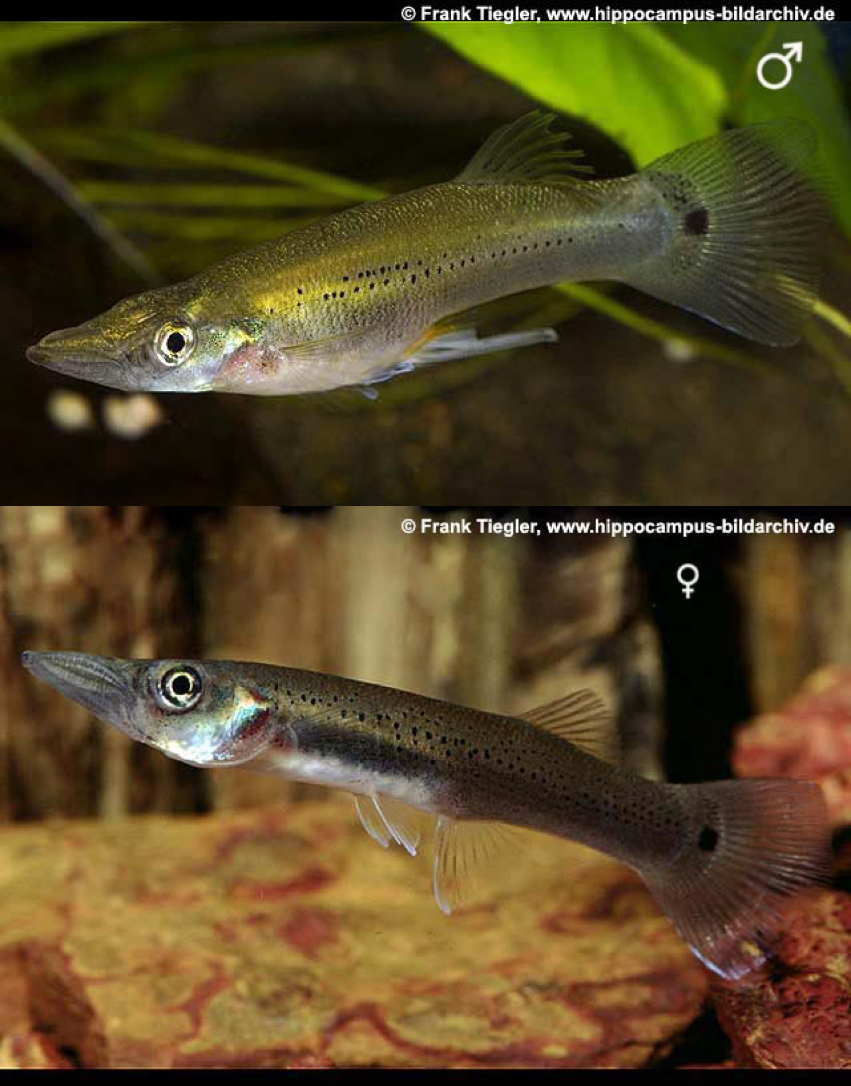
The Pike Killifish (Belonesox belizanus) is fascinating small fish. Rudolf Kner, an Austrian ichthyologist and physician, described the Pike Killifish in 1860, and created a new genus, Belonesox, for this distinctive fish.  What do you see?   How do the morphological traits translate to behavior? This distinctive, small fish has a fusiform body shape and is slightly compressed in posterior region. It has a large eye and a dorsal fin far back from the center of gravity.  Its mouth is oblique and the lower jaw is longer than the upper jaw.   This form is adapted for a surface-feeding ambush predator.  But there is much more to learn about this fascinating little fish.   
Male and Female Pike Killifish.  Photos by Frank Tiegler 
Belonesox implies a cross between a needlefish and a pike. The Latin word, belonÄ“, meaning needle, was first applied to the needlefish by Pliny the Elder in The Natural History (77-79 AD).  Esox is the genus of pikes and pickerels. The teeth and jaw protrusion abilities make the Pike Killifish a little killing machine. The Pike Killifish lies in wait for prey and ambushes, stalks or pursues its fish prey with minimal stealthy movements.  When it locates a suitable prey, it makes one explosive lunge at the prey. Greven and Brenner (2008) discovered that the prey of Pike Killifish were struck within 36 milliseconds and captured at velocities of approximately 11 body lengths per second.  The jaws are greatly enlarged for this small fish and are extended in a long pointed beak filled with canine teeth. The outer series of teeth are conical and curved backwards and smaller than the inner series of teeth. Furthermore, the maximum gape, at 44% of the head length, may be a record for similar sized fish.  The large toothy gape can hold struggling prey while the orientation of the teeth makes it easy for prey to enter, but impossible to escape. Any small, surface-dwelling fish, such as mosquitofishes, swordtails, platies, and even other Pike Killifish, are easy prey.
Note the teeth are unicuspid and have multiple orientations.  Photo of head source Photo of teeth on premaxilla from Grevner and Brenner (2008).
Pike Killifish are in the Order Cyprinodontiformes, the toothed carps, and the Family Poeciliidae.  Poeciliidae is a species-rich family with over 300 species, many of which are known by common names, such as the guppy, molly, swordtail, topminnow, and mosquitofish. Pike Killifish may reach 22 cm and females are much larger than males. The Pike Killifish is the largest species in this family and the only one with the elongated jaws.    Marchio and Piller (2013) concluded based on genetic analyses that there is only one valid species throughout Central America.   
Phylogeny of Belonesox and closest relatives (Ferry-Graham et al. 2010)
Whereas most cyprinodont fishes are micro-carnivores, or pickers, with a small gape designed for nipping, the Pike Killifish is a specialized piscivore.  Pike Killifish achieve this enlarged gape (~20mm) by a mobile premaxilla that is capable of rotating dorsally and a ventrally rotating lower jaw (Ferry-Graham et al. 2010).  While most fishes have to grow into the specialized piscivore niche, the Pike Killifish is capable of the large gape essentially from birth.
Cranial and jaw anatomy. In top diagram the maxilla and adductor mandibulae (A) are removed to show muscle insertions.  Ferry-Graham et al. (2010)
Pike Killifish live in slow-moving streams and rivers, mangrove and weedy swamps, and inlets salty bays, where they associate with abundant submersed vegetation.  They are endemic to Central America from northern Costa Rica through parts of Mexico.  Pike Killifish emerged as a small, but top carnivore, among other small poeciliid fishes many millions of years ago.  Many of these habitats were formed via dissolution of karst topography creating unique aquatic lake types (aguadas, reumideros, and cenotes) in addition to rivers, backwaters, and bays (Vega-Cendejas et al. 2013).  The Pike Killifish are tolerant of low dissolved oxygen, high salinity, and high temperature (Turner and Snelson 1984; Kerfoot et al. 2011)   
 
Range map of the Pike Killifish.  Source
Males mature at 6 cm and females at 8 cm. Breeding is year-round.  The male has a modified anal fin that serves as an intromittent sex organ, aka gonopodium.  Males repeatedly conduct ritualistic behavioral acts when in the presence of females.  The courting male fans his fins and gonopodium in her direction (Horth 2004).  Fertilization is internal and large clutches (100-300) may be produced every 6-7 weeks.  Newly born Pike Killifish are approximately 15 or 16mm at birth.   All reproductive traits contribute to a high reproductive rate.
 
Large adult Pike Killifish. Photo by Kenneth Tse Photography
From a single introduction in Miami-Dade County in 1957, the Pike Killifish became established in south Florida
(Schofield et al 2017).  Pike Killifish are common from central western Florida to the Florida Everglades.   Pike Killifish adapted to the physical conditions of Florida because of their wide tolerance for temperature, salinity, and oxygen levels. In the Everglades, the Pike Killifish persisted in several canals east of the Everglades for more than 20 years before expanding dramatically in the 1980s and 1990s; however, no coincidental changes in indigenous fishes were noted (Trexler et al. 2000).  Admittedly, few investigations have examined effects of Pike Killifish in Florida.  One challenge to evaluating the effects of fish introductions is the lack of before-introduction community data.  Greenwood (2012) examined effects of the Pike Killifish on indigenous fishes of the Tampa Bay in Florida.  Here, the Pike Killifish first occurred in 1994 and pre-invasion monitoring data were available.  Pike Killifish reduced the abundance of small resident, indigenous fishes, namely the Eastern Mosquitofish Gambusia holbrooki , Goldspotted Killifish Floridichthys carpio, Sheepshead Minnow Cyprinodon variegatus, and Sailfin Molly Poecilia latipinna.   
Trend in the biomass of Pike Killifish in the Everglades (Trexler et al. 2000)
It is likely the Pike Killifish will persist and spread.  Perhaps it will be accommodated without major effects. It’s too early to know if the Frankenstein Effect (i.e., new invasions are likely to have unexpected consequences) will emerge.  Though most successfully invasive fish are euryphagous, the feeding behavior of the Pike Killifish, though optimized for specialized feeding on fishes, is just as effective for capturing a variety of elusive prey. If there are no fish prey, the Pike Killifish switches to shrimp prey (Harms and Turingan 2012).  

Ornamental and aquaria are growing industries. Photo by Dan Woudenberg/LuCorp Marketing
Florida is home to more non-indigenous fishes than any state due to historic practices. Tropical ornamentals industry contributes $28M per year to Florida’s economy, and ornamental fish farms must be licensed by the Florida Department of Agriculture and Consumer Services.  Best practices can and do minimize the escape, if implemented (Tuckett et al. 2016), and that can reduce the likelihood of invasion success.      

References
Ferry-Graham LA, Hernandez LP, Gibb AC, Pace C, 2010. Unusual kinematics and jaw morphology associated with piscivory in the poeciliid, Belonesox belizanus. Zoology  113:140-147.
Greenwood, M.F.D.  2012.  Assessing the effects of the nonindigenous pike killifish on indigenous fishes in Tampa Bay, Florida, using a weighted-evidence approach.  Transactions of the American Fisheries Society 14(1):84-99
Greven, H., and M. Brenner. 2008. Further notes on dentition and prey capture of the Pike killifish Belonesox belizanus (Poeciliidae). Bulletin of Fish Biology 10(1/2):97-103.
Harms, C.A., and R.G. Turingan. 2012.  Dietary flexibility despite behavioral stereotypy contributes to successful invasion of the pike killifish, Belonesox belizanus, in Florida, USA.  Aquatic Invasions 7:547-553.
Horth, L, 2004. A brief description of the courtship display of male pike killifish (Belonesox belizanus). Florida Scientist 67:159-165.
Kerfoot, J.R., Jr. 2012. Thermal tolerance of the invasive Belonesox belizanus, pike killifish, throughout ontogeny. Journal of Experimental Zoology Part A: Ecological Genetics and Physiology 317(5):266-274. http://onlinelibrary.wiley.com/journal/10.1002/(ISSN)1932-5231/issues
Kerfoot J.R., J.J. Lorenz, and R.G. Turingan RG, 2011. Environmental correlates of the abundance and distribution of Belonesox belizanus in a novel environment. Environmental Biology of Fishes 92:125-139.
Kerfott, J.R., and R.G. Turingan.  2011.  Similarity and disparity in prey-capture kinematics between the invasive pike killifish (Belonesox belizanus) and the native Florida largemouth bass (Micropterus floridanus).  Florida Scientist 74:137-150
Marchio, E.A., and K.R. Piller. 2013. Cryptic diversity in a widespread live-bearing fish (Poeciliidae: Belonesox). Biological Journal of the Linnean Society 109:848-860.
Schofield, P.J., L. Nico, and M. Neilson 2017. Belonesox belizanus.  USGS Nonindigenous Aquatic Species Database, Gainesville, Florida.   Website https://nas.er.usgs.gov/queries/FactSheet.aspx?speciesID=843 [accessed 8 February 2017]
Trexler J.C., W.F. Loftus, F. Jordan, J.J. Lorenz, J.H. Chick, and R.M.Kobza. 2000. Empirical assessment of fish introductions in a subtropical wetland: an evaluation of contrasting views. Biological Invasions 2:265-277.
Tuckett, Q.M., J.L. Ritch, K.M. Lawson, and J.E. Hill. 2016. Implementation of best management practices for Florida ornamental aquaculture with an emphasis on non-native species. North American Journal of Aquaculture 78: 113-124.
Turner, J.S., and F.F. Snelson. 1984. Population structure, reproduction and laboratory behavior of the introduced Belonesox belizanus (Poeciliidae) in Florida. Environmental Biology of Fishes 10:89-100.
Vega-Cendejas, M.E., M.H. de Santillana,  and S. Norris. 2013. Habitat characteristics and environmental parameters influencing fish assemblages of karstic pools in southern Mexico. Neotropical Ichthyology 11(4):859-870.