Posts
Posts


“What's an umbrella fish?” a young student asked me. Stumped, I replied “Never heard of one.” The question
bugged me until a library search confirmed there was no “umbrella fish.” However, in conservation biology the term ‘umbrella’
species is one of several buzzwords used for surrogate species. Surrogate
species may indicate biological diversity or environmental change or simply
connect in the public’s imagination regarding habitat protection. Surrogate buzzwords include focal species,
indicator species, keystone species, umbrella species, target species,
foundation species, flagship species, and ecological engineer species (Caro
2010). Even if the terms are loosely
used, the species-centered conservation approaches can promote public awareness
and raise funds for conservation. If it works, use it.
Flagship species are primarily intended to promote public
awareness and to raise funds for conservation. While flagship species are
selected for their marketing value, umbrella species are selected based on
ecological criteria and are expected to benefit a wide range of co-occurring
species (Caro 2010; Kalinkat et al. 2017). Is it possible to select flagship
umbrellas to describe species that explicitly integrate both functions? Perhaps. The classic giant panda (Ailuropoda melanoleuca) is a popular
charismatic species used since the 1960s by World Wildlife Fund for Nature for
fundraising as well as it benefits for co-occurring endemic species.
Recently, Kalinkat et al. (2017) identified over 60
potential freshwater flagship umbrella species.
So, there could be an umbrella fish. The next phase must be to implement
and evaluate conservation strategies based on the flagship umbrella species
approach. Do the flagship umbrella
species attract public attention and funding for conservation? Is the diversity of co-occurring communities
protected? We don’t know.
Emmanuel Frimpong
(2018) argues that our lack of knowledge perpetuates ineffectual conservation
practices in tropical Afrotropical freshwater fishes. We need to understand
which fishes are rare and which are common and how the species may interact in
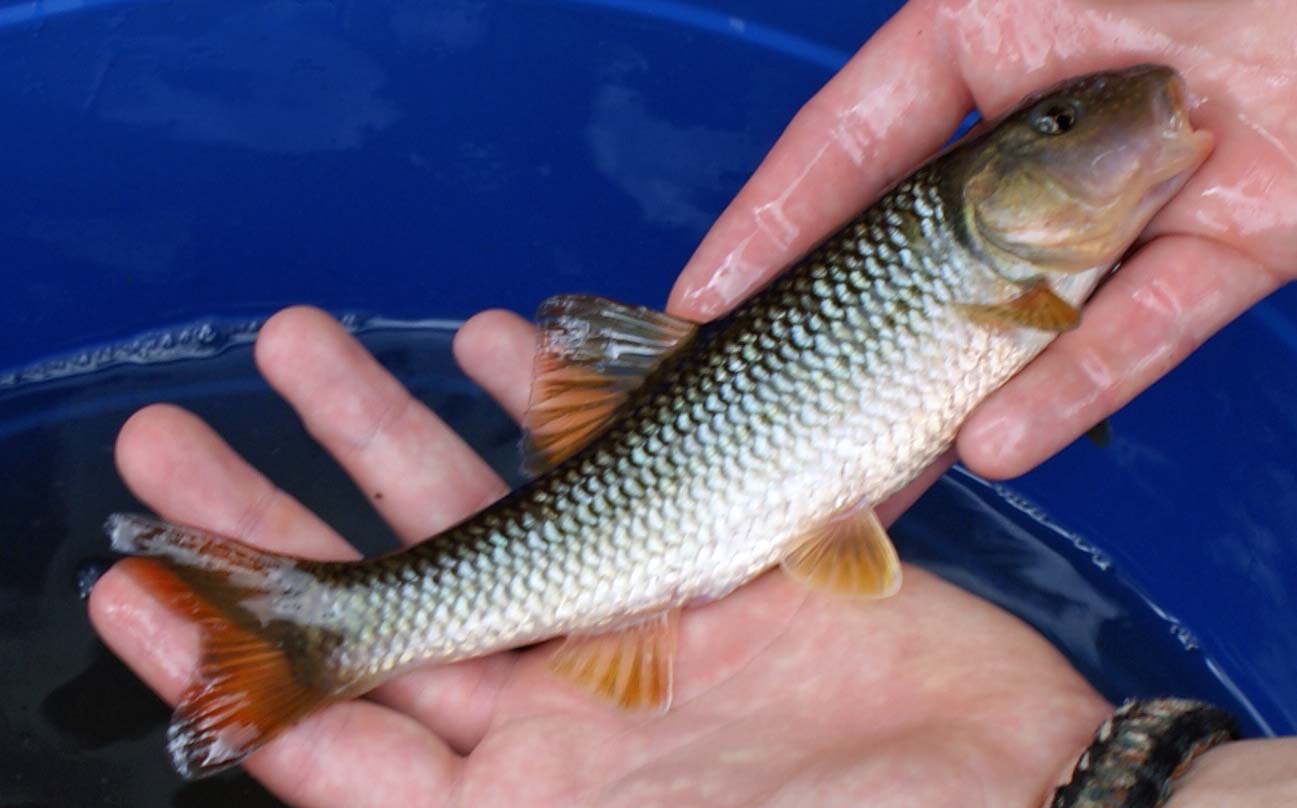
aquatic ecosystems. His experiences, studying Nocomis breeding and nest associates, confirmed that seven species
of cyprinids may breed on Nocomis nests. Therefore, Nocomis
may be an umbrella species, but conservation action may take time. His story emphasizes to us all that understanding
the ecology and natural history of individual species is essential to adopting
the language of flagship umbrella species.
That is one thing holding us back in fish conservation efforts. Frimpong
(2018) then asks “Can we protect these rare species without protecting the
common species that function as their hosts?”
Probably not!
 |
| A Bluehead Chub Nocomis leptocephalus guards his breeding mound in Toms Creek, Virginia. Photo by Emmanuel Frimpong. |
We have yet to see if the flagship umbrella species approach
develops and spurs effective conservation programs. However, the concept of an umbrella is an
important one. However, the multiple individual values and
motivations around fish conservation should be embraced within a large,
inclusive umbrella community of conservationists. Here I review a few of these potential umbrella
fish. Remember, while umbrella species may not exist for all systems, they may
be effective in some. Therefore, the
concept is important to consider further to promote conservation action.
The Humphead Wrasse Cheilinus
undulatus (also known as the Napoleon Wrasse) shares habitat with a diverse
community in coral reefs. The species has a broad geographic distribution in
the Indo-Pacific Ocean, a region with tremendous coral reef biodiversity. Like
most wrasses (Labridae), the Humphead Wrasse is a protogynous hermaphrodite,
meaning they will start life as females and may transition to males. As a
large, conspicuous coral reef fish that is severely overfished, it fits the
criteria for a flagfish species. Most
tropical marine protected areas (MPA) are too small to effectively protect the
Humphead Wrasse and a significant scaling up of MPA is required (Weng et al
2015). Protecting the Humphead Wrasse
would protect many co-occurring species with shared habitat requirements. Therefore, it may be both a flagship and an
umbrella species.
 |
| Humphead Wrasse. Photo by Paolo Macorig. |
Asian Arowana Scleropages formosus (Müller
& Schlegel, 1844) is also known as the Golden Dragonfish or Golden Arowana.
These fish are so highly valued by the aquarium trade that they are seldom
eaten. Yet, the native swamps and sluggish rivers in southeast Asia are highly
altered and the entire aquatic ecosystem and its services are at risk. This recognizable and charismatic fish may be
an appropriate flagship umbrella species.
 |
| Asian Arowana. Photo by Marcel Bulkhead. |
The largest
salmonid in the world is the highly migratory Taimen or Huchen Hucho hucho. The Taiman, known to locals as the “river
god’s daughter,” may reach up to six feet and weigh up to 200 pounds. Overfishing and habitat change reduced
populations that once thrived throughout Mongolia and Siberia (Geist et al.
2009). Since sport anglers value the
large, unique fish, the Taimen is the target species in creating a large
catch-and-release fishing reserve. Read
more here.
The Arapaima is one of the largest freshwater fishes and can
reach 8 feet in length. However,
throughout it range in Brazil and Guyana it seldom reaches that large size
anymore due to overfishing. One of the most heavily exploited fishes in South
America, even today, scientists are not certain how many species of Arapaima
exist (Stewart 2013a, 2013b; Watson et al. 2016). While it fits some requirements
for a flagship species, whether it’s an umbrella species will require
more studies.
 |
| Arapaima sp. Photo by J-subculture.com |
The Mekong river and delta regions support a highly diverse
ecosystem, which is heavily dammed.
Biodiversity of the Mekong basin is second only to the Amazon
basin. New fish species are described from
the Mekong regularly and no other river has so many species of very large
fishes. These include giant freshwater stingray Himantura polylepis, several giant barbs (Catlocarpio saimensis and
Probarbus spp), and giant catfishes.
Two catfishes, the Mekong Giant Catfish (Pangasianodon gigas) and the Striped Catfish (Pangasianodon hypophthalmus) are candidate flagship umbrella
species (So et al. 2006). Fish make up ½ to 2/3rd of the diet of
rural people of the Mekong and 2/3rd of the people are engaged in
wild capture fisheries so conservation of these areas is critically important.
 |
| Mekong Giant Catfish (left) and striped catfish Planet Catfish (right) |
Mahseer (Tor spp; Cypriniformes: Cyprinidae) are
large-bodied, migratory freshwater fishes that are endemic to the monsoonal
rivers of Asia. They are flagship species because of their economic,
recreational and conservation interests.
Six of eighteen species of Tor are
endangered, while others are threatened or data deficient (Pinder et al. 2015).
Mahseers are referred to as “kings of aquatic systems” and are the primary targets
of recreational anglers. Fishing guides
and recreational anglers have a stake in the protection of the catchments that
support populations of Mahseer (Bower et al. 2017), yet the value of Mahseers as
umbrella species has not been assessed.
 |
| Dekkan Masheer Tor khudree Photo by J. F. Helias |
In North America, sturgeons (Acipenseridae), American Eel,
Pacific salmonids, and Brook Trout are potential flagship umbrella
species. Brook trout Salvelinus fontinalis are well studied and a variety of
conservation planning tools have been developed. Many tools designed to characterize the
continuum of viability, habitat condition, and vulnerability of Brook Trout
populations may also protect a wide variety of co-occurring species.
Sturgeons and
Paddlefish in North America are possible flagship umbrella species. In 2012, the North American Sturgeon and Paddlefish Society formed to focus on “current declines in sturgeon and paddlefish
populations across North America, NASPS is dedicated to promoting the
conservation and restoration of these species by developing and advancing
research pertaining to their biology, management, and utilization.” There are many threats that are specific to
individual species of sturgeon. While study methods are improving, conservation
efforts are playing a game of catch up. Perhaps a flagship umbrella species
approach can help protect essential riverine habitats for hackelbacks.
Although the status of American Eel is unclear, but one
thing is clear. American Eels may be
hindered from reaching up to 84% of upstream habitats, thereby fragmenting the
single, panmictic population. Efforts to
restore connectivity may benefit a large number of co-occurring fishes.
 |
| Four species of cyprinids that are nest associates with Bluehead Chub nests. Photo by Derek Wheaton. |
We have a difficult challenge in conserving the fishes and their
habitats. Pluralism is the rule in
conservation in general and fish conservation in particular. Many approaches,
many values, and many types of people must be engaged in the process (Cooke et
al. 2013). Green et al. (2015) advocated
for creating a much larger community that is strengthened, rather than
factionalized, by pluralistic viewpoints. Local and large-scale activities are important
to our conservation efforts. If the
concept of flagship umbrella species can assist in making conservation more
effective, then we should pursue the idea vigorously.
References
Bower, S.D., A.J.
Danylchuk, R. Raghavan, S. C. Danylchuk, A.C. Pinder, A.M. Alter, and S. J.
Cooke. 2017. Involving recreational
fisheries stakeholders in development of research and conservation priorities
for mahseer (Tor spp.) of India
through collaborative workshops. Fisheries Research 186:665-671.
Caro, T. 2010.
Conservation by proxy: Indicator, umbrella, keystone, flagship, and other
surrogate species. Island Press.
Cooke, S. J. et
al. 2013. Failure to engage the public in issues related to inland fishes and
fisheries: strategies for building public and political will to promote
meaningful conservation. Journal of Fish
Biology 83(4):997-1018.
Frimpong, E. A. 2018. A case for conserving common species. PLOS Biology 16(2): e2004261
Geist J, Kolahsa
M, Gum B, Kuehn R. 2009. The importance of genetic cluster recognition for the
conservation of migratory fish species: the example of the endangered European
huchen Hucho hucho (L.). Journal of Fish Biology 75(5):1063-1078.
Green, S. J., J.
Armstrong, M. Bogan, E. Darling, S. Kross, C.M. Rochman, A. Smyth, and D.
Verissimo. 2015. Conservation needs diverse values,
approaches, and practitioners. Conservation Letters doi:
10.1111/conl.12204
Hogan, Z.S. 2011.
Ecology and conservation of large-bodied freshwater catfish: a global
perspective. American Fisheries Society Symposium 77:39–53.
Kalinkat, G. and
seventeen coauthors. 2017. Flagship umbrella species needed for the
conservation of overlooked aquatic biodiversity. Conservation
Biology 31:481-485.
Kalinkat, G. and
seventeen coauthors. 2017. Flagship umbrella species needed for the
conservation of overlooked aquatic biodiversity. Conservation
Biology Supplemental file. 18 pp.
Pinder AC,
Raghavan R, Britton JR. 2015. Efficacy of angler catch data as a population and
conservation monitoring tool for the flagship Mahseer fishes (Tor spp.) of Southern India. Aquatic Conservation: Marine and Freshwater Ecosystems
25(6):829-838. 204
So, N., J.K. Van
Houdt, and F.A. Volckaert. 2006. Genetic diversity and population history of
the migratory catfishes Pangasianodon
hypophthalmus and Pangasius bocourti
in the Cambodian Mekong River. Fisheries
Science 72(3):469-476. 237
Stewart,
D. J. 2013a. Re-description of Arapaima agassizii (Valenciennes),
a rare fish from Brazil (Osteoglossomorpha: Osteoglossidae). Copeia 2013:38–51.
Stewart,
D. J. 2013b. A new species of Arapaima (Osteoglossomorpha,
Osteoglossidae) from the Solimões River, Amazonas State, Brazil. Copeia 2013:470–476.
Watson, L.C.,
D.J. Stewart, and A.M. Kretzer. 2016. Genetic
diversity and population structure of the threatened giant Arapaima in southwestern Guyana: Implications for their conservation.
Copeia 104:864-872.
Weng, K.C., M.W.
Pedersen, G.A. Del Raye, J. E. Caselle, and A. E Gray. Umbrella species in marine systems: using the
endangered humphead wrasse to conserve coral reefs. Endangered
Species Research 27:251-263.