Posts
Posts


Anyone who travels in the New River valley know it’s a very
special place. Those who study the
fishes know some secrets too. The New River is the oldest major stream in
the eastern United States – it should be the Old River. The historic Teays River originated in the
Tertiary Period and at that time drained much of eastern North American in the
pre-glacial period. However, the
original route of the ancient Teays was altered by glacial advances which
created a massive ice dam blocking the northward-flowing Teays. Geologists
maintain that the river retained its course from headwaters in the Blue Ridge
province, across the Valley and Ridge province and into the Appalachian plateau
for 100 million years or more. Through
this period of slow uplift of the Appalachian region the river continued to
slowly erode its bedrock streambed through gaps in major mountain ranges. This wide, shallow, bedrock river flows
northward across the strike or grain of underlying geological structures
(Spotila et al. 2015).
New River supports 46 native fishes, 8 of which are endemic
species. Endemic species are unique to a
defined geographic location. The endemic
fishes of the New River likely diverged after geographic isolation from ancestral
forms during the Pleistocene glaciation. These glaciers, as they advanced
southward, displaced fishes into unfrozen tributaries. The upper New River drainage was likely an
important refugia for fishes during this most recent ice age. This history explains why the number of native
fish species in the New River is low compared with similar sized rivers in the
eastern US. However, the number of
endemic species is high.
 |
| New River near Rich Creek, Virginia. Photo by Valerie F. Orth. |
New
River has a relatively high number of endemic fishes due to two main causes:
(1) the presence of natural barriers and (2) the
immobility of a species. The Pleistocene
glaciers did not reach Virginia though the climatic and barrier effect was a
strong influence in the New River fish fauna.
During the Pleistocene, the climate cooled and for fish in the New
River, it was “no way out and no way in.”
New River fish had to stay, adapt, or die. The mainstem falls, cascades, rapids
prevented upstream dispersal after the Pleistocene glaciation. The Pleistocene ended 10,000 years ago,
leaving many native New River fishes as cool-adapted. Few native warmwater species are widespread. Today, the New River has the highest
proportion of introduced to native fishes of any eastern USA drainage as at
least 57 introduced fishes persist in the New River alongside 44 native fishes
(Easton et al. 1993; Easton and Orth 1994; Angermeier and Pinder 2015; Hilling
in press).
The eight endemic fishes include three minnows,
two sculpins, and three darters, all groups that typically have little or no
long-range migrations. The first three endemic fishes are in cyprinids. Cyprinids are members of the family
Cyprinidae (minnows), the most species rich family of fishes in North
America. There are 53 recognized genera
and 286 species of minnows in North America (Mayden 1991).
The Bigmouth Chub Nocomis platyrhynchus occurs only in the New River drainage and its
distribution is allopatric with its closest relatives, the River Chub Nocomis micropogon and the Bull Chub Nocomis raneyi. Bigmouth Chub inhabits medium- to large-sized
tributaries and the mainstem New River which have a moderate gradient, warm,
usually clear water, and a good mix of gravel to boulder substrates. For more information, click here.
 |
| Bigmouth Chub male (top) and female (bottom). Photos by Hunter Hatcher (top) and D. J. Orth (bottom) |
The
Kanawha Minnow Phenacobius teretulus is one of five species of Phenacobius referred to as suckermouth
minnows for obvious reasons. The Kanawha
Minnow is the only Phenacobius in the
New River, has a limited distribution, and is an uncommon part of the fish
assemblage. Juveniles and adults
typically occur in riffles and runs of gravel, rubble, and boulder in cool to
warm creeks and small to medium rivers.
For more information, click here.
 |
| Kanawha Minnow. Photo by Fritz Rhode. |
New
River Shiner Notropis scabriceps occurs
in pools and slow runs of cool to warm creeks and small to medium rivers. It is
more common in Blue Ridge province than in the Appalachian or Ridge and Valley
provinces. As with other New River
endemics, temperature has been postulated as a major factor governing its
distribution. In one of the few
temperature preferenda studies, the final thermal preference of the New River Shiner
was 19.3 °C, or 66.7 °F (Shingleton et al. 1981). Two
non-native species, the telescope shiner Notropis
telescopus and whitetail shiner Cyprinella
galactura may also compete with the New River Shiner (Keplinger 2007).
 |
| New River Shiner. Photo by Ben A. Cantrell. |
Kanawha
sculpin Cottus
kanawhae was first considered a subspecies of the
Banded Sculpin Cottus carolinae. It is widely distributed in tributaries of
the New River and often overlaps with the Mottled Sculpin Cottus bairdi. Why? I don’t know.
 |
| Kanawha Sculpin. Photo by Derek Wheaton. |
 |
| Dorsal saddles of Kanawha Sculpin. Photo by D.J Orth. |
 |
| Dorsal fin of Kanawha Sculpin. Photo by D.J.Orth |
Bluestone
sculpin Cottus sp. has a very limited
distribution in the Bluestone River and little is known about its present
status and distribution.
 |
| Bluestone Sculpin. Photo by Noel M. Bulkhead. |
Candy
Darter Etheostoma
osburni is a rare fish that’s currently under review for federal listing as an endangered species. Candy
Darters are most abundant in shallow riffle and run habitats but only occurs in
a limited number of streams and has declined or disappeared from some historic
locations. The proposed Mountain Valley pipeline would
cross Big Stony Creek, which supports one of the remaining populations of Candy
Darters. The Candy
Darter may be the most colorful local darter.
It’s occurrence in clear mountain streams means it can be seen by the
avid snorkeler willing to crawl amidst the fast-flowing boulders and cobbles. Click on this video link to watch the Candy Darter behavior underwater.
 |
| Candy Darter male. Photo by Derek Wheaton. |
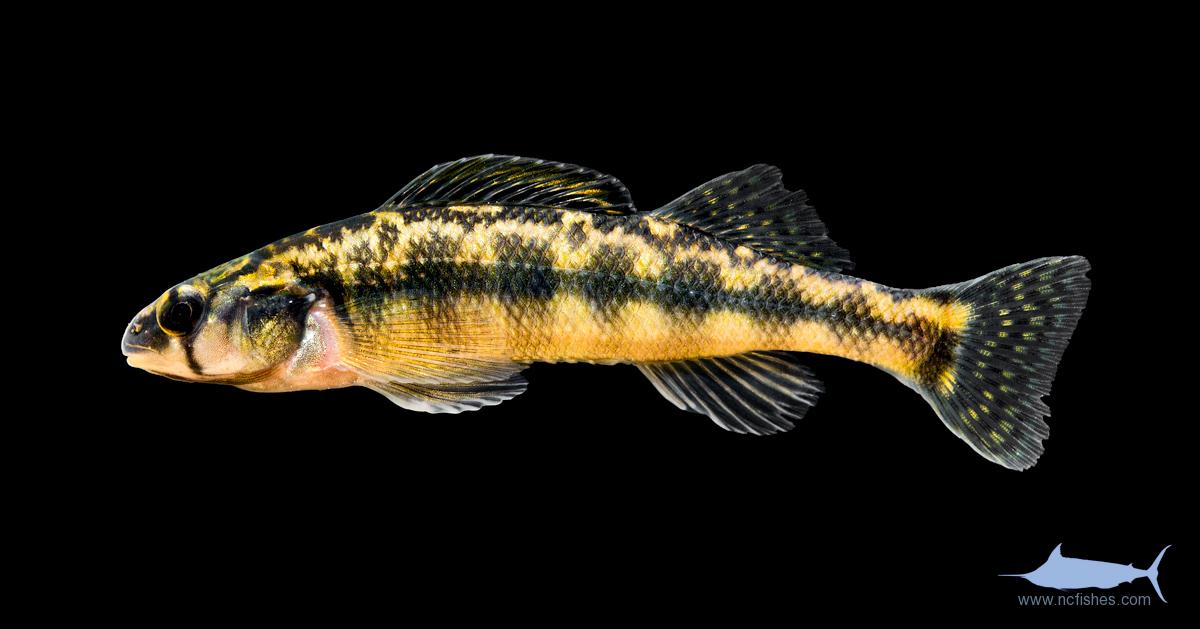
Kanawha
Darter Etheostoma kanawhae is a close
relative of the Candy Darter and the two distributions do not overlap. Kanawha Darter occurs in fast-flowing riffles in
tributaries of the New River in North Carolina and Virginia. Their
ancestral form was likely widely distributed in the Teays and Old Mississippi
rivers and separated by the Pleistocene glacial advance. Other close relatives occur in the Ozark
highlands and the upper Ohio drainage.
 |
| Kanawha Darter male. Photo by Noel M. Burkhead. |
Appalachia Darter Percina gymnocephala is one of the rare, endemic darters of the New
River. Although it has no special state
or federal status, its distribution and status has never been evaluated. For more
information, click on this link. Not much is known about the Appalachia Darter and its life history. It's safe to say that as a New River endemic it's adapted for cool water and inhabits cobble and boulder habitats.
 |
| Appalachia Darter. Photo by Isaac Szabo. |
One
cannot discuss the percid fishes of the upper New River without a mention of
the Walleye Sander vitreus. Jenkins and Burkhead (1994) considered the Walleye
to be an introduced species. However, a genetically
unique walleye was discovered in the New River and is the basis for a
restoration effort (Palmer et al. 2007). Jenkins and Burkhead relied on the
fact that there were no reports of Walleye by 19th century
investigators (Cope 1868 paper) and the Virginia Fish Commission. However, no targeted investigations were ever
done and intensive stocking of Walleye in Claytor Lake began after 1939. These introductions were traceable to Lake
Erie and Hudson bay stock. Work is now
underway in the Hallerman Genetics Lab at Virginia Tech to examine and continue
marker-assisted selection. The unique
walleye strain is a river-spawning Walleye and may have adaptive traits that
permit it to survive better in the New River.
They grow to large size (see photo).
 |
| Historic state record Walleye from the New River. 22 pounds and 8 ounces. |
The
endemic fishes of the New River are unique and their limited distribution means
many anthropogenic activities may have a disproportionate influence on species
viability. The construction of dams on the mainstem New and its tributaries fragmented populations and eliminated
coolwater habitats. In addition to hydropower dams, emerging threats include introduction of
nonnative species and climate change (Angermeier and Pinder 2015). New River is a special place for people – and now
you know why its special for fishes.
References
Angermeier, P.L.,
and M.J. Pinder. 2015. Viewing the
status of Virginia’s environment through the lens of freshwater fishes. Virginia
Journal of Science 66(3). Article 2 http://digitalcommons.odu.edu/vjs/vol66/iss3/2
Cope, E.D.
1868. On the distribution of freshwater
fishes in the Allegheny region of southwestern Virginia. Journal of the Academy of Natural Science of Philadelphia, Series
2, 6, part 3, article 5 (1869):207-247.
Easton R.S. and
D.J. Orth D.J. 1994. Fishes of the main channel New River, West Virginia. Virginia Journal of Science 45: 265–277.
Easton R.S., D.J.
Orth, and N.M. Burkhead. 1993. The first collection of rudd, Scardinius erythrophthalmus
(Cyprinidae), in the New River, West Virginia. Journal of Freshwater Ecology 8:263–264.
Hilling, C.D.,
S.L.Wolfe, J.R. Copeland, D.J. Orth, E. M. Hallerman. In press. Occurrence of Two non-indigenous catostomid
fishes in the New River, Virginia. Northeastern
Naturalist
Jenkins, R.E. and N.M.
Burkhead. 1994. Freshwater fishes of Virginia. American Fisheries Society,
Bethesda, Maryland.
Keplinger,
B.J. An experimental study of vertical
habitat use and habitat shifts in single-species and mixed-species shoals of
native and nonnative congeneric cyprinids.
Masters thesis, West Virginia University, Morgantown.
Mayden, R.L.
1991. Cyprinids of the New World. Pages 240-263 in I.J. Winfield and J.S.
Nelson, editors. Cyprinid Fishes: Systematics, Biology and exploitation. Springer, Dordrecht
Palmer, G.C., J.
Williams, M. Scott, K. Finne, N. Johnson, D. Dutton, B.R. Murphy, and E.M.
Hallerman, 2007. Genetic marker-assisted restoration of the presumptive native
walleye fishery in the New River, Virginia and West Virginia. Proceedings of
the Annual Conference of the Southeastern Association of Fisheries and Wildlife
Agencies 61:17-22.
Shingleton, M.V.,
C.H. Hocutt, and J.R. Stauffer, Jr. 1981.
Temperature preference of the New River Shiner. Transactions
of the American Fisheries Society 110:660-661.
Spotila, J.A.,
K.A. Moskey, and P.S. Prince. 2015. Geologic controls on bedrock channel width in
large, slowly-eroding catchments: Case study of the New River in eastern North
America. Geomorphology 230:51-63.