Friday, March 20, 2020

How To Teach Online — Right Away, by Don Orth


Early in March it appeared that the coronavirus would soon close down the campus and our classrooms. We were advised to consider how we might continue the educational experience for students if campus is closed. Rather than simply announcing to class to “read the book, the exam will be held on finals week,” I enrolled in an online class on “Everything you need to know to teach online.”  Why bother.  I was ready because I had written about this before (Orth 2018).   Maybe now students would return from their extended spring breaks and abandon the “cram, pass, and forget” strategies they learned so well and engage with a community of practice in learning about fish—just because it’s fun.  Classes begin online Monday, March 23rd
Photos posted in Ichthyology Class at VT Flickr site. A. closeup of Northern Hogsucker Hypentelium nigricans; B. Breeding tubercles of Bluehead Chub Nocomis leptocephalus; C. Cartilaginous ridge of Central Stoneroller Campostoma anomalum. Photos by D.J. Orth
Five pedagogies of public writing, twitter/facebook and infographics, digital storytelling, online communities, and electronic portfolios were already part of my teaching strategies.  By the time the semester is over, I’ll be able to share more about my experiences with virtual field trips, virtual jars of unknowns, and the online lecture.  I anticipate students teaching others and posting essential fish facts and annotated photos on Flickr.  Perhaps they will get past dreaming of catching a musky and learn to pay attention to mandibular pores, cheek scales, and branchiostegal counts.  The Virginia Tech Ichthyology blog will have posts of student writing on fascinating fish topics.   In place of in-class essays, students will have developed and posted infographics on fish topics.  Their stories “on becoming an Ichthyologist” will be searchable on YouTube.  And the Virginia Tech Ichthyology Facebook group will have rallied in support of student attempts to remember sayanus and blennioides and more.

Today, March 20, 2020 I remain optimistic that I can deliver meaningful and interesting lessons in Ichthyology, Principles of Fish and Wildlife Management, and Fisheries Management in the next 8 weeks and celebrate the first online commencement exercise.   By the time you read this the spinning wheel will have ceased and the videos will be uploaded. I’ll know more. Maybe I’ll never return to campus.  Keep calm and wash your hands!
 
Orth, D.J. 2018. Social media may empower fisheries students via learning networks. Fisheries 43(3):130-138.

Wednesday, March 11, 2020

Hope for the Future of Lake Sturgeon, by Don Orth

During the Mesozoic when the first flowering plants appeared and dinosaurs were the dominant large land animal, the ancestral sturgeon swam the waters of the ancient Tethys Sea.  This tropical body of salt water separated the supercontinent of Laurasia in the north from Gondwana in the south during much of the Mesozoic Era (251 to 65.5 million years ago). As the ancient Tethys Sea shrank and continents separated, new sturgeon species emerged. The ancestor to the North American sturgeons likely swam over 100 million years ago (Mya) in the North American Inland Sea.[1] Sturgeons have existed on our planet Earth longer than any other of the 33,000+ species of ray-finned fishes.  Further, sturgeon even persisted through the last major extinction event 66 Mya, when about 17% of all families, 50% of all genera and 75% of all species became extinct (Raup and Sepkoski 1982).

Today there are 27 species of sturgeon distributed in the Northern hemisphere. Six species in Acipenser and three species in Scaphirynchus live in North American waters.  The Lake Sturgeon Acipenser fulvescens Rafinesque 1817 has the largest distribution of any freshwater fish in North America. Lake Sturgeon can live for 100 years, grow more than 8 feet long and weigh up to 300 pounds. Instead of scales, they are protected by five rows of bony scutes along the body. Lake Sturgeon is an efficient bottom feeder with four taste-bud-filled barbels trailing from its snout as it cruises near the river or lake bottom.  Despite its common name, the Lake Sturgeon is a fluvial-dependent fish that depends on shallow, well-oxygenated flowing waters for reproduction. And like other sturgeon they jump clear out of the water. Perhaps Lake Sturgeon are communicating with other lake sturgeon as they aggregate on their breeding grounds (Sulak et al. 2002).  Imagine the characteristic acoustic signal that must be produced when a large sturgeon smacks the surface.

Distribution of Lake Sturgeon.  From Williamson (2003).
The majority of spawning runs of Lake Sturgeon have been lost. Lake Sturgeon are considered extirpated from four states, endangered in 11 states and provinces, threatened in four states and provinces, and of special concern in four states and provinces (Bruch et al. 2016a). Lake Sturgeon is approaching extinction or is extirpated in the Missouri, Ohio, and middle Mississippi river drainages.  Last year the U.S. Fish and Wildlife Service found that listing the sturgeon as threatened or endangered may be warrantedCommercial overfishing, dams and hydroelectric facilities, along with river dredging and channelization, habitat fragmentation, invasive species, and water quality deterioration are principal causes of imperilment (Bruch et al. 2016a). The slow growth and reproductive rates and the extremely high value placed on mature, egg-bearing females make sturgeon particularly vulnerable to overfishing. Their populations in lakes Erie and Ontario are less imperiled than in Minnesota, Lake Superior, the Missouri River, Ohio River, Arkansas-White River, Mississippi River, and Lake Michigan. Most states within the fish’s range provide state protection, prohibiting or limiting harvest. 

Although the U.S. Fish and Wildlife Service was to rule on the status of Lake Sturgeon, the agency missed a May 2019 deadline for determining whether the Lake Sturgeon actually warrants protection.  Consequently, the Trump Administration is being suedThe status of populations of Lake Sturgeon today reflect the interplay among place, people, and sturgeon. Spearing of Lake Sturgeon by Native American tribes fed them for thousands of years.  Spearing by Menominee people in Wisconsin occurred in spring when Lake Sturgeon migrated upstream to shallow riverine spawning grounds. In addition to being an important source of food, Lake Sturgeon is culturally and spiritually significant to tribal members. Immigrants from Europe adopted other fishing methods including spearing, netting, snag lines, and trapping, and created a short-lived, unregulated though profitable fishery. Without regulations, the yields of Lake Sturgeon from the Great Lakes peaked at 7.84 million pounds in 1879 and dropped to just 1.77 million pounds in 1899 (Bruch et al. 2016a).   Before the many values of the sturgeon were appreciated, populations were doomed with commercial extinction. 

Sturgeon spearing ice shanty in 2016.  Photo by Neil Staeck. CC BY-NC 2.0 Flickr
Today, the Winnebago System in east central Wisconsin is home to one of the largest remaining populations of naturally reproducing Lake Sturgeon in North America. The Winnebago system consists of a chain of three lakes – Winnebago, Butte des Morts, Winneconne, and Poygan – and two major inflowing river systems, the Wolf and upper Fox Rivers.   While once having incredible abundance on spawning grounds, the Lake Sturgeon of the Winnebago system was depleted and its recovery was delayed by the long controversy over spearing sturgeon in Wisconsin and several dams built between 1892 and 1926, which served as impassable barriers to upstream fish movement.  The people who settled in the Green Bay and Lake Winnebago regions were descended from French explorers who settled in the 1600s. They remained independent and relied on subsistence hunting and fishing and opposed restrictions on fishing. Gill nets, ice shanties, and spearing were permitted in Lake Winnebago long after they were banned statewide. Wisconsin imposed a statewide moratorium on sturgeon harvest in 1915 which was too late and was not to last long.

It wasn’t long after the Great Depression that regulated spearing and set line fishing was once again allowed in Lake Winnebago and upper lakes in 1932.  The minimum size limit was 30 inches and the season’s bag limit was 5. Spearing is done from ice shanties miles from shore over muddy feeding grounds. When spearing was permitted, fisheries biologist, Ed Schneberger was unable to answer questions about the size of the population, trends, or past harvest of Lake Sturgeon (Kline et al. 2009, p. 61).  In 1941, Ed Schneberger obtained information from spearers on length, weight, and sex of Lake Sturgeon harvested.  Many also shared the head of the sturgeon so the otolith could be examined for age. It turned out that many of the Lake Sturgeon harvested (ages between 14 and 40) were immature (Schneberger and Woodbury 1944).  Female Lake Sturgeon reproduce between the ages of 20 and 26 years old and fecundity increases as she grows. A record harvest of 2,828 sturgeon speared in 1958 caused concern and annual fishery assessments from 1954 to 1964 revealed the legacy of a long history of overfishing on Lake Sturgeon. In 1958, seasonal bag limit on spearing was reduced to one Lake Sturgeon.  Years later studies by Gordon Priegel of the Wisconsin DNR justified a 5% annual harvest limit. Priegel spent decades on sturgeon management and made detailed observations on sturgeon gonads that were part of the early observations used by Ron Bruch who continued to examine sturgeon gonads and the health of the spawning populations (Bruch and Binkowski 2002).

Juvenile Lake Sturgeon. Photo U.S. Fish and Wildlife Service. Source.
Lake Sturgeon did not survive in many places because of the actions of people.  The Orth principle of fish conservation optimistically states that “Passionate and persistent people who understand the fish and the place will find a way to create partnerships to conserve valued fish in perpetuity.”  But it takes time for the passionate and persistent people to come together and form lasting, trusting partnerships. The Wisconsin Lake Sturgeon Management plan was approved in 2000 (see here). Efforts to restore the Lake Winnebago populations started with formation of Sturgeon for Tomorrow led by Bill Casper and others in 1977.  Partnerships between Menominee Indian Tribes, Wisconsin Department of Natural Resources, and others were essential to restore Lake Sturgeon.  

Restoration efforts in the Menominee Indian Reservation were guided by the 1995 Menominee Reservation Lake Sturgeon Management Plan which employed stocking hatchery reared fingerlings, and transferring a small number of wild adults (~15-20 fish) per year from the lower Wolf River for release in the upper Wolf River on the Reservation (Runstrom et al. 2002). While stocking is a primary restoration strategy, for the Lake Sturgeon it would take between 20 and 40 years before initial success in terms of captured wild F1 progeny could be measured. Koenigs et al. (2018) demonstrated that the capture and transfer of adult and sub-adult Lake Sturgeon over the first 5 years worked to restore migrant spawning and resident riverine sturgeon stocks to fragmented sections of the upper Wolf River. This project was a collaborative effort with the Menominee Indian Tribe (see video).  

Sturgeon for Tomorrow has five local chapters and is the largest citizen advocacy group for sturgeon in the world. They recruit and train Sturgeon Guards to monitor spawning Lake Sturgeon throughout the spawning season from mid- to late April.    People today value the Lake Sturgeon for more reasons than consumption. Sturgeon viewing is a new activity. Each spring the spawning activities attract many fish viewers.  Visitors spent about $57 a trip on gas, food and equipment and a total of about $344,000 during the viewing season. Most have been coming back for 13 years or more to annually view sturgeon.  
Photo posted by Sturgeon for Tomorrow Facebook Group February 23, 2020. 
Scientists Bill Ballard and Fred Binkowski experimented with breeding methods and succeeded in breeding Lake Sturgeon in captivity in 1979. Many perceptive and persistent fisheries biologists followed the lead of Ed Schneberger and refined the approach to aging and stock assessment (Bruch et al. 2009).  Lake Sturgeon have been found to make sounds associated with spawning drumming sound known by local Native Americans as ‘sturgeon thunder’ (Bruch and Binkowski 2002). Regulations are better justified with appropriate harvest caps in place to reduce harvest mortality on the most fecund females.   

Methods developed for artificial propagation allowed other states to work on refilling the vacant range of Lake Sturgeon. These efforts ultimately depend on the healthy brood stock from lake Winnebago and more trusted partnerships.  Carlos Echevarria, hatchery manager at the Warm Springs Hatchery has traveled with his staff every year to collect eggs from Lake Sturgeon caught in Wisconsin’s Wolf River. Artificial breeding and captive propagation has produced founder populations for many waters that no longer have Lake Sturgeon populations. 
  
Recent efforts made by Tribal, State, Federal, and private partners have assisted toward restoring Lake Sturgeon to the Red River of the North, a place where the Lake Sturgeon is culturally and traditionally important to the Red Lake Band. Since 1998, the Tennessee Aquarium Conservation Institute has worked in partnership with the Southeast Lake Sturgeon Working Group to raise and introduce over 200,000 juvenile Lake Sturgeon back into its native range in the Tennessee River.  The Tennessee Aquarium teaches visitors about the Lake Sturgeon and anglers who catch a Lake Sturgeon can report it online.  Similar efforts to repatriate the Lake Sturgeon into its former range are underway in Georgia, Missouri, New York, and the Toledo Zoo (Dittman et al. 2015).

A juvenile lake sturgeon captured during a fisheries assessment in the St. Clair-Detroit River System. James Boase, USFWS.  Source. 

The final conservation message from the Lake Sturgeon relates to the importance of working to organize like-minded people and facilitate exchange of information.  Ron Bruch was the persistent and inspirational leader for the formation and development of the North American Sturgeon and Paddlefish Society (NASPS). The North American Sturgeon and Paddlefish Society is the North American affiliate of the World Sturgeon Conservation Society. The organization is dedicated to promoting the conservation and restoration of sturgeon species in North America by developing and advancing research pertaining to their biology, management, and utilization (Bruch et al. 2016b). The efforts of many passionate and persistent cooperators will increase the odds that Lake Sturgeon will persist for many millions of years into the future.
__________________________________________
[1] origin time for Acipenseriformes was 389.7 Mya with a 95% credibility interval of 361.5–414.2 Mya”. “The split time between sturgeons and paddlefishes is dated back to Early Jurassic at 184.4 Mya with a 95% credibility interval of 150.0–199.5Mya.” “Within the Acipenseridae clade, the divergence time between the Pacific and the Atlantic clades appears as about 121 Mya” (Peng et al. 2007)

References
Bruch, R. M., and F.P. Binkowski. 2002. Spawning behaviour of lake sturgeon (Acipenser fulvescens). Journal of Applied Ichthyology 18:570–579.
Bruch, R.M., T. J. Haxton, R. Koenigs, A. Welsh, and S. J. Kerr. 2016a. Status of Lake Sturgeon (Acipenser fulvescensRafinesque 1817) in North America. Journal of Applied Ichthyology 32(Suppl. 1):162-190.
Bruch, R.M., T.J. Haxton, and H. Rosenthal 2016b. History of the founding and early years of the North American Sturgeon and Paddlefish Society (NASPS). Journal of Applied Ichthyology 32(S1):11-14.
Bruch, R. M., S.E. Campana, S.L. Davis-Foust, M.J. Hansen, and J. Janssen. 2009. Age validation of lake sturgeon using bomb radiocarbon and known age fish. Transactions of the American Fisheries Society 138:361–371.
Dittman, D.E., M.A. Chalupnicki, J.H. Johnson, and J. Snyder. 2015. Reintroduction of Lake Sturgeon (Acipenser fulvescens) into the St. Regis River, NY: Post-release assessment of habitat use and growth.  Northeastern Naturalist 22(4):704-716.
Kline, K.S., R.M. Bruch, and F.P. Binkowski. 2009. People of the Sturgeon: Wisconsin’s Love Affair with an Ancient Fish. Wisconsin Historical Society Press, Madison, Wisconsin. 292 pp.
Koenigs, R., R. Bruch, D. Reiter, and J. Pyatskowit. 2018. Restoration of naturally reproducing and resident riverine lake sturgeon populations through capture and transfer. Journal of Applied Ichthyology 35(1):160-168.
Peng, Z., A. Ludwig, D. Wang, R. Diogo, Q. Wei, and S. He. 2007. Age and biogeography of major clades in sturgeons and paddlefishes (Pisces: Acipenseriformes). Molecular Phylogenetics and Evolution 42:854–862
Raup, D. and J. Sepkoski Jr. 1982. Mass extinctions in the marine fossil record. Science 215 (4539):1501–1503.
Runstrom, A., R.M. Bruch, D. Reiter, D., and D. Cox. 2002. Lake Sturgeon (Acipenser fulvescens) on the Menominee Indian Reservation: An effort toward co-management and population restoration. Journal of Applied Ichthyology18:481–485. https://doi. org/10.1046/j.1439-0426.2002.00426.x
Schneberger, E., and L. A. Woodbury. 1946. The lake sturgeon, Acipenser fulvescens Rafinesque, in Lake Winnebago, Wisconsin. Transactions of the Wisconsin Academy of Science, Arts, and Letters 36:131–140.
Sulak, K.J., R.E. Edwards, G.W. Hill, and M.T. Randall. 2002. Why do sturgeons jump? Insights from acoustic investigations of the Gulf Sturgeon. Journal of Applied Ichthyology 18:617-620.
Williamson, D. F. 2003. Caviar and conservation: status, management and trade of North American sturgeon and paddlefish. World Wildlife Fund. Washington, D. C.

Tuesday, February 25, 2020

BOOK REVIEW: Grab Your Mask and Snorkel and Get Ready for a Wet and Wild Adventure. by Don Orth

Title: Snorkeling the Hidden Rivers of Southern Appalachia: A Photographic Snorkel Guide to Sites, Species, and Gear. Freshwaters Illustrated, East Tennessee.  71pp.
Author: Casper Cox
Photographers: Jeremy Monroe, David Herasimtschuk, Casper Cox
Cover for Snorkeling the Hidden Rivers of Southern Appalachia. 
This is a one-of-a-kind snorkel guide by Casper Cox, aka the Snorkelmiester. It’s a how-to guide that also tells you where to go to learn all about the fishes and mussels of the hidden rivers of southern Appalachia.   These hidden rivers are a recognized biodiversity hotspot—that is, a region that has a biologically rich-yet-threatened flora and fauna.  The Southern Appalachians are a globally relevant biodiversity hotspot where aquatic biodiversity is declining faster than terrestrial biodiversity. Many groups of organisms, such as salamanders, trees, mosses, fungi, lichens, spiders, snails, beetles, crayfish, and fish reach high levels of diversity in the Southern Appalachians.  Over 550 North American freshwater fishes (79%) are found in the Southeast (Page and Burr 2011). Because little land is under protection, watersheds in this biologically rich area are undergoing land conversion to urbanization (Terando et al. 2014; Elkins et al. 2019). More than half of the U.S. population lives within a day’s drive of some part of the Appalachians (Ford 2015). Yet, because of access and remoteness, the treasures of the many rivers remain hidden from many of us.  
Excerpt from the guide describing the fishes of Conasauga River. 
The purpose of this guide it to introduce the reader to these hidden rivers by learning to use a mask and snorkel to look below the surface.   The snorkel guide is an outgrowth of the feature film, Hidden Rivers: Discover America’s Richest Waters, produced by Freshwater Illustrated.   As I read the guide, I couldn’t help but be reminded of Mary Oliver’s poem “Sometimes” (Oliver 2008):

Instructions for living a life: 
Pay attention. 
Be astonished. 
Tell about it.
Excerpt of the guide describing the fishes of the Hiwassee River. 
On each and every page, Casper Cox tells about his experiences snorkeling in some very special places and shares his techniques, advice, and experiences.  Casper’s rich knowledge of the rivers and aquatic ecosystems of this region are evident on each page.  Clear and healthy waters may be found in this region and many of them are suited for exploring with a mask and snorkel.  If we “pay attention” we will be amazed and astonished by the diversity of life below the surface.  
Excerpt of the guide describing fishes of Citico Creek.
The layout of the snorkel guide is very effective.  The pages are on heavy duty paper and are spiral bound so you can lay the guide flat or fold it over.  Each page has color photographs or a color map to guide the reader to snorkel sites. Each fish watching site is described so you can plan your visit, find nearby camping, and drive or hike to access sites.  Underwater photos of many fishes will astonish you and motivate you to plan your next snorkel trip and bring along friends. David Herasimtschuk is a professional photographer who also dons a mask and snorkel in order to capture the rare moments and motivate one to explore these special waters.  Explore one of his underwater excursions here for a sample of his work. 

Snorkeling is an economical activity that every nature lover should try. "Have snorkel, will travel" is the mantra of Christopher Scharpf and this snorkel guide facilitates developing more snorkeling trails.   The snorkel guide provides essential advice about snorkel gear, equipment, and tips for getting comfortable in the water and being safe.  When you begin your explorations you will see examples of poor land management and road building.  Many local organizations participate in local stream clean ups.  In addition to connection to aquatic life, the guide pays homage to important institutions in the region.   Conservation Fisheries Inc., The Tennessee Aquarium, and the Tennessee Aquarium Conservation Institute are engaged in conservation activities to make sure you can "get below the surface for the real show" now and into the future.
Author Casper Cox looking over a spawning aggregation of Tennessee Shiners.
Purchase this snorkel guide.   I liked it so much, I gave my first copy away and then bought more copies in order to "tell about it."    With this snorkel guide and Williams (2020) more readers will be motivated to safely explore local rivers and streams and tell about it. Snorkeling exposes us to aquatic life in their natural habitats.   "In the end we will conserve only what we love; we will love only what we understand; and we will understand only what we are taught." (Baba Dioum 1968.)

References
Elkins, D., S.C. Sweat, B.R. Kuhajda, A.L. George, K.S. Hill, and S.J. Wenger. 2019.  Illuminating hotspots of imperiled aquatic biodiversity in the southeastern US.  Global Ecology and Conservation 19 300654 https://doi.org/10.1016/j.gecco.2019.e00654
Ford, T.R. 2015. The Southern Appalachian Region: A Survey. University of Kentucky Press, Lexington, Kentucky.
Oliver, M. 2008. Red Bird. Beacon Press. Boston, Massachusetts.
Page, L.M., and B.M. Burr. 2011. Peterson Field Guide to Freshwater Fishes, Second Edition.  Houghton Mifflin, New York, NY
Terando, A.J., J. Costanza, C. Belyea, R.R. Dunn, A. McKerrow, and J.A. Collazo. 2014. The Southern Megalopolis: Using the Past to Predict the Future of Urban Sprawl in the Southeast U.S. PLoS ONE 2014, 9.
Williams, K. 2020. Snorkeling Rivers and Streams: An Aquatic Guide to Underwater Discovery and Adventure. Stackpole Books, Guilford, Connecticut. 224 pages.

Tuesday, February 4, 2020

BOOK REVIEW Are You Ready for More Underwater Adventures? by Don Orth

Snorkeling Rivers and Streams: An Aquatic Guide to Underwater Discovery and Adventure, by Keith Williams, Stackpole Books, Guilford, Connecticut. Release date March 1, 2020.   224 pages.  ISBN-10: 0811738450 ISBN-13: 978-0811738453.  Product Dimensions: 6 x 9 inches.

When you see a river or stream, do you want to explore it?  Do you wonder what lives there?  Do you feel the river calling to you to get wet?   If you answered yes, to any of these questions, then I have a book for you.  Snorkeling Rivers and Streams: An Aquatic Guide to Underwater Discovery and Adventure, by Keith Williams, is an invitation to explore the many secrets that lie beneath the water's surface.   


Keith Williams is executive director of NorthBay, an outdoor educational program.  He has snorkeled extensively in rivers across the United States, has developed river snorkeling-based science curriculum, and works with the U.S. Forest Service to develop river snorkeling programs. This new book helps you to understand how to see beneath the water surface with a mask and snorkel.  There are twelve chapters, ten about specific fish you may encounter via snorkeling, and one chapter on frogs, toads, turtles, snakes, and gators, and one chapter on benthic macroinvertebrates.  The reader will learn about many types of animals seen when snorkeling.   However, the book must leave out many fishes in order to keep the book reasonable short and accessible.   I found a broad and national representation of fish groups so the reader will not be bored.  Salmon, lamprey, eels, darters, minnows, tomcods, sculpins, herring, quillback, shad, sunfish, and bass are dominant fishes described in the book.  These provide ample opportunities for fish watching and specific issues and people related to the conservation and restoration of these fish. You meet many people on snorkeling adventures.  One that Keith Williams met was Elmer Crow, a Nez Perce elder who shared his philosophy— “We are the circle. That’s what life is about. So when one of us is in trouble, that’s when the rest of us need to step in.”

The introduction uses a story of Keith instructing a young student to find and identify a small fish.   After seeing and identifying a new species for the first time, she stops and asks “How can we conserve something if we don’t know it’s there?”   The introduction illustrates that the focus on this book is educational.  This student quickly got the message and understood that in order to protect a stream, we need to know and appreciate and love it.  Watching and experiencing aquatic animals means we must watch and experience their life in its habitat.   The introduction provides thorough descriptions of gear, safety, snorkel etiquette, and where to go, before providing a message for conservation.  Throughout the book, it’s clear that conservation starts with snorkeling.  

Each of the chapters provides useful information on where to go and how to observe the fish or other animal in its habitat.   Specific locations for planning your next underwater adventures are described and illustrated with photos.   In addition, specific directions on how to get to the access site are provided.  Lack of public access may deter many would-be snorkelers.  I error checked the directions for some rivers and find the information complete and accurate. The reader will find much useful information on where to go and how to observe the fish or other animal in its habitat.   Specific locations for planning your next underwater adventures are described and illustrated with photos.   In addition, specific directions on how to get to the access site are provided.  Lack of public access may deter many would-be snorkelers.  I error checked the directions for my local rivers and found then accurate and complete.
Kate Meyer surveying the South Fork of McKenzie River. Photo by Keith Williams. 
Spawning Brook Lamprey. Photo by Keith Williams. 
This book is written for anyone and everyone.  You don’t have to be an aquatic ecologist to read and apply what is learned.  The only requirement is a desire to “get your face wet and appreciate underwater life right in your backyard.” My favorite parts of the book were the many snorkeling experiences described and illustrated with color photos. I felt as though I was underwater with Keith Williams, surreptitiously experiencing the same places and unique aquatic animals. 
Iridescent metallic scales make river herring one of our most beautiful fish. Photo by  Keith Williams. 
Is it the best book on subject? It’s the only book on the subject that has a national perspective.  If you want to explore rivers and streams, you will find this book very helpful for your first trip and all subsequent ones.  One regional guide Snorkeling the Hidden Rivers of Southern Appalachia includes descriptions of 7 snorkeling sites and how to find others.   This guide also explores safety, proper gear, species encountered, and environmental concerns and contains outstanding photos by Casper Cox, Jeremy Monroe, and Dave Herasimtschuk.  This is for sale on here.  

Large stonefly nymph. Photo by Keith Williams.
Female lampsilis mussel lure.  Photo by Keith Williams.
You will be ready to jump right in before finishing the book.  In the closing chapter on benthic invertebrates, Keith Williams calls us to “stick your face in the water, and get to know those unknown species—on their own terms underwater.  Settle into the creek to just watch and learn and admire the beauty and intricacy of even the smallest freshwater lifeforms.” The book and the similar regional Snorkeling the Hidden Rivers of Southern Appalachia confirm that snorkeling streams and rivers is a legitimate and growing outdoor educational activity.   

I expect the book will help the activity to expand.  What comes next is anyone’s guess. Jim Herrig, a longtime Fisheries Biologist on the Cherokee National Forest began programs to get youth groups to snorkel in creeks on the National Forest.  Keith Williams has worked with the U.S. Forest Service and other to develop a freshwater snorkeling curriculum.  If you wish to expand your own underwater adventures with youth groups, consider the snorkeling toolkit and curriculum available here.   

Jim Herrig, of the Cherokee National Forest, started public snorkeling programs in the Conasauga River basin as a way to connect people with the incredible diversity of aquatic life in Southern Appalachian streams. Photo by Tom Martin, public domain. Flickr
In the future, I hope to see evaluations of the educational values of these activities. Educators and education administrators want to know if these short-term outreach activities can have a positive impact on the scientific literacy and long-term career goals of the participants. 

Wednesday, December 11, 2019

Fluvial Fishes Lab Year in Review, by Don Orth

Before the calendar changes, let's look back on 2019.  Long ago I adopted Author D.S. Mixell's  New Year's resolution: “...to never make New Year's resolutions. Hell, it's been the only resolution I've ever kept!”   I am required to create an electronic Faculty Activity Report (eFAR), not to make resolutions. Most colleges and universities have an electronic data base designed to make reporting as tedious and uninteresting as possible.  While it serves for annual merit review purposes, it's format and requirements are annual reminders of the creeping and creepy corporatization of the university. 
"The corporate university's language of new findings, technology transfer, knowledge economy, grant generation, frontier research, efficiency, and accountability dominates how academic scholarship is now framed both within the institution and outside it." Berg and Seeber (2017)
Calvin, from Calvin and  Hobbes, has plenty to say about resolutions.  Watterson (1988).
Two years ago while working on my eFAR, I took a break to visit Virginia Tech's Animal Hospital carrying a dead Freshwater Drum Aplodinotus grunniens. It was destined for the x-ray machine. My Ichthyology students had an easy time finding the lucky stones with the help of this radiograph (below), showing the large ear bone behind the eye socket and under the brain case. Large otoliths in the Freshwater Drum are called lucky stones, which are often found washed up on the river banks or lakeshores.  I have no lucky stones in my pocket, but do keep a lucky fish scale in my wallet.
Lateral view of Freshwater Drum radiograph. 
The Virginia, Virginia Tech, and West Virginia chapters of the American Fisheries Society met in Blacksburg for a joint annual meeting.  The first-day workshop focused on R3 Initiatives to Recruit, Reactivate, and Retain anglers.  John Arway, retired Executive Director of the Pennsylvania Fish and Boat Commission, was our keynote speaker. John shared his experiences and questioned whether the North American model of conservation is still relevant for the 21st century (hint: it's not).  Ever since this session, I've had the word "relevance" buzzing around in my head.  Can I find messages of relevancy for my eFARS?  Jane Lubchenco, Tyler Laureate and former NOAA administrator and distinguished University professor,  wrote that:  “Scientists need to make their research more relevant, more understandable, more connected to people's lives. I believe this is part of the way to address our ‘post truth’ world.”  Science and society are linked and making work relevant is not as easy as it sounds. Many debate how scientific findings should be shared and by whom.  
John Arway presents keynote address to AFS chapters meeting in Blacksburg, Virginia.
Hae Kim, BS 2017, won the coveted fertility fish hat at the annual chapter raffle. 
I hope my teaching and scholarship is relevant beyond the classroom.  Virginia Tech Ichthyology is a public Facebook group that has topped 1,020 group members this year.  Members greatly enrich novice student experiences in Ichthyology.  Students are reminded daily of how others are making a living and finding enrichment through fishes.  Students posted relevant assignments to Facebook, including the Ichthyologist of the WeekVirginia Tech Ichthyology class blog is viewed by people around the world each day and provides an outlet for relevant student writings.  Please share these outlets with others who may find them relevant.   
Ichthyology class, spring 2019, with Mahi Mahi Coryphaena hippurus.
Andrew Bartee (left) and Emma Hultin (right) are excited about capturing a colorful Luxilus!
Hanna Moreland (right) and Emma Hultin (left) examine live fish in a photo box.  We can never have enough field trips to learn more about the fishes.
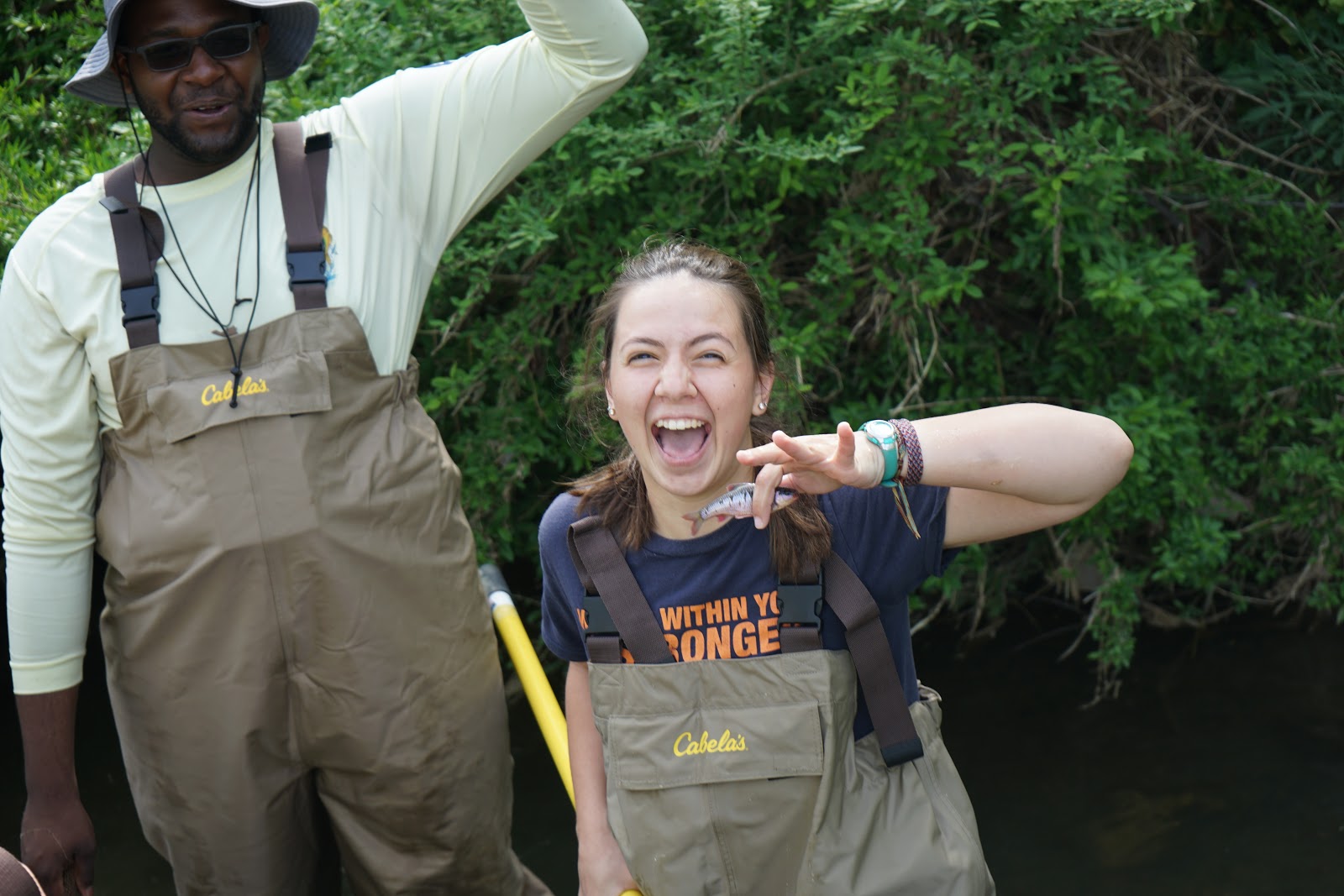
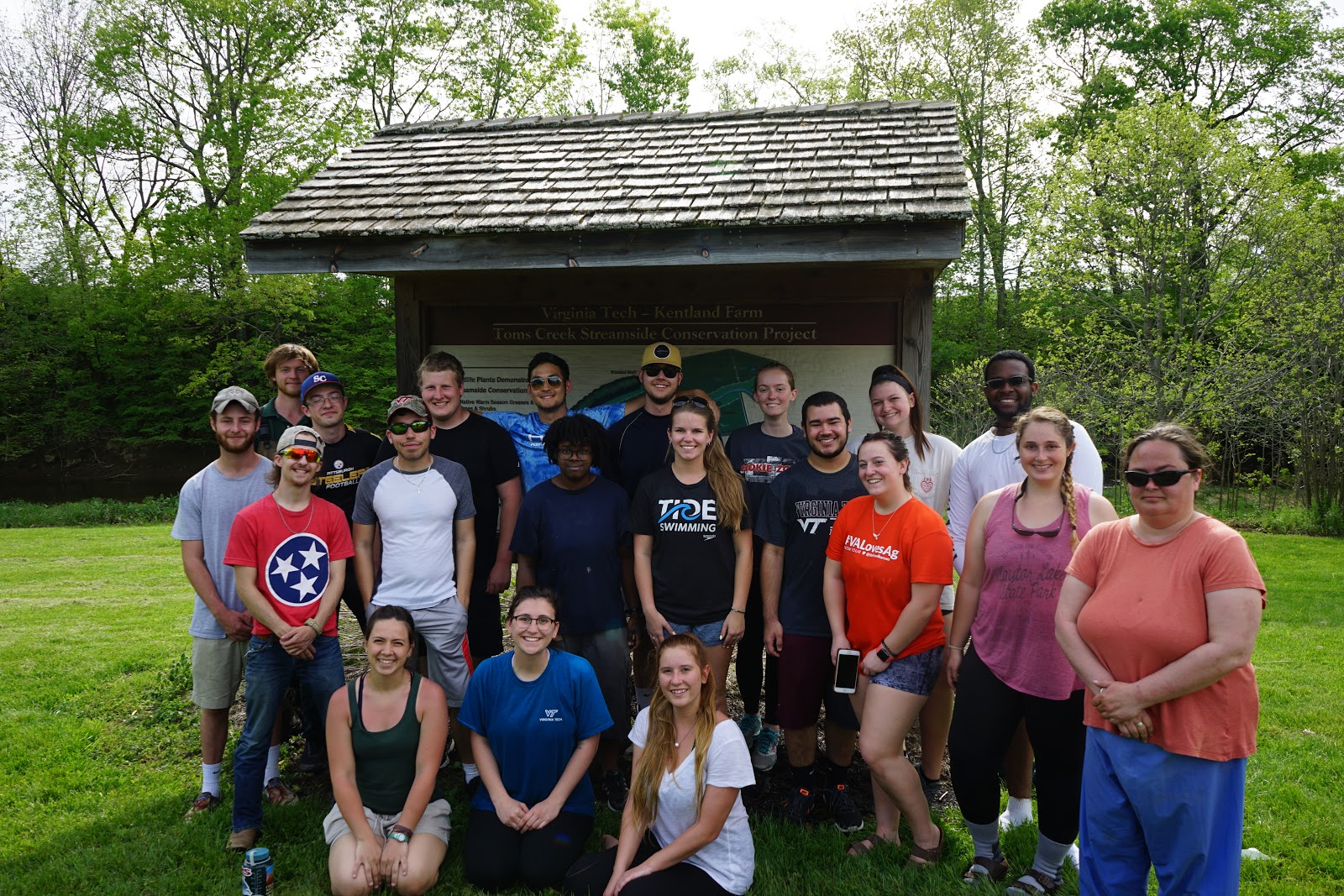
Ichthyology class at the wet and sweaty end-of-semester field trip. 
Relevance in Virginia Tech’s strategic plan means commitment to a comprehensive global land grant mission and transdisciplinary learning and engagement.  Every day we connect with students in ways that transcend the classroom experience. It's called the Virginia Tech Difference, which relies on a globally relevant campus experience that has a life-long influence on students. At the annual meeting of the American Fisheries Society in Reno, Nevada, I was honored to receive the 2019 Excellence in Public Outreach Award.  Relevance depends on writing for many audiences, and not just for the few scientists in my own narrow field of interest. Even introverts can do public outreach and I hope my students will be inspired to explore innovative methods to reach a broader audience.

Executive Director of AFS, Doug Austen, congratulates me on 2019 Excellence in Public Outreach Award, in Reno, Nevada. Photo by Valerie Orth.
The long-awaited Field Guide to Freshwater Fishes of Virginia was released by Johns Hopkins University Press in September.  Many relevant lessons were learned while creating this new book. Ben Aaronovitch wrote, “There’s nothing quite like Latin for disguising the fact that you’re making it up as you go along.” Seriously, getting all the scientific and common names correct and up-to-date was harder than we expected.   New fish facts are discovered each day and we may not learn about them unless and until we attend fish conferences.  Get a copy and learn what's new in the world of Virginia's freshwater fishes.  Book reviews by Matthew L. Miller,  Bruce Ingram, and Scott Smith (2019) suggest that you shouldn't collect fish without it.
Field Guide to Freshwater Fishes of Virginia was published in September 2019.   Photo by Pat Cooney. 
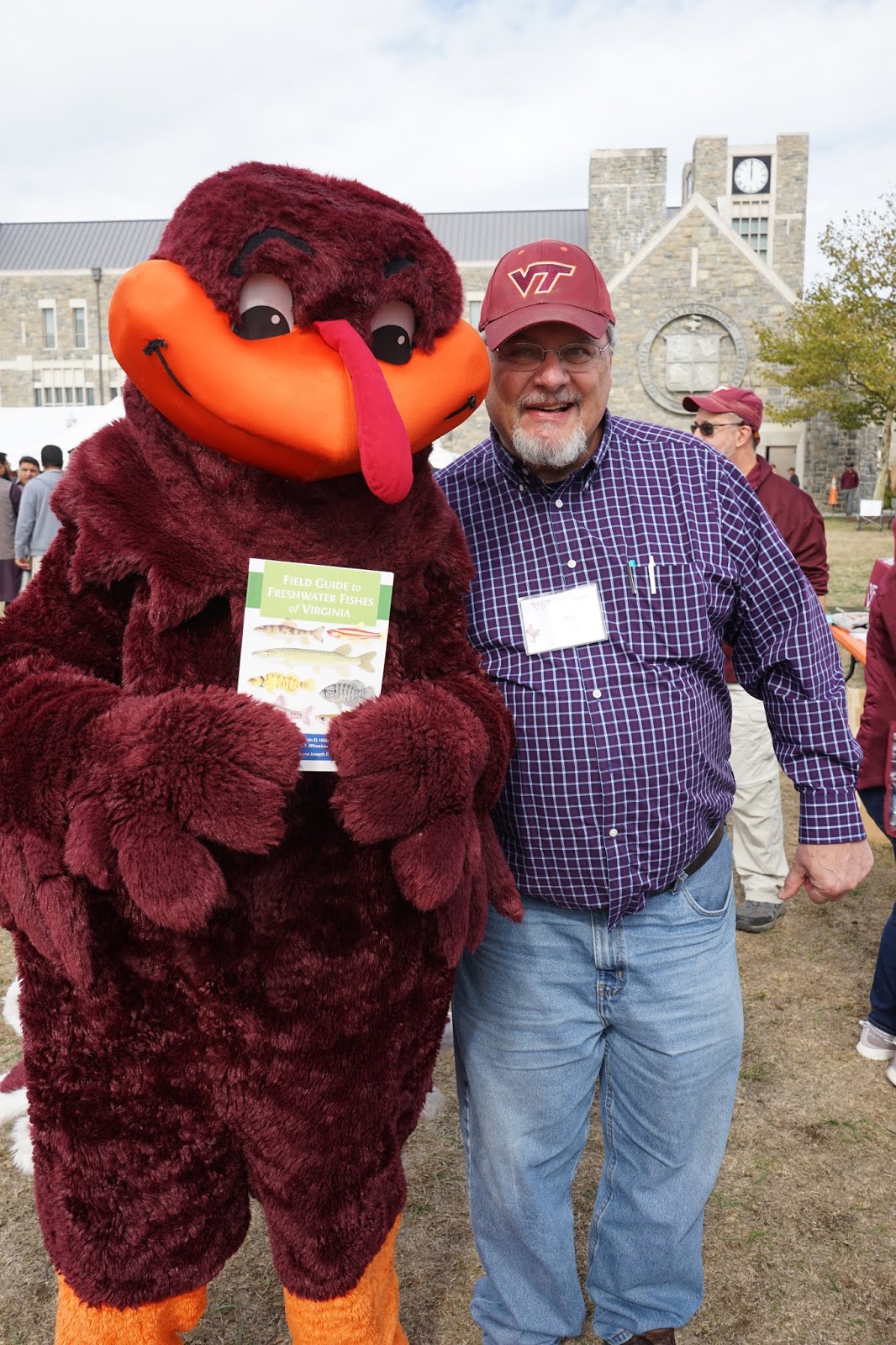
Even the Hokie Bird needs a copy of the Field Guide. Photo by Valerie Orth.
I wrote a 38-page letter (March 15, 2019) to the Federal Energy Regulatory Commission (FERC) in response to their request for input on study plans for re-licensing the Byllesby-Buck Dam Hydroproject Pre-Application Document (FERC NO. 2514). There's no place to put this in the eFAR--it's "other professional activities." However, environmental effects of the hydroproject operations will be altered because the power company installed new gates that allow more control of water levels.  Consequently, new studies are needed during the re-licensing process so that FERC may balance environmental protection and power production.  These two dams block the upstream migrations of many fishes, including the Walleye, a unique strain and the target of restoration. Walleye eggs from this unique river-spawning population have 65% larger volume, an adaptive trait for living in less productive waters. Byllesby and Buck dams flood presumed historic spawning habitats and block their migrations.  For more relevant background on the New River ecosystem, read this conference paper from the 2019 New River symposium
Buck Dam and bypass reach. Photo taken March 20, 2019 by Don Orth.
Former and current lab members are moving on. Corbin and Lindsey Hilling were blessed with the birth of Penelope Hilling (photo below).  Rebecca Bourquin defended her Master's thesis, Genetic Diversity and Population Fragmentation of Chrosomus sp. cf. saylori (Clinch Dace). Ryan McManamay, PhD 2011, left his position at Oak Ridge National Laboratory, and moved to become an Assistant Professor at Baylor University in August.  Zach Moran, BS 2015, began a PhD program at Baylor University.  Hunter Hatcher, BS 2016, left Florida Fish and Wildlife Commission to take a Fisheries Biologist position with the Virginia Department of Game and Inland Fisheries in Farmville.   Skylar Wolf, BS 2017, completed his MS at Oklahoma State University and begins a new job as fisheries biologist at the Utah Division of Wildlife in Logan, Utah.
Penelope Hilling was born on October 30.  Congratulations to Corbin and Lindsey. 
The top viewed blog post of 2019 was How Old Do Flathead Catfish Get? This post was relevant to over 1,700 viewers.  In June, Timmy Dixon posted a photo (below) of a 62 pound Flathead Catfish caught on a trotline in the New River.  This photo generated much interest because Smallmouth Bass, not Flathead Catfish, are the top targeted sport fish in the upper New River.  Flathead Catfish are targeted by trotline fishers in a hidden fishery.  Corbin Hilling removed the otolith and counted 25 annual rings. The hidden population of Flathead Catfish is well known by trot liners and those who SCUBA dive in the New River.  Watch this short underwater video by SCUBA divers in the deep whirl hole in Eggleston, Virginia (video posted by Charles Horton).  Many other relevant writings for the general public were posted in ChesapeakeCatfish.com.
Flathead Catfish caught in July 2019 from New River near Fries, Virginia. For comparison, Timmy Dixon (pictured here) stands 6 feet, 4 inches
Finally, the Fluvial Fishes Lab was renovated in 2019.
Here is a photo during the renovation.
Fluvial Fishes Lab in September.

Relevant Publications in 2019 (I can pluck these right into my eFARS!)


Bugas, P.B., Jr., C.D. Hilling, V. Kells, M.J. Pinder, D.A. Wheaton, and D.J. Orth. 2019.  Field Guide to Freshwater Fishes of Virginia.  Johns Hopkins University Press, Baltimore, Maryland.  200 pp.  
Hilling, C.D., A.J. Bunch, J.A. Emmel, J.D. Schmitt, and D.J. Orth. 2019. Growth and mortality of invasive Flathead Catfish in the tidal James River, Virginia. Journal of Fish and Wildlife Management 10(2):641-652.
Orth, D.J. 2019. Socrates opens a Pandora’s Box of Northern Snakehead issues. Pages 203-221 in J.S. Odenkirk and D.C. Chapman, editors.  First International Snakehead Symposium. American Fisheries Society Symposium 89, Bethesda, Maryland. 
Orth, D.J. 2019. Fish, fishing, and ecosystem services and dysfunctions in the New River.  New River Symposium. Boone, North Carolina.  18 pp.
Schmitt, J.D., B.K. Peoples, L. Castello, and D.J. Orth. 2019. Feeding ecology of generalist consumers: a case study of invasive blue catfish Ictalurus furcatus in Chesapeake Bay, Virginia, USA. Environmental Biology of Fishes 102:443-465.  
Schmitt, J.D, J.A. Emmel, A.J. Bunch, C.D. Hilling, and D.J. Orth. 2019. Feeding ecology and distribution of an invasive apex predator: Flathead Catfish Pylodictis olivaris in subestuaries of the Chesapeake Bay, Virginia, USA. North American Journal of Fisheries Management 39:390-402.  
Schmitt, J.D., B.K. Peoples, A.J. Bunch, L. Castello, and D.J. Orth. 2019. Modeling the Predation Dynamics of Invasive Blue Catfish Ictalurus furcatus in Chesapeake Bay. Fishery Bulletin 117(4):277-290.  
Stang, S.A., C.D. Hilling, and D.J. Orth. 2019. Lessons learned from 35 years of students organizing the mudbass classic. Fisheries 44(3):115-117.
  
There are so many ways to disseminate research findings so that they are are relevant to broader segments of society (below).  The bewildering number of options may discourage one from the activities entirely. However, it is our personal responsibility to make choices about the audience and mode of communications to be used.   
Possible approaches to research dissemination arrayed by size of audience and mode of communication.  From Gould et al. (2019).
So it's time to celebrate the end of 2019 and the end of the decade of the 2010s. This 'Slow Professor' plans many more timeless times, detours, and delays in 2020.  Timeless times are needed for me to think critically and creatively. These slow times counteract the notions of efficiency, productivity, and speed that creep into the corporatized university.  Things may not go as hoped, but that's okay.
from Berkeley Breathed

References

Berg, M., and B.K. Seeber. 2017. The Slow Professor: Challenging the Culture of Speed in the Academy. University of Toronto Press. 136 pp.  
Gould, R.K., K.J. Coleman, D.H. Krymkowski, I. Zafira, T.Gibbs-Plessl, and A. Doty. 2019. Broader impacts in conservation research. Conservation Science and Practice DOI: 10.1111/csp2.108
Smith, S. 2019. Review of Field Guide to Freshwater Fishes of Virginia. American Currents 44(4):27. 
Watterson, B. 1988. The Essential Calvin and Hobbes: A Calvin and Hobbes Treasury.  Andrew McMeels Publishers, 256 pp.