Monday, May 6, 2013

Advantages of Reproductive Strategies in Hermaphroditic Fishes, by Britney Kreiner


When the word hermaphrodite is uttered, it is often in hushed tones with references to grotesque, disparate rumors. In the world of biology, however, hermaphroditism is known to be a common and successful reproductive strategy among a wide variety of organisms. Plants, invertebrates, and many species of fish use hermaphroditism to ensure that their genes make it on to the next generation of individuals. This term in itself is not easily defined as there are many different forms; sequential, simultaneous, and self-fertilizing are a few of many broad classifications. In general, a hermaphrodite is an organism with both male and female sex organs during some stage in its life cycle. In order to fully understand hermaphroditism in fish and its evolutionary advantages, or lack thereof, we must look at the different forms and the varying ways that fishes use them. Hermaphroditism in fishes comes at a price for those that use it, but for many species it is the only way to ensure survival in a harsh world.
A fantastical depiction of a hermaphrodite in Le Louvre. (Photo by Paul H.)
Most common in fishes is sequential hermaphroditism, meaning that the fish starts life as one gender and at some point, due to genetic or environmental factors, morphs into the opposite sex. The process of changing sex from female to male is called protogyny, and this is the most widely used form of sequential hermaphroditism (75%). The other form, switching from male to female, is termed protandry (25%). Groupers (Serranidae), porgies (Sparidae), wrasses (Labridae), parrotfishes (Scaridae), angelfishes (Pomacanthidae), and gobies (Gobiidae) are all fish that are protogynous. For example, moon wrasse populations are made up of drab females, drab primary males, and gaudy secondary protogynous males. A secondary male, which began life as a female, may control a harem of females and mate with them individually while the primary males, each born with a single set of male reproductive organs, must aggregate in large groups to spawn with a single female (Robertson and Choat 1974). Examples of protandrous fishes are damselfishes (Pomacentridae). Several species of clownfish live in small hierarchical groups in a single anemone. There is a dominant female, a smaller mating male, and several non-reproducing males with no functional gonads. Only when one of the mating pair dies does the next highest ranking male step up and take on the sexual transformation (Fricke and Fricke 1977). Sequential hermaphroditism is an advantage for many fishes because it allows them to overcome the challenges of population structure biases.
 
Clownfish are protandrous simultaneous hermaphrodites. (Image from www.breedclownfish.com)
Simultaneous hermaphroditism is exactly as it sounds: the fish has both male and female gonads at the same time. While this is relatively uncommon in fishes, there are several species that exhibit this characteristic in the family Serranidae. These fish may take turns fulfilling each role over the course of multiple mating events. For these groups of fishes, this life history could be the only way to ensure the survival of a population. Simultaneous hermaphroditism is an incredibly valuable trait when mating opportunities are rare due to sparse or dispersed individuals—it ensures that when two fish do cross paths, they are always compatible. It also balances the cost of paternal and maternal energy allocation when resources are in short supply. These fish can be said to be the ultimate compromisers and opportunists. While there are obvious benefits for some species of fish in extreme situations, simultaneous hermaphroditism can be difficult to develop because individuals must evolve congruent yet identical genitalia (Michiels 1998).
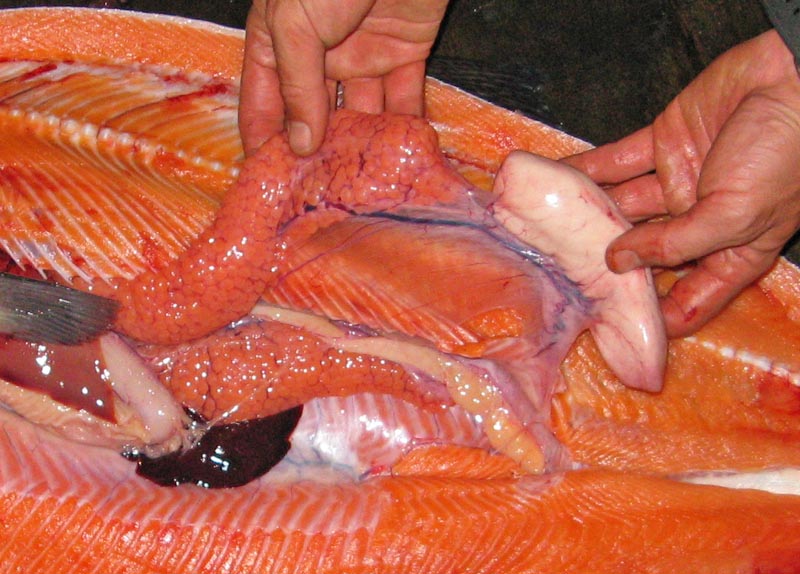
Internal anatomy of a simultaneously hermaphroditic salmon. (Image from http://www.piscatorialpursuits.com

It is rare to find a fish in nature that is a self-fertilizing simultaneous hermaphrodite. When an organism uses its own sperm to fertilize its own eggs, this process is called selfing and results in genetically identical offspring, also known as clones. Far from science fiction, this act insures that an individual’s genes are passed on regardless of circumstance. The Mangrove Killifish, for example, is a self-fertilizing hermaphrodite, but there are still some male-only fish in the population. While the mangrove killifish are able to survive and reproduce on their own no matter the conditions, it is the breeding with the males that introduces genetic diversity and ensure the survival and adaptability of the population as a whole (Grageda, et al. 2005). Without this outcrossing of genes, the Mangrove Killifish would vulnerable to extinction due to a very small gene pool. As we can see here, cloning is a useful strategy in situations where fish are far and few between, but it isn’t a proper substitute for traditional breeding practices.
 
Self-fertilizing Mangrove Killifish Rivulus marmoratus  Photo http://www.practicalfishkeeping.co.uk

In conclusion, hermaphroditism in its many forms is a unique adaptation evolved over the course of history to increase the survivorship of the species that use these methods. In populations of fish where individuals are less likely to come in contact with one another, simultaneous hermaphroditism raises the probability of an encounter with another fish being breeding compatible from 50% all the way to 100%. In sequential species, hermaphroditism plays a crucial role in behavioral rituals and sex ratios. Most oddly of all, self-fertilizing hermaphrodites are able to create a prodigy of their own even if they never come in contact with another of their species throughout their entire lives. Many of these strategies come with trade-offs of their own, especially the genetic issues with selfing hermaphroditism, but in the end it is better to have a compromised existence than none at all. Natural selection has given these species of fish what they need to endure in even the most desperate of circumstances.


References


Fricke, H., and S. Fricke. 1977. Monogamy and sex change by aggressive dominance in coral reef fish. Nature 266:830-832.

Grageda, V. C., et al. 2005.  Differences in life-history traits in two clonal strains of the self-fertilizing fish, Rivulus marmoratus.  Environmental Biology of Fishes 73:427-436.


Michiels, N. C. 1998. Mating conflicts and sperm competition in simultaneous hermaphrodites. Pages 219-254 in T. R. Birkhead and A. P. Moller, editors. Sperm competition and sexual selection. Academic Press, San Diego, California.


Robertson, D. R., and J. H. Choat. 1974. Protogynous hermaphroditism and social systems in labrid fish. Proceedings of the Second International Coral Reef Symposium 1:217-225.

Optimal Optics: A Fish Illusion for Four Eyes, by Ashley Weston


Adapt or die.  The theory of natural selection favors individuals in a population who are the fittest.  The fastest cheetahs catch the most gazelle, the quickest diving hawks seize the most field mice, and the surface dwelling fish with the superior eye sight feeds on the most insects.  Access to limited resources ensures that the fittest genetic material will be passed on to generation to come.  The fishes of the genus Anableps have eyes adapted for optimal function when bisected horizontally by the surface of the water.  Due to this characteristic, there are two separate regions to each eye.  This phenotype has developed from the genotypic advantage attributed to individuals with eyes that are dorsally located close together, so they are superlatively adapted for catching prey.  The four eyed fish?  No, they do not wear glasses, but literally the appearance of four eyes in Anableps is due to two distinct optical systems in each eye.  There are structural and macromolecular differences in both dorsal and ventral corneas, but the distinction between two eyes and four becomes unclear when simply looking at the fish. 
 
In the order Cyprinodontiformes and family Anablepidae, there are three species of fish in the genus Anableps.  The Anableps species are described as being neither primitive nor particularly advanced and are found evolutionarily between Ostariophysi and Perciformes (Schwab, 2001).  The species Anableps anableps (A. anableps) is found in South America from Trinidad and Venezuela to the Amazon delta in Brazil, and live in both freshwater and brackish water ecosystems (Nelson, 1994).  The species Anableps dowei (A. dowei) is found in Central America, and it is distributed in Pacific drainages, from southern Mexico to Nicaragua.  A. dowei can be found in freshwater, brackish, and marine environments (Nelson, 1994).  Lastly, the species Anableps microlepis (A. microlepis) is found in Central and South America from Trinidad and Venezuela to the Amazon delta in Brazil, and is found in freshwater and brackish water (Nelson, 1994).  All three species have similar environmental conditions, and their eyes have adapted in virtually the exact same way (Schwab, 2001).  Anableps are able to keep their body and the ventral portion of their large eyes submerged, while the dorsal portion of the eyes are exposed to the surface of the water.  These morphological characteristics are why these species are named to be in the genus Anableps. The word Anableps derives from the root “ana” meaning up, and the root “bleps” meaning glance or sight (Nelson, 1994). 
 
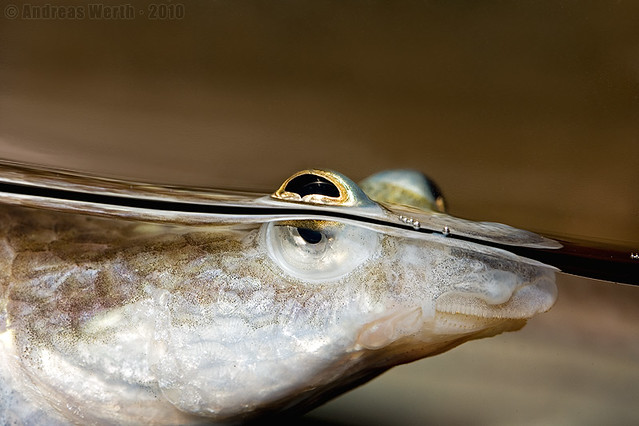
Eyes of Anableps anableps    Photo by Andreas Werth  Flickr.com


The unique eyes of Anableps have raised many questions about how they function, and what causes them to be different.  Why is there an illusion of four eyes?  Anableps fish have the ability to see above and below the water at the same time.  Each eye contains two pupillary apertures and a divided cornea.  The aerial pupil is larger than the aquatic pupil.  The eye prevents a double image from forming through an iris flap that divides the apertures in two across the midline (Schwab, 2001).  There are two retinas, each containing a single optic nerve.  The ventral retina is larger and thicker, and contains double the number of cones compared to the thinner dorsal retina.  The dorsal retina receives upwelling light filtered through water and dissolved solutes that alter spectral content, and the ventral retina receives aerial light unfiltered by water (Owens, 2012).  The eyes must receive broad-spectrum light from the surface, and dimmer, narrow-spectrum light from under water.  Wavelength sensitivity differs in the dorsal and ventral retinas of each eye, enabling Anableps to use their photoreceptors according to which region the light is received from.  The enhanced sensitivity is advantageous to Anableps in the brackish waters of the mangrove forests and river deltas, as these often contain dissolved organic matter that shifts light abundance to longer wavelengths (Owens, 2012).


The variations between the dorsal and ventral region of each eye have proven that the dorsal region is more essential.  By recording electrical discharges in the optic tectum in response to a small optic stimulus in the visual field, the dorsal system shows to have better acuity, and it is more important to the species (Schwab, 2001).  The corneas of the eye display that there is roughly twenty layers of epithelial cells in the dorsal cornea, while the relatively thin ventral cornea contains about five epithelial cell layers.  The thicker layer of cells in the dorsal cornea accounts for the fact that it is positioned facing upward and directly exposed to the sunlight.  A greater number of epithelial cells may provide additional chromophores to absorb UV light (Swamynathan, 2003).  The vast adaptation of the epithelial cells enhances the argument that Anableps eyes are supremely adapted to their specific environment and surface feeding.

When compared to a common, constantly submerged fish, such as Danio rerio (zebrafish), the full structural and macromolecular differences in A. Anableps may be accounted for.  Anableps have developed many morphological adaptations to become excellent surface feeders, specifically pertaining to their vision.  In addition to having an abnormally thick dorsal corneal epithelial layer, they also have a high concentration of glycogen in the dorsal corneal epithelium.  Corneal epithelial cell glucose and glycogen concentrations have been shown to increase upon exposure to UV radiation, suggesting Anableps dorsal corneal epithelial cells accumulate glycogen in response to UV radiation.  The thickness also aids with aerial vision through a refractive role, and protects against desiccation when exposed to air because Anableps lack a tear layer and eye lids (Swamynathan, 2003).  This remarkable feat allows Anableps to remain at the surface of the water for the maximum amount of time before having to submerge to moisten the epithelium and wet the gills.  Dissimilar to Anableps, Danio rerio must always swim below the water surface, using only aquatic vision.

Anableps will feed above the water surface, at the water surface, and in the water column.  They use their aerial vision to leap out of the water and attack insects, and they use aquatic vision to eat smaller fish.  Although they have excellent aerial vision, they must still evade predators.  While feeding on the surface, Anableps expose their light underside, making themselves vulnerable to aquatic predators.  They are also susceptible to prey by terrestrial predators when swimming along the surface.  Anableps have developed several strategies to escape predators.  The first includes quick evasion by either submerging to the bottom, or jumping out of the water.  Their eyes can function under water so they have the option of swimming below the surface without being impaired (Nelson, 1994).  Schooling tactics allow these fish to feed in inundated mangrove forests and move by way of tidal migration to utilize available food (Brenner, 2007).  While feeding together, they react according to how others in the school react, allowing there to be a less likely chance that an individual will be picked out by a predator.  Additionally, moving with the tide, Anableps can use the water depth so that they do not end up exposed to predators in shallow water (Schwab, 2001).  Whether Anableps will evolve four true eyes is an evolutionary mystery, but it would support the idea that the populations we are witnessing today have evolved from two eyes, and are on their way to becoming the fittest population possible with four eyes.


References

Brenner, M., & Krumme, U. (2007). Tidal migration and patterns in feeding of the four-eyed fish Anableps anableps L. in a north Brazilian mangrove. Journal of Fish Biology, 70, 406-427. 

Nelson, J. S. (1994). Family Anablepidae - Four-eyed fishes, onesided livebearers & white-eye. FishBase..

Owens, L. G., Rennison, D., Allison, W. T., & Taylor, J. S. (2012). In the four-eyed fish (Anableps anableps), the regions of the retina exposed to aquatic and aerial light do not express the same set of opsin genes.  Biology Letters, 8, 86-89
.
Schwab, R. I., Ho, V., Roth, A., Blankenship, T. N., & Fitzgerald, P.G. (2001).  Evolutionary  attempts at four eyes in vertebrates. Transactions of the American Ophthalmic Society, 99, 145-157.
 
Swamynathan, K. S., Crawford, M. A., Robison, W. G., Kanungo, J., & Piatigorsky, J. (2003). Adaptive differences in the structure and macromolecular compositions of the air and water corneas of the “four-eyed” fish (Anableps anableps). The Journal of the Federation American Societies for Experimental Biology, 17, 1996-2005.