Sunday, February 9, 2014

On Becoming An Ichthyologist, by Don Orth


Even if you do not see yourself in a career as an Ichthyologist, your learning will be improved by assuming the role and seeking to become an Ichthyologist.   Just accepting the notion that "I am a novice" or "I am becoming" will make it easier for you to ask questions.  My own thinking about becoming an Ichthyologist began a long time ago.
 
I was born and raised on the south side of Chicago, in a neighborhood known as West Englewood.  Fish was what we ate on Fridays, not a potential career aspiration.  At age 10 I got my first paper route, delivering the Chicago American in the Marquette Park and West Englewood neighborhoods.  On weekends, my buddy Michael D. and I would lash our fishing poles to our bikes and ride to Marquette Park, where we fished in the park lagoon (catch and release before it was fashionable).    

In the summers we took the CTA bus to Rainbow Beach to cool off and pretend to swim in Lake Michigan.  In 1967, we were surprised when our beach visits meant we had to endure smells from huge windrows of dead alewives that now dominated the beach.  No one knew why these fish were dying, ruining our beach experience.   I was curious and that curiosity about what is happening underwater has driven me ever since.  Many years later I read a report written by Edward Brown, U.S. Bureau of Commercial Fisheries; he described the massive fish kills that occurred throughout the lake in 1967 and summarized observations without confirming a cause (Brown 1968).  We will discuss this die off phenomenon when we discuss Homeostasis in Fishes.  
 A Live Alewife Alosa pseudoharengus  Photo: Jim Negus
I enjoyed fishing and used my weekly paper-route earnings to buy Outdoor Life.   One day I read an ad that referred to people called Ichthyologists who studied fishes.  This was my Archimedes Eureka moment.    Eureka! I have found it!   It was an early discovery that there were people who made their living by studying fish.  Imagine that!  I have been becoming ever since.
The notion behind "becoming" is known as the community of practice (CoP) model, developed and studied by cultural anthropologist, Jean Lave, and educator Etienne Wenger (Wenger 2007).   This is a shift from "learning from the teacher" and involves learning through engagement in a community of practice.   As a novice, we are at the periphery of the community of practice and there are rituals, practice, and collaboration that we need to engage with to become bona fide members of the community of practice.   In thinking through the learning activities that I assign, every action is a chance for you to move from a position from the periphery of this CoP to a more involved part of the CoP.   Mastery takes repetitive practice with others.  
 
Graphic depiction of the community of practice model of Jean Lave and Etienne Wenger. Source. 
How can you join the CoP?   Volunteer with other fish-heads and adopt a curious attitude; everyone has something to teach you.    There are more fish-heads on the Virginia Tech campus than there ever were in my West Englewood neighborhood.  Everything we do is easier if we do it in a group.   Catch you own fish.  Learning to outwit an animal with a brain as small as a pea is essential to keep you humble as you become a proud Ichthyologist.   Watch fish.  Keep fish alive in an aquarium.   Make intelligent observations about fish.   Photograph fish.  Post stories about what you are learning on Facebook, Twitter, Flickr, Pinterest, Instagram, or whatever networks you like.  Once you start to share, you will connect with others in the Fish-head CoP.   If you do not contribute to the learning of others, you are not a member of the CoP, you are just another stalker at the periphery of the group.
 

Joining the Fish-head community of practice may resemble joining a religion and you will find that you begin to study religiously!   In Religion for Atheists, Alain de Botton points out that there's a great difference between a sermon and a lecture!  Religions realize that we need ritual, repetition, and an emphasis on the practical value of lessons. You will need to be curious and develop a ritual of observing fish, collecting and practicing the tasks that all Ichthyologists do.  The French naturalist Constantine Rafinesque once wrote  "The art of seeing well, or of noticing and distinguishing with accuracy the objects which we perceive, is a high faculty of the mind, unfolded in a few individuals, and despised by those who can neither acquire it, nor appreciate its results."

You cannot obtain the tacit, know-how, and thinking knowledge of an Ichthyologist from reading a text alone.  Textbooks are filled with the explicit kinds of knowledge.  What you need most of all is to participate in the rituals we practice and do these many times, each time gaining that tacit knowledge held within the community of practice we refer to as Fish-heads. 
 
I am still becoming an Ichthyologist.  When you read a text, do not read it as a student, read it as one who is becoming an Ichthyologist.  When you dissect a new fish specimen, do it not as a student, but as one who is becoming an Ichthyologist.  Every new fish specimen you encounter is a part of your journey toward becoming an Ichthyologist.

References
Brown, E. H., Jr.  1968.  Population characteristics and physical condition of alewives, Alosa pseudoharengus, in a massive dieoff in Lake Michigan, 1967.  Great Lakes Fishery Commission Technical Report 13.
Wenger, Etienne (.ca 2007) Communities of practice. A brief introduction. Communities of practice [http://wenger-trayner.com/theory/  Accessed February 8, 2014].
Three key dimensions of any community of practice are (1) kind of knowledge, (2) community interaction and identity, and (3) integration of sharing knowledge and work.    Source.

Friday, May 17, 2013

On the value of zooming in, by Don Orth


The semester is over, final grades are submitted, and all but the graduating students have left campus.    At this point, students of Ichthyology may be more frustrated and less fascinated by the enormous diversity of fishes.    In lab we introduced students to over 74 of the 515 families of fishes in the world.     From the monospecific Amiidae (bowfin) to the species-rich Cyprinidae (minnows and carps), each group of fishes presents different challenges for identification.   Some, such as the gars are so unique that you will never misidentify one, whereas others, in particular the sculpins, are easily confused even by the experienced fish specialists.   The week before the final lab practical we visited and sampled two tributaries of the New River drainage.    Over 89 fish taxa are known in the upper New River drainage and 48 are native and 8 are endemic.   When sampling a single reach we are, in fact, zooming in from the zoogeographic pool of likely fishes to the specific assemblage that is present at the site.   Here local factors, such as elevation, channel slope, temperature, and physical habitat will influence the fish species we encounter.   Small high-elevation mountain drainages may have only a few species, such as brook trout, blacknose dace, and mottled sculpin, while the larger downstream reaches may support 12 to 15 species.     In diagnosing fish species, I also preach the value of zooming in.    

Photo of Blacknose Dace Rhinichthys atratulus, Sinking Creek near Newport, Virginia. Photo: D. J. Orth


For weeks the students were learning characteristics and annotated their specimens based on examination of specimens preserved in ethanol.   Often the name was in the jar - no challenge there.  As I watched the students faced with an unknown live and squirming specimen, I encouraged them to “Tell me what you see. What do you think it is?”   Students have been learning to start with the bigger categories and drill down to likely species by zooming in on diagnostic characteristics.     For example, the minnows can be bewildering until the student learns to zoom in on characteristics of the mouth, or scale size and pattern.   Most minnows have a small terminal mouth, so any variation from this is important.   A ventral mouth may mean a Rhinichthys dace, Kanawha minnow, cutlips minnow or central stoneroller.   Zooming in on the characteristics of the mouth will quickly reveal the diagnostic character of the species.     For example, the cutlips and tonguetied minnows are distinguished for all other minnows by its three-lobed lower jaw with middle lobe sticking out like a tongue (photo on left).  This adaptation allows it to capture miniscule gastrods and insect larvae, which it scrapes from rocks, and also assists the male cutlips minnow who builds a nest of small pebbles; click here to view a video.     The lower jaw of the Central Stoneroller has a hard cartilaginous ridge (photo on right) which it uses to scrape ooze from the stream bottom.  It gets its name by the habit of the male excavating a nest by moving gravel with its nose


Close-up photos of the ventral view of the mouth of  Cutlips Minnow Exoglossum maxillingua  (Photo by Dylan Hann) and Central Stoneroller Campostoma anomalum   (Photo by D. J. Orth.)

It is spring time and the males of many species are showing the special secondary sexual characteristics.   The Nocomis chubs and Campostoma stonerollers already have tubercles on the heads, and white suckers and hog suckers have tubercles on anal and caudal fins.     The male fantail darter Etheostoma flabellare  develops little egg mimics at the tips of his spiny dorsal fin.  The fantail darter selects a large flat cobblestone in riffles for a nest site and the female lays eggs on underside of the cobble while the male fertilizes and guards the developing embryos.      The egg mimics are a bit of visual trickery as the females searching for a suitable mate and nest site see there are already eggs in the nest.   In fact, in an elegant experiment, Knapp and Sargent (1989) demonstrated that females preferred males with eggs over males without eggs, and furthermore that females preferred males with egg-mimics over males without egg-mimics.    Therefore, female choice played a major role in the evolution of the egg-mimics in fantail darters.

Fantail darter Etheostoma flabellare  from Sinking Creek near Newport, Virginia.  Note the egg mimics at tips of spines of first dorsal fin in this male specimen.   Photo by D. J. Orth
The week after our field trips, a spring storm dumped heavy rains and these easily-waded streams now overflowed their banks.   The large flat cobblestones selected as nest sites by the fantail darter are highly resistant to being entrained and mobilized in these common spring floods. The cavity under the cobblestone is also inaccessible to potential egg predators.   I am certain the less-selective male fantail darters soon learn the hard way the value of finding a nest site below a big, stable cobblestone.  


The sculpins (Cottidae) are a group of bottom-dwelling fishes that are widely distributed in temperate regions of North America and Eurasia.  They exhibit extreme variation in morphology and species are difficult to characterize and identify.  While the group is not as species-rich as either the darters or minnows,  their identification may stymie the novice Ichthyologist until s/he learns to zoom in on the characteristics.   Streams we sampled had both the Mottled Sculpin Cottus bairdi and the Kanawha Sculpin Cottus kanawhae (formerly considered a subspecies of banded sculpin Cottus carolinae carolinae Robins 2005).       Here I include close-up photos to show the pigmentation patterns of the dorsal fins and chins. 


Dorsal fins of the Kanawha Sculpin (top) and the Mottled Sculpin (bottom).  Photo by D. J. Orth


Sculpins are so well camouflaged to match the stream bottoms that anglers are seldom aware that the streams they fish are loaded with sculpins.   Some fly tiers have learned to mimic the color and pattern of the sculpin with streamer patterns.  In fact the world-wide favorite Muddler Minnow was created to mimic a sculpin.    These are effective for a variety of game fishes as long as they are fished right on the bottom and fished slowly, with occasional twitches to mimic escape action.    

Chins of the Mottled Sculpin (left) and the Kanawha Sculpin (right).  Photos by D. J. Orth

The family Cyprinidae (minnows and carps) is one of the largest families of fish in the world (over 2,400 species in the last authoritative count) and these are often the most abundant fishes in freshwater streams.   The diversity of the Cyprinidae is truly impressive on a global scale and when we zoom in on the Virginia waters we have 67 species.    All the minnows have one dorsal fin, pelvic fin in abdominal position,  pectoral fin low on the body, and lack an adipose fin.   Beyond that one needs to zoom in the lower jaw, tiny barbels, pigment patterns, scale size and pattern, and even fin ray counts.  The first fish we captured in Toms Creek was a very small minnow, a rosefin shiner Lythrurus ardens.   I didn't think the students would be able to identify it, but when they zoomed in to observe the diagnostic characteristics, they nailed it.


Telescope Shiner  Notropis telescopus from Sinking Creek near Newport.  Photo by D. J. Orth
White Shiner Luxilus albeolus from Sinking Creek near Newport.   Photo by Jessica Dodds.
Close up photos of the dorsal scales of the Telescope Shiner (top) and lateral line scales of the White Shiner (bottom).  Photos by D. J. Orth.

Telescope shiner and white shiner are depicted in these photos    --   when I first learned Ichthyology these two were in the same genus Notropis, a lot of things were easier back then.   But when we zoom in, to the scale patterns we see important differences.   Telescope shiner had dark scale margins in the nape and dorsolateral scales and the scales are larger and irregularly shaped, leaving a distinct zig-zag line pattern.   The White Shiner is in the genus of high-scale shiners (Luxilus) so named for the exposed scales in lateral line that are twice as high as the exposed width -- something you only notice when you zoom in.  


We encountered two species of Rhinichthys, the daces.  The genus name Rhinichthys translates to "snout fish" in reference to the prominent snout.   Here zooming in requires the observer to be more precise about the pattern or proportions.    The blacknose dace has a blacknose, the longnose dace has a longnose, yet the correct identification requires us to be more precise about “how long is the long nose?”   We must zoom in to interpret.     The two species co-occur in Ridge-and-Valley and Blue Ridge streams and are often easy to confuse. 

Photos of head (lateral view) and ventral view of mouth of Longnose Dace Rhinichthys atratrulus.  Photos by D. J. Orth.


There is much value in zooming in and ever since my close-up vision was compromised by middle-age, I have had to rely on a magnifying lens to assist me when zooming in.      There is plenty to do while sampling for fish in our local streams or sorting through a net full of fish.   Zooming seems like one of the last things to do after obtaining a sample, but it is an essential part of the fascinating study of the fishes.    To my Proud Ichthyology Students of 2013, go forth and catch many fishes, use your newfound knowledge to earn an honest living, share  your enthusiasm for fish and their habitats with family and friends, never be satisfied with the status quo, and know when you need to zoom in.


References

Knapp, R. A.,  and R. C. Sargent.   1989.  Egg-mimicry as a mating strategy in the fantail darter, Etheostoma flabellare: females prefer males with eggs.  Behavioral Ecology and Sociobiology 25:321-326.


Robins, C. R.  2005.  Cottus kanawhae, a new cottid fish from the New River systems of Virginia and West Virginia.   Zootaxa 987:1-6.


Wednesday, May 8, 2013

We have a winner -- Fishing Lure Design

This extra credit assignment was designed to integrate your knowledge of fish anatomy, sensory systems, feeding, and water conditions to create an effect lure design. All students were provided the same size wooden lure blank. This extra credit assignment was designed to encourage students to apply both knowledge of fish and creativity to design a lure to catch fish. 
Students  submitted a completed lure (without hooks and hardware) with a 200-word description and the design was evaluated based on (1)  marketing appeal,  (2)  mimicry, (3) rationale for design and lure name, and (4) artistry.   
The entries included such notable names as the American Shad Popper, Tubular Tubercle Chub, The Weakest Link, Royal Gramma Grabber, Northern Fire-glacier Minnow, and the Heart Snatcher.     The top scoring entry was the Alosa, a 6 inch, 1.5 ounce topwater bait, handcarved to mimic the Alosa forage fish.  
The Alosa.  Note the individually defined scales, countershading color pattern, and pearlescent paint finish.  This lure is sealed with several coats of lacquer  and ready to to be outfitted with treble hooks and fished immediately.  Britney Kreiner
Other contenders for top lure design include the following:
Tubular Tubercle Chub with life-like scales and eye popping refracting color to trick any predator.  Caitlin Worsham

The Heart Snatcher is designed with vibrant colors and silvery sheen to mimic the Rosyside Dace.  Jeanne Change
Musky Pop-R is designed to be a top-water plut and spits and throws water.  Its flared gill operculum provides a convincing silhouette.   Zach Moran.

This pencil -popper style lure simulates a fish fleeing at the water's surface. The body coloration mimics the American Shad with blueish yellow top coat and silvery white underside.   Ashley Weston

Congratulations to the winner and all entrants who spent time thinking about how to catch fish.  

Monday, May 6, 2013

Advantages of Reproductive Strategies in Hermaphroditic Fishes, by Britney Kreiner


When the word hermaphrodite is uttered, it is often in hushed tones with references to grotesque, disparate rumors. In the world of biology, however, hermaphroditism is known to be a common and successful reproductive strategy among a wide variety of organisms. Plants, invertebrates, and many species of fish use hermaphroditism to ensure that their genes make it on to the next generation of individuals. This term in itself is not easily defined as there are many different forms; sequential, simultaneous, and self-fertilizing are a few of many broad classifications. In general, a hermaphrodite is an organism with both male and female sex organs during some stage in its life cycle. In order to fully understand hermaphroditism in fish and its evolutionary advantages, or lack thereof, we must look at the different forms and the varying ways that fishes use them. Hermaphroditism in fishes comes at a price for those that use it, but for many species it is the only way to ensure survival in a harsh world.
A fantastical depiction of a hermaphrodite in Le Louvre. (Photo by Paul H.)
Most common in fishes is sequential hermaphroditism, meaning that the fish starts life as one gender and at some point, due to genetic or environmental factors, morphs into the opposite sex. The process of changing sex from female to male is called protogyny, and this is the most widely used form of sequential hermaphroditism (75%). The other form, switching from male to female, is termed protandry (25%). Groupers (Serranidae), porgies (Sparidae), wrasses (Labridae), parrotfishes (Scaridae), angelfishes (Pomacanthidae), and gobies (Gobiidae) are all fish that are protogynous. For example, moon wrasse populations are made up of drab females, drab primary males, and gaudy secondary protogynous males. A secondary male, which began life as a female, may control a harem of females and mate with them individually while the primary males, each born with a single set of male reproductive organs, must aggregate in large groups to spawn with a single female (Robertson and Choat 1974). Examples of protandrous fishes are damselfishes (Pomacentridae). Several species of clownfish live in small hierarchical groups in a single anemone. There is a dominant female, a smaller mating male, and several non-reproducing males with no functional gonads. Only when one of the mating pair dies does the next highest ranking male step up and take on the sexual transformation (Fricke and Fricke 1977). Sequential hermaphroditism is an advantage for many fishes because it allows them to overcome the challenges of population structure biases.
 
Clownfish are protandrous simultaneous hermaphrodites. (Image from www.breedclownfish.com)
Simultaneous hermaphroditism is exactly as it sounds: the fish has both male and female gonads at the same time. While this is relatively uncommon in fishes, there are several species that exhibit this characteristic in the family Serranidae. These fish may take turns fulfilling each role over the course of multiple mating events. For these groups of fishes, this life history could be the only way to ensure the survival of a population. Simultaneous hermaphroditism is an incredibly valuable trait when mating opportunities are rare due to sparse or dispersed individuals—it ensures that when two fish do cross paths, they are always compatible. It also balances the cost of paternal and maternal energy allocation when resources are in short supply. These fish can be said to be the ultimate compromisers and opportunists. While there are obvious benefits for some species of fish in extreme situations, simultaneous hermaphroditism can be difficult to develop because individuals must evolve congruent yet identical genitalia (Michiels 1998).

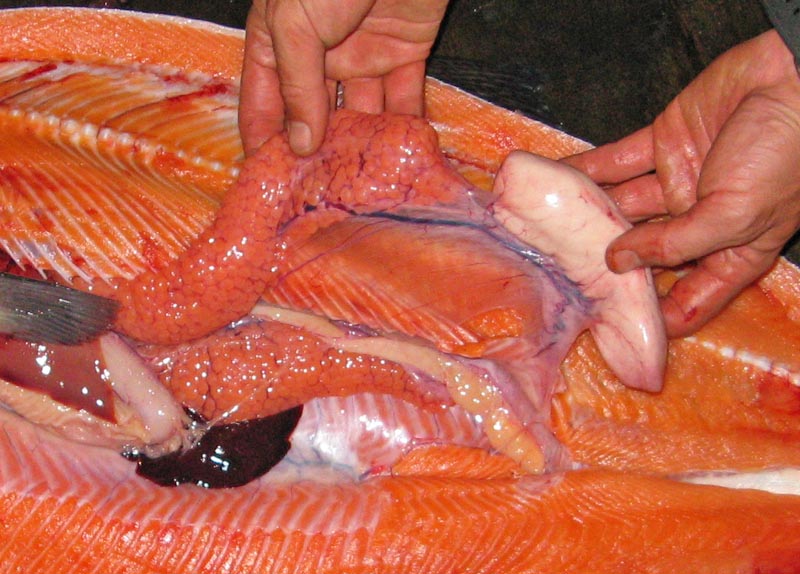
Internal anatomy of a simultaneously hermaphroditic salmon. (Image from http://www.piscatorialpursuits.com

It is rare to find a fish in nature that is a self-fertilizing simultaneous hermaphrodite. When an organism uses its own sperm to fertilize its own eggs, this process is called selfing and results in genetically identical offspring, also known as clones. Far from science fiction, this act insures that an individual’s genes are passed on regardless of circumstance. The Mangrove Killifish, for example, is a self-fertilizing hermaphrodite, but there are still some male-only fish in the population. While the mangrove killifish are able to survive and reproduce on their own no matter the conditions, it is the breeding with the males that introduces genetic diversity and ensure the survival and adaptability of the population as a whole (Grageda, et al. 2005). Without this outcrossing of genes, the Mangrove Killifish would vulnerable to extinction due to a very small gene pool. As we can see here, cloning is a useful strategy in situations where fish are far and few between, but it isn’t a proper substitute for traditional breeding practices.
 
Self-fertilizing Mangrove Killifish Rivulus marmoratus  Photo http://www.practicalfishkeeping.co.uk

In conclusion, hermaphroditism in its many forms is a unique adaptation evolved over the course of history to increase the survivorship of the species that use these methods. In populations of fish where individuals are less likely to come in contact with one another, simultaneous hermaphroditism raises the probability of an encounter with another fish being breeding compatible from 50% all the way to 100%. In sequential species, hermaphroditism plays a crucial role in behavioral rituals and sex ratios. Most oddly of all, self-fertilizing hermaphrodites are able to create a prodigy of their own even if they never come in contact with another of their species throughout their entire lives. Many of these strategies come with trade-offs of their own, especially the genetic issues with selfing hermaphroditism, but in the end it is better to have a compromised existence than none at all. Natural selection has given these species of fish what they need to endure in even the most desperate of circumstances.


References


Fricke, H., and S. Fricke. 1977. Monogamy and sex change by aggressive dominance in coral reef fish. Nature 266:830-832.

Grageda, V. C., et al. 2005.  Differences in life-history traits in two clonal strains of the self-fertilizing fish, Rivulus marmoratus.  Environmental Biology of Fishes 73:427-436.


Michiels, N. C. 1998. Mating conflicts and sperm competition in simultaneous hermaphrodites. Pages 219-254 in T. R. Birkhead and A. P. Moller, editors. Sperm competition and sexual selection. Academic Press, San Diego, California.


Robertson, D. R., and J. H. Choat. 1974. Protogynous hermaphroditism and social systems in labrid fish. Proceedings of the Second International Coral Reef Symposium 1:217-225.