Showing posts with label spawning. Show all posts

Friday, May 26, 2017

Grunnion React to Moon Phases, by Cole Reeves

As the sun sets off the California coast, sky above and sea below are burnished with its soft orange glow. Beneath these gently sunlit waters, a certain little planktivorous fish pursuits its tiny prey, bright flashes in the delicately luminous sea from the silver stripe along its length. As the sun continues to set and the moon begins to rise the fish continues to pursuit its prey, for the fish is preparing for a time, now imminent, during which strenuous effort will be required. Above the grunion the moon, either luminously full or bathed in the stygian gloom of the new moon, heralds a change that will dictate a radical alteration in the behavior of the mature grunion, for the full or new moon coincides with the amplitudes of the tides reaching a zenith; this tidal zenith intimates within the mind of the grunion, however dimly the thought is realized, that the apical moment of the life history of the grunion is at hand and the time to perform the peculiar spawning ritual for which the grunion are known is soon to come. The grunion senses the descending onrush of water returning to the sea from the shore, and being attuned to its force it can sense that the spring tides are in their full strength, leading to a cascade of altered behavior associated with the spawning of the grunion.

In ordinary times, the grunion at night form relatively small groups, but during the time of the grunion’s spawning the grunion form huge schools of extraordinary density. As the grunion, in their densely packed ranks, venture forth towards the shore the brown pelicans and seagulls that had mustered their own ranks in anticipation of just this event sprung from their ambush in the shoreside rocks to descend on the bright silvery huddle. The pelicans and gulls plunge into the sea, taking great mouthfuls of fish, but the grunion appear in such density that their number is hardly depleted. As the gulls and the pelicans continue their assault from above, the grunion face another threat from below as the totoaba strike from the depths. The totoaba, a species of particularly large croaker, lunge voraciously and the grunion form boils at the surface as they flee its eagerly grasping jaws. As the grunion near the shore, they halt just outside the surf zone at which point a few male grunion head for the shore alone to allow the surf to carry them in and across the wave tossed beach. These grunion are called scouts, and for good reason, for if they are interrupted in their expedition the runs often do not materialize. However, if the scouts do return unmolested, the grunion run begins in earnest and the grunion move together, allowing the waves to carry them inshore, then actively fighting against the wave as it returns to the sea so that the grunion may remain onshore to perform the actual act of reproduction and the at first incomprehensible ritual that precedes it.

Grunion Spawning. Jeff Foott/Discovery Channel Images/Getty Images
The grunion run, to an outside observer looking at the writhing mass of fish illuminated in the light of a flashlight or a headlamp, looks like a perfectly chaotic bedlam of flopping silver bodies wriggling in the wet sand, thrashing about without any discernible pattern. There is however, a set mating ritual performed by the grunion, beginning with the male grunion bumping its head against the operculum or pectoral fins of the female fish. This signals to the female fish the amorous intentions of the male fish, and in response the female digs its way into the soft sand tail first to create a cavity so that it may lay its eggs therein. The male fish, though far more often several male fish wrap themselves around the female fish, which holds itself upright throughout, and squeeze the female to help the female fish release its eggs. The moment in which the female releases its eggs is proceeded almost instantaneously by the male grunion releasing their milt, which runs down the body of the female to reach the eggs in the cavity below as the female writhes in the soft sand to help the sperm reach the eggs below. The female subsequently extricates herself from both the sand and the tightly clinging males; as she leaves the sand closes around the eggs forming a protective capsule thereby and the male grunion, who often wrap around the female grunion in such numbers that they become buried in the wet sand and must struggle to extricate themselves, similarly untangle themselves. The entire act lasts an average of thirty seconds after which the female grunion, having expended all its eggs, returns to the ocean and the male grunion remain on the beach to seek the attention of further female fish. The actual act of spawning having concluded, the grunion run, which on average lasts just under an hour and a half, ends rather abruptly. Although there are fish coming and going throughout this chaotic period, the density of the fish remains fairly constant until at the very end when the density of fish drops precipitously.

With the coming of the next full or new moon, the final chapter of this unique saga begins to unfold as the next spring tide washes over the now fully developed grunion eggs. The progeny of the previous spring tide’s grunion run feel the ocean water move in and over the restful cavity of damp sand in which they had been incubating and an instinct as primal as their parents’ comes over them. The larval grunion emerge from their eggs and between the spring tide eroding the cavity in which they had been given form and the onrush of water making the sand itself a more tractable medium for movement, the grunion reach the surface of the sand where the tide’s embrace carries them out to sea.

Bibliography

Clark, Frances N. 1925. Fish Bulletin No. 10. The Life History of Leuresthes tenuis, an Atherine Fish with Tide Controlled Spawning Habits. Scripps Institution of Oceanography Library, San Diego.


Griem, J. & K Martin. 2000. Wave action: the environmental trigger for hatching in the California grunion Leuresthes tenuis (Teleostei: Atherinopsidae). Marine Biology (2000) 137: 177.


Leet, W. S. CDFG (California Department of Fish and Game). 2001. California's living marine resources: A status report. Sacramento, California.


Martin, K.L.M., Moravek, C.L., & Walker, A.J. 2011. Waiting for a sign: extended incubation postpones larval stage in the beach spawning California Grunnion Leuresthes tenuis (Ayres). Environ Biol Fish 91: 63-70. doi:10.1007/s10641-010-9760-4

Muench, K. A. 1977. Behavioral ecology and spawning periodicity of the Gulf of California grunion, Leuresthes sardina. The University of Arizona.

Taylor, M. 1984. Lunar Synchronization of Fish Reproduction. Transactions of the American Fisheries Society 113:4, 484-493.


Thomson, Donald A. and Muench, Kevin A. 1976. Influence of Tides and Waves on the Spawning Behavior of the Gulf of California Grunion, Leuresthes sardina (Jenkins and Evermann). Bulletin of the Southern California Academy of Sciences 75:198-205.


Walker, Boyd W. 1949. Periodicity of Spawning by the Grunion, Leuresthes tenuisL, an Atherine Fish. Scripps Institution of Oceanography. Master’s Thesis. UC San Diego, San Diego, California.

Friday, October 7, 2016

Respect the Redhorse, by Don Orth

-->Golden Redhorse Moxostoma erythrurum is one of many unappreciated and little studied fishes in the family of suckers (Catostomidae).  All sucker fishes have downward-directed mouths that create a vacuum pump action to “suck up” small organisms.  In fact, the word, Catostomidae, is derived from Greek roots meaning “downward” and “mouth.”  The genus, Moxostoma, consists of 22 species commonly referred to as redhorse and jumprock suckers.  Fossils of Moxostoma exist from the early Pleistocene, which indicates that the origin of this genus in middle North America dates back to at least 2.5 million years ago.  
Distribution of the Golden Redhorse Moxostoma erythrurum Source USGS
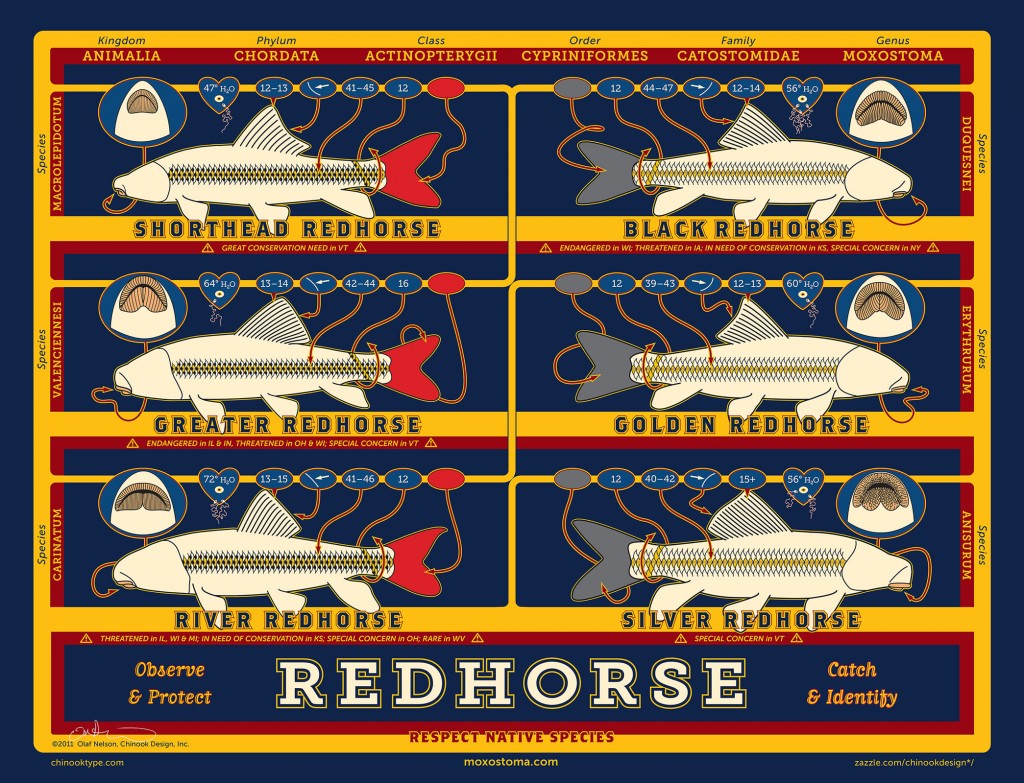
Moxostoma fishes are widespread primarily east of the western continental divide.  The distribution of the Golden Redhorse Moxostoma erythrurum is shown here.  It overlaps with many other species of Moxostoma.    The poster (below) developed by Olaf Nelson should assist in identifying the more common species of Moxostoma.
 
Identification aids for species of Moxostoma, Poster by Olaf Nelson.
 The Golden Redhorse is aptly named for the golden scales on its body.   Other characteristics include a slate gray tail, a concave dorsal fin, and plicate lips.   

Golden Redhorse    Source:  Fishes of Georgia Gallery, Flickr.com
The mouth of the Golden Redhorse can protrude far from the snout during feeding.  Plicate lips of the Golden Redhorse are folded lengthwise (see photo).    Other redhorse suckes have lip textures that are a mix of plicae and papillae (individual bumps).    The lips are covered with taste buds that allow the Golden Redhorse to taste their food before sucking it in.  
Lips of the Golden Redhorse.  Photo by Jim Negus
Food selection and retention is also done by a palatal organ, which is a thick pad covered with taste buds located at roof of the pharynx. Non-food items are detected by the palatal organ and spit out.  Food particles are processed and moved to the esophagus by pharyngeal bones and teeth.    Golden Redhorse will eat many types of crustaceans, immature insects (i.e, caddisflies, mayflies, and midges), fish eggs and larvae, small molluscs and crayfishes.  However, the pharyngeal teeth are smaller and better adapted for processing macroinvertebrates than for crushing molluscs.   
Pharyngeal teeth from Golden Redhorse (A) and River Redhorse Moxostoma carinatum (B)  Source: Bailey (1951)

Golden Redhorse live in streams and rivers and orient their bodies to the current  and the stream bottom.  When observed they may be cruising together in large schools in pools or, if strong currents are present, they are at the stream bottom with their pectoral fins used to increase friction and reduce lift.  

Golden Redhorse spawn in April and May (water temperatures ~ 10 C, or 50 F) and often migrate upstream and into smaller tributaries to locate suitable spawning grounds.   Spawning habitats selected tend to have moderate-to-fast current velocity over gravel-size substrates.  Spawning depths are variable; however, the Golden Redhorse are most visible on shallow spawning habitats.
Map of a spawning area showing locations of territorial males (Kwak and Skelly 1992).
In shallow riffles the spawning males are territorial and females may cruise over spawning areas from a nearby deeper holding area.  Males use tubercles to touch and prod females to release eggs.  Rapid body movements disturb the gravel substrate so that the adhesive, demersal eggs are buried.  Repeated disturbances of gravel leave behind pits. Spawning may occur during day and night and typically two males spawn with one female.   Watch this video of River Redhorse Moxostoma carinatum spawning. Females produce between 5,000 and 25,000 eggs, depending on body size; many newly deposited eggs are quickly eaten by predators.

Boldly striped breeding male Golden Redhorse  Source Page and Johnston (1990)
Breeding male Golden Redhorse develop tubercles.  Breeding tubercles are keratinized epidermal structures that play a role during contact between spawning individuals.  The tubercles on Golden Redhorse develop about the head, body and fins and are formed by many cells that have been keratinized. 
Breeding tubercles on Golden Redhorse.  Source:  Fishes of Georgia gallery, Flickr.com 
The common name, redhorse, comes from a old method of capture called snaring; snaring is now outlawed by many states.   Snaring of redhorse occurred during the spawning  season when the males were holding on territories in shallow water.  Snaring involved   “using a twelve- or fourteen-foot cane  pole tipped with a loop made of a guitar string, with a little piece of lead on the bottom of the wire loop, to catch big river sucker by the tail”  (Brown 2006,   p. 12).   Brown further explains that “The sliding lead weight was to drag along the bottom and so keep the plane of the wire loop at right angles to the current. The overall aim was not to catch the Redhorse by the tail with the noose, or snare, but just behind the gills and in front of the pectoral fins. Too big a loop and it would go completely over the fish without snaring it. When you got the noose positioned just right, you had hold of a strong fish of from three to six or more pounds with head and tail free, and no give in the wire: “They’ll horse, too, they’ll pull. They’re a lot of fun.” "
 
A typical wire-loop apparatus for snaring Redhorse.  Photo by Jim Brown (2006). 
Redhorse spawning in the shallows are also easy targets for sharpshooters with rifles.   Scott County, Virginia, is the only remaining locality that permits the shooting of suckers.  A proposal to disallow it for safety concerns and effects on non-target fish and mussels was rejected by the Board of the VDGIF in 2014.  Although the rationale appeared to be sound, a Board member said  “It is the DGIF’s task to preserve as many outdoor pastimes as possible, even the quirky ones, while doing so with an eye toward safety, ethics and sound biology. As for shooting fish, the staff needs to do more homework.”  

Golden Redhorse are bona fide “roughfish” that are caught by many anglers by hook and line.  This video demonstrates one technique.    Redhorse  are also caught as bycatch by catfish anglers.  

A Golden Redhorse landed by a young angler.
The combination of high fecundity, rapid early growth, long life span,  specialized invertebrate feeding, and migratory habits contribute to population resilience.  Threats are often related to large-scale habitat change, such as construction of dams or diversions that inhibit recolonization after local dissappearance. Redhorses are fish that need to swim. Dams get in the way and work on passage is needed throughout their range. 

The Golden Redhorse and all members of the genus Moxostoma deserve our respect.    Fortunately, there is a nascent movement to “Respect the Redhorse.”    A website  maintained by Olaf Nelson (follow on twitter @moxostoma) promotes fishing for redhorse and other roughfish.    The Roughfish.com website has a special section for the redhorses.  Roughfish gives a Redhorse Master Award to individuals who have caught six or more species of redhorse.  Now that is a newfound respect for the redhorse and the redhorse angler. 

References
Bailey, R.M. 1951.  A check-list of the fishes of Iowa, with keys for identification.   Pages 187-238  in J.R. Harlan and E.B. Speaker, Editors.  Iowa Fish and Fishing.  State Conservation Commission Of Iowa, Des Moines. 
Brown, J. 2006.  River redhorse and the seasonal snaring thereof in Alabama.  Tributaries 9:9-26.   
Curry, K.D., and A. Spacie.  1984.  Differential use of stream habitat by spawning catostomids.  American Midland Naturalist 111:267-279.
Kwak, T.J., and T.M. Skelly.  1992.  Spawning habitat, behavior, and morphology as isolating mechanisms of the golden redhorse, Moxostoma erythrurum, and the black redhorse, M. duquesnei, two syntopic fishes.  Environmental Biology of Fishes 34:127-137.
Meyer, W.H.  1962. Life history of three species of redhorse (Moxostoma) in the Des Moines River, Iowa. Transactions of the American Fisheries Society 91:412-419.
Page, L.M., and C.E. Johnston.  1990.  Spawning in the creek chubsucker, Erimyzon oblongus, with a review of spawning behavior in suckers (Catostomidae). Environmental Biology of Fishes 27:265-272.

Friday, April 26, 2013

Suckers Spawning on Virginia Tech Campus in Stormwater Inlet, by Don Orth


On Wednesday, April 24th, I hiked over to the VT Veterinary Medicine stormwater pond to check for spawning activity.   In April 2010 I got an email from Mike Rosenzweig, Director of Blacksburg Nature Center and Biology Instructor, who asked me about the identity of large fish in the pond inlet.    When I went to investigate I discovered these were white suckers and they were spawning in the inlet.    I have been watching the inlet since late March but have seen no evidence, presumably because of our cool spring this year.  Last Wednesday I observed at least 2 dozen large adult males congregating near the pond inlet.   Two had already swam up the bedrock shelf that separates the pond and the culvert under the walking path.   So sucker spawning season has begun and one can easily observe this phenomenon on campus.   
Male white sucker with breeding coloration pattern.  Photo by Ryan McManamay.


In 2010, Ryan McManamay, Tyler Young, and I took advantage of the opportunity to ask several questions:  Was this suboptimal spawning microhabitat or is it similar to habitats where white sucker normally spawn?  Did the spawning result in successful fertilization and development of embryos?   Are the reproductive needs of this population being met in small remnants of a natural channel in an otherwise human created system?     Over a two-week period we counted spawning suckers, collected and measured males and females, described spawning habitats, and collected drifting larval white suckers.  These observations are summarized in “Spawning of White Sucker (Catostomus commersoni) in a Stormwater Pond Inlet,” published in the American Midland Naturalist.  
  
We learned that the water source for this stormwater pond originates in a heavily modified subwatershed that is 41% impervious surfaces; the remainder is the VT baseball and softball fields, sports practice fields, track and football stadium, all of which are designed to rapidly shed rainwater.    The upper areas of the watershed include Stadium Woods and many grated inlets that intercept runoff and route the flow to a cluster of culverts that merge in to a concrete-lined tunnel feeding the inlet.  The day-lighted portion of the inlet is only 45 meters before entering the pond.   Stadium Woods, a controversial site for expansion of athletics practice fields, is a forest on the border of campus, and features 46 white oaks that are over 250 years old.   From a hydrological standpoint, this forest is the source of the cool, perennial flow that enters the pond inlet, yet the original spring and stream channel is buried, replaced by culverts.  All that remains of the natural channel is the 45 meters stretch.

Stormwater pond inlet stream used by spawning white suckers.  Photo by Ryan McManamay.


White suckers are known for their migratory runs in spring.  They spawn in swift flowing, shallow waters over gravel or cobbles, where they deposit adhesive eggs.   On a single day we estimated there were between 200 and 300 white suckers spawning in this small inlet.  We believe this to be the peak day of spawning as numbers dwindled appreciably thereafter.   These fish were demonstrating all the classic sucker spawning behaviors in the inlet stream as well as in the concrete tunnel, which has a thick deposit of fine gravel.    The stream temperature at this time (12.4 C) was 7.6 C cooler than the pond’s littoral zone.    Further, we documented fertilized eggs in the drift 8 days later and larval stages 12 days later.   Although I have unwittingly driven by this small pond inlet numerous times, I have never sampled it for fish.  But at least once per year it becomes an essential habitat for completing the life cycle.    It is shallower than other streams where white suckers spawn, but the velocities and bottom sediments were within the preferred range established by other investigators. 

Underwater photo of white suckers in inlet stream. Photo by Ryan McManamay.


The good news is that this highly modified watershed and pond system has a remnant 45-meter natural channel that sustains the reproductive needs of the pond population.  For local fish enthusiasts, now is the time to sit near the bank and observe the spawning behavior.   It will be over soon.     Observe and report.   I think you will agree that "Fish are awesome!"