Monday, June 8, 2020

Liberty and Justice for Black Lives, by Don Orth

Two weeks of protests, prompted by the killing of George Floyd by police officers, dominate the news cycle. We’ve seen this before. I fully support protesters and demand liberty, justice, and an end to police brutality. Black Americans are two-and-a-half times as likely as white Americans to be killed by police officers. I am angry.
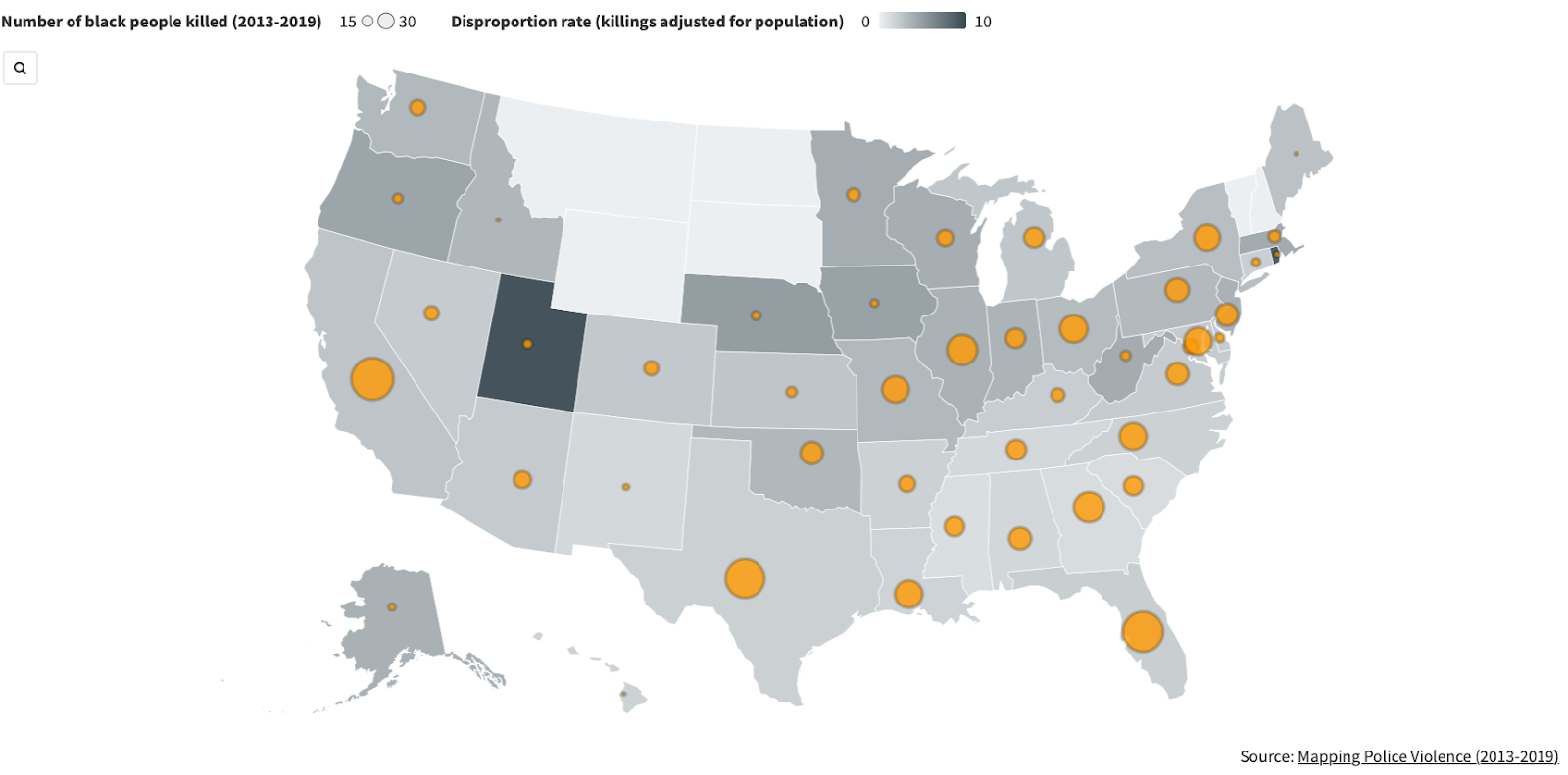

Where black people are most disproportionately killed by police. Source.
Where you live matters! The color of your skin matters! The color of skin matters if you complain about police misbehavior (Headley et al. 2020). Black and Hispanic complainants are much less likely to have their allegations of police misconduct sustained. 

Do we still have a dream?
I have a dream that my four children will one day live in a nation where they will not be judged by the colour of their skin, but by the content of their character”. On 28 August in 1963, Dr. Martin Luther King, Jr.  When I re-read Martin Luther King’s acceptance speech for the Nobel Peace Prize and I wonder how he maintained his faith.  When a police officer kills a dream, you can expect a protest. 
George Floyd protest, Columbus Ohio, May 30, 2020. Photo by Paul Becker  CC BY 2.0
This video, Seething, by Milmon F. Harison, reflects stories told across the United States. It’s time to listen, show solidarity, and join the movement to dismantle institutions and systems built on white supremacy and racism.  The privileged should not wonder why we are protesting.  Protests will continue until real reforms are made. 

As a young adolescent, I learned lessons from protests against injustice. I see several parallels to the present day.  In the 1960s instead of a widespread pandemic killing people, we had far distant, unpopular war killing people in Viet Nam.  The 1960s also saw strong anti-black sentiment, and disgust for progressive programs of relief, recovery, and reform that generated jobs and hope for the disadvantaged. It was a time of hope from passage of the Civil Rights Act of 1964 and the Voting Rights Act of 1965. And the privileged were threatened.  In 2020, we have a pandemic killing people, resurgence of white supremacists, calls for law and order (the shooting begins when the looting starts), and anti-progressive or anti-Obama political order. 
I was too young to remember the lynching of 14-year-old Emmett Till in 1955. Till was raised in a neighborhood due west of my West Englewood neighborhood on the south side of Chicago. On a visit to see relatives in Mississippi a white woman accused Till of whistling at her. Till was kidnapped and brutally murdered by her husband and brother.  The woman later confessed she had lied (T. Tyson 2017, The Blood of Emmett Till).  Thousands viewed his mutilated body in his funeral in Chicago.   A month after the murder the husband and brother were acquited by an all-white, 10-man jury that deliberated 67 minutes. Yet, the Emmett Till Antilynching Act is now stalled in the U.S. Senate. 

As I look back on the 1960s, the causes of unrest appear clear. President Lyndon Johnson brought together the Kerner Commission to locate the causes of urban unrest, and many told him the truth about what the problem was. There was an entire minority report called The Harvest of American Racism, that the public never saw. Harvest of American Racism Minority Report was labeled DESTROY (McLaughlin 2014). 
On May 14, as Jackson State College students protested the injustices of the war and American racism, the police opened fire on the rally, killing two and injuring 12. Founded in 1877 to serve those recently freed from slavery, Jackson State College struggled against white supremacists seeking to limit African American access to education.  Four Kent State students were killed by the Ohio National Guard as they protested the war. These shootings and those at Jackson State set off a widespread outrage that linked the war to police violence and domestic injustice. The protest of a spectrum of black leaders, athletes, activists, artists, and entertainers helped force the federal government to start withdrawing troops from Vietnam in late 1969. 
Blatant discrimination lead to formation of organizations like the Student Nonviolent Coordinating Committee, Black Panthers, and Students for a Democratic Society, which organized protests.  The 1960s saw assassinations of strong and vocal leaders. Medgar Evers assassinated in 1963 a by white supremacist KKK member. John F. Kennedy, Jr., assassinated in 1963 by a lone gunman or a un-named group of conspirators.   Malcom X denounced the Viet Nam war, and advocated for separation of blacks from whites, was killed in 1965.  Martin Luther King, Jr., was the earliest and most effective voice for civil rights and non-violent protests. He also denounced the Viet Nam war.  He was assassinated by James Earl Ray in 1968 after receiving a threatening letter from the FBI that said “You are done.” 
   
The influence of the war in Viet Nam had some parallels with the current pandemic.  Both the Viet Nam war and the COVID-19 pandemic have had a disproportionate effect on African Americans. African Americans were disproportionately drafted. In 1967, 64% of eligible African American youth were drafted, but only 31% of eligible whites. During 1965-66, the casualty rate for blacks was twice that of whites
 Six of the twelve U.S. servicemen killed on October 8 in the crash of two U.S. Marine helicopters in South Viet Nam. AP photo. CC BY 2.0
Rioting in the Watts neighborhood in Los Angeles occurred after an incident of police overreaction. Year of discriminatory housing practices affected Watts, like many other city neighborhoods, that had absorbed large population of blacks during the period from WWII to 1965.  An African-American, Maquette Freye on parole for robbery was pulled over for reckless driving and a fight with police ensued.  This incident led to eight days of rioting, and left 34 people dead, 1,032 injured, 3,952 arrested, 600 businesses destroyed, and total damage of more than $40 million. Los Angeles was the location of rioting against police brutality after the Rodney King beatings in 1972. 

I remember the rioting in Chicago at the summer Democratic convention in 1968. President Lyndon Baines Johnson withdrew his name from consideration in March 1968, leaving the Democratic spot open. Tensions were high and rioting occurred in many cities after the assassination of Martin Luther King Jr. on April 4, 1968. In June, Robert F. Kennedy, a progressive Presidential nominee, was assassinated. At the Chicago convention, riots broke out from Anti-Vietnam war protestors supporting anti-war candidate Eugene McCarthy. Chicago Mayor Richard Daley deployed 12,000 police officers and called in another 15,000 state and federal officers to contain the protesters. The situation then rapidly spiraled out of control, with the policemen severely beating and gassing the demonstrators, as well as newsmen and doctors who had come to help.

The riot, known as the Battle of Michigan Avenue,was caught on television, and sparked a large-scale change in American society. For the first time, many Americans came out in opposition to the Vietnam War. Protests continued in many cities. Hubert Humphrey, Johnson’s vice president, won the Democratic nomination. George Wallace ran as a racial segregationist and Richard Nixon ran on a campaign that promised to restore law and order to the nation's cities and provide new leadership in the Vietnam War. Nixon’s rhetoric appealed to the anti-black voters at the time. John Ehrlichman wrote in his diary, the subliminal appeal to the anti-black voter was always present in Nixons statements and speeches.”   We all know how that turned out.

Fast forward 50 years. The decade of 2010-2020 has been marked by police brutality and killing, white nationalism, and domestic terrorism.  The U.S. Senate and house condemned violence as hundreds of torch-bearing White nationalists, White supremacists, Klansmen, and neo-Nazis [who] chanted racist, anti-Semitic, and anti-immigrant slogans and violently engaged with counter-demonstrators on and around the grounds of the University of Virginia in Charlottesville.”  Donald Trump, now a symbol of division, referred to "very fine people on both sides," while clearly aware there were white supremacists (Unite the Right) on one side.  

The killing last month of George Floyd at the hands of four police officers, was not an isolated incident. It is a recent incident among numerous incidents of unjustified use of force by police against innocent citizens. This is systematic racism. Recent events were recognized by independent experts who are calling for the US to reform its criminal justice system (UN Human Rights Council).   Blacks make a greater share of prisoners in U.S. prisons and have for a long time (Gramlich 2019).

 Source Pew Research Center
Police brutality and killings by police, white supremacists, and domestic terrorists affects us all as we grieve with families of Trayvon Martin, Michael Brown, Ezell Ford, Laquan McDonald, Eric Garner, Jamar Clark, Resell Jones, Kenny Watson, Walter Scott, Terrence Crutcher, Michelle Shirley, Philando Castille, Botham Jean, Stephon Clark, Ahmaud Arbery, Breonna Taylor, Alton Sterling, George Floyd, Chris Beaty, and so many others. 

President Donald Trump emboldens white nationalists and fails to speak or act on the problem. Silence supports the status quo science and supports systematic racism. Dylan Roof killed nine at a Charleston church in 2015.  Robert Gregory Bowers killed 11 wounded six at a Pittsburgh synagogue in 2017. More than 70,000 people signed a letter saying that Trump was not welcome until he "fully denounces white nationalism" rabbi Jeffrey Myers said, "There is hate, and it isn't going away. It just seems to be getting worse. ... We've got to stop hate, and it can't just be to say we need to stop hate. We need to do, we need to act to tone down rhetoric"

Mural showing the portrait of George Floyd in Mauerpark in Berlin. To the left of the portrait the lettering "I can't Breathe" was added, on the right side the three hashtags #GeorgeFloyd, #Icantbreathe and #Sayhisname. The mural was completed by Eme Street Art aka Eme Free Thinker on 29 May 2020.  CC0 1. 
Actions To Fight Racism

  • Do not remain silent.  "You got to fight the power, fight the power, fight the powers that be." Public Enemy, from Do the Right Thing 
  • Businesses should speak out. Ben & Jerry’s has been publicly calling out racism and tells its customers why systematic racism is real. 
  • Recognize your own privilege and begin a conversation about racism with coworkers. While it may be difficult, it is not as difficult as living in fear every day.  We must recognize that our colleagues who are black and brown experience a hateful world and many difficulties in working in our disciplines.
  • Read the news critically. Some recent reports on assaults on police were falsehoods, and in fact, policy behavior was appalling and unjustified.  
  • Sponsor or participate in public events to highlight black scientists.  The Twitter #blackbirdersweek event was highly successful.  We heard many stories including a story of a scientist who is “always scared for my safety.”
  • Join a group, join a protest, let people know we are listening and that we believe black lives matter because solidarity matters.
  • Find your voice and speak to power now. The most dangerous form of white racism is the “the taken‐for‐granted routine privileging of white interests” that goes unremarked in the political mainstream (Gillborn 2005).
  • Faculty members should advocate to their administration to invest strongly into strengthening diversity and equity initiatives. 
  • Vote!
  • Act consistently and persistently.
  • Avoid being judgmental.  Barack Obama said “Thats not activism. Thats not bringing about change,” he said. If all youre doing is casting stones, youre probably not going to get that far. Thats easy to do.”
  • Demand congressional oversight of Commission on law enforcement and administration of justice 
  • Fight for environmental justice. Government responses to disasters fail to protect all communities equally (Bullard and Wright 2012). In places like Detroit and Flint, Michigan, water rights violations were a powerful motivator to protest and fight for inclusive government and fair access to water (Christy 2018).    
  • Show of solidarity with your professional organizations. The American Society of Ichthyologists and Herpetologists, The American Fisheries Society, and many other scientific and professional groups have released statements about recent police killings. 
Racism distorts all parts of the system. Source. 
Bigger policy issues remain after making small steps in police reforms.  Racism is built into every place in our society. Income inequality, particularly in urban areas, has increased markedly over the last forty years.  The divide between rich and poor is reflected in access to education, opportunities, services, political influence, and justice. Reforms are needed to address systematic reforms in educational policy (Gillborn 2005; Cabrera 2014), welfare systems (Kolkvosky 2018), mental health care (Brown 2003), housing (Metzgar and Webber 2019), urban planning (Banzhaf et al. 2019; Reardon and Raciti 2019), public health (Lee et al. 2015; Brailsford et al. 2019), water utilities (Clark 2019), and environmental protection (Konisky 2009).  Contact your congressional representatives and ask that they support the Justice in Policing Act of 2020Support DC statehood so residents have a voice in government. 

The long history of discriminatory practices and recent egregious actions by police against blacks means mediation is required to improve policy-minority community relations before real reforms in policing are possible (Braga et al 2019). What seems very different today from the 1960s is the widespread hatred spread by irresponsible, despicable idiots on television. For example, conservative commentator Tucker Carlson Fox News recently denounced the cult racial mentality, as if white supremacists haven’t been pushing a racial division agenda for many decades.  Boycott these idiots.

Truly I tell you, whatever you did for one of the least of these brothers and sisters of mine, you did for me. reply, Truly I tell you, whatever you did not do for one of the least of these, you did not do for me. Matthew 25 (40-45) 

Black Lives Matter is about justice and equality, and putting an end to police brutality 

References
Assari, S. 2018. Educational attainment better protects African American women than African American men against depressive symptoms and psychological distress. Brain Sciences 8(10):182 https://doi.org/10.3390/brainsci8100182
Banzhaf, S., L. Ma, and C. Timmins. 2019. Environmental Justice: The Economics of Race, Place, and Pollution. Journal of Economic Perspectives 33 (1): 185-208.
Braga, A.A., R.K. Brunson, K.M. Drakulich. 2019. Race, place, and effective policing. Annual Review of Sociology 45:535-555.
Brailsford, J. M., J. Eckhardt, T.D. Hill, A.M. Burdette, and A.K. Jorgenson. 2019. Race, Environmental Inequality, and Physical Health. Pages 71-86 in Underserved and Socially Disadvantaged Groups and Linkages with Health and Health Care Differentials (Research in the Sociology of Health Care), Emerald Publishing Limited https://doi.org/10.1108/S0275-495920190000037009
Brown, T.N. 2003. Critical Race Theory Speaks to the Sociology of Mental Health: Mental Health Problems Produced by Racial Stratification. Journal of Health and Social Behavior. Race, Ethnicity, and Mental Health 44(3):292-301. 
Bullard R.D., and B. Wright. 2012. The Wrong Complexion for Protection: How the Government Response to Disaster Endangers African American Communities. New York University Press, New York.
Cabrera, N.L. 2014. Exposing whiteness in higher education: white male college students minimizing racism, claiming victimization, and recreating white supremacy. Race Ethnicity and Education 17:30-55. DOI: 10.1080/13613324.2012.725040
Gillborn, D. 2005. Education policy as an act of white supremacy: whiteness, critical race theory and education reform.Journal of Education Policy 20:485-505.
Clark, C. 2019. Race, austerity and water justice in the United States. Pages 175–188 in F. Sultana and A. Loftus, editors. Water Politics: Governance, Justice and the right to water. 
Gramlich, J. 2019. The gap between the number of blacks and whites in prisons is shrinking. FactTank News in the Numbers. Pew Research Center. April 30, 2019. https://www.pewresearch.org/fact-tank/2019/04/30/shrinking-gap-between-number-of-blacks-and-whites-in-prison/
Headley, A.M., S.J. D’Allessio, and L. Stolzenberg. 2020. The effect of a complainant’s race and ethnicity on dispositional outcome in police misconduct cases in Chicago.  Race and Justice 10: https://doi.org/10.1177%2F2153368717726829
Kolkvosky, K.M., A. Weaver, M. Constance-Huggins. 2018. Critical race theory: opportunities for application in social work practice and policy. Families in Societies: The Journal of Contemporary Social Services 96: 269-276.
Kozhimannil, and C. Henning-Smith. 2018. Racism and health in rural America. Journal of Health Care for the Poor and Underserved 29: 35-43. doi:10.1353/hpu.2018.0004.
Konisky 2009 The Limited Effects of Federal Environmental Justice Policy on State Enforcement. Policy Studies Journal37:475-496.
Lee, Y., P. Muenning, I. Kawachi, and M.L. Hatzenbuehler. 2015. Effects of racial prejudice on the health of communities: a multilevel survival analysis. American Journal of Public Health 105(11):2349-2355.
McLaughlin M. (2014) Harvest of American Racism. In: The Long, Hot Summer of 1967. Palgrave Macmillan, New York
Metzger, M.W., and H.S. Webber, Editors. 2019. Facing segregation: Housing policy solutions for a stronger society.New York, NY, Oxford University Press, 2019
Lucks, D. 2017. African American soldiers and the Vietnam War: no more Vietnams. The Sixties: A Journal of History, Politics and Culture 10:196-220. 
Reardon, K., and A. Raciti 2019. Advocacy planning in the age of Trump: an opportunity to influence National urban policy. Planning Theory and Practice 20:606-611.  

Thursday, May 28, 2020

Writing During The COVID-19 Pandemic, by Don Orth

Stay healthy and learn something during the pandemic! That’s been my credo since COVID-19 sent me home March 7th. I created a nearly impossible writing schedule, and then realized I budgeted no time for reading, research, responding to survey requests, writing letters of reference, many rounds of editing, interruptions, zoom meetings, and finding my copy of that article or book I know possesses the wisdom I lack. In this post I follow the advice of Yoda “Pass on what you have learned.” It's been 10 weeks of stay-at-home, so I must have learned something that may help at least one writer. 

Highly erratic writing is my style. I tell my students to just finish the first shitty draft. I don’t like my shitty writing. And I hate to read the first shitty draft of a student writer. Yet "Write the shitty first draft" is Rule One.  Fear perfection — it is your enemy.  “Named must be your fear before you banish it you can.” — Yoda.  Only after you have some sentences can you get on with clarifying, organizing, polishing, and trimming.  

In graduate school and my early days as Assistant Professor, I wrote with a pencil on lined paper. Shitty it was.  “The greatest teacher, failure is.” — Yoda.   You may never get a manuscript ready to share with others if you do not first write that shitty draft.  Before I ever attempted to type up a draft for someone else to read and edit, my lined paper was all marked up with carets, circled phrases, arrows, insertions, strike throughs and erasures. Only then did I attempt to sit at a typewriter and compose the draft. A double-spaced draft meant the shitty draft could at last be read and edited by someone.
IBM Selectric typewriter. Photo by Oliver Kurmis.  CC Y 2.5. 
I learned later that Anne Lamott, in Bird by Bird: Some Instructions on Writing and Life (1994), wrote that “Almost all good writing begins with terrible first efforts. You need to start somewhere.”  I still chuckle thinking about her phrase, “fantasy of the uninitiated,” when I hear a graduate student say “Everything for my thesis is done, except for writing it up.”

Thirty years ago my older brother, who was ten years old at the time, was trying to get a report written on birds that he'd had three months to write, which was due the next day. We were out at our family cabin in Bolinas, and he was at the kitchen table close to tears, surrounded by binder paper and pencils and unopened books about birds, immobilized by the hugeness of the task ahead. Then my father sat down beside him put his arm around my brother's shoulder, and said, "Bird by bird, buddy. Just take it bird by bird.” 
― Anne Lamott, Bird by Bird: Some Instructions on Writing and Life

The last phrase has stayed with me — I often tell myself “Bird by bird, buddy. Just take it bird by bird.”  How many revisions are needed? Don’t worry about it.  Just focus on one sentence and then one paragraph at a time.  In the graph below I plot the word count against the version number for a manuscript currently in review. I wrote the first shitty draft (version 1) in January 2018! Maybe the 31st version will be acceptable for publication.
Plot of word count for thirty one versions of one manuscript awaiting reviews. 
Today, I am not as fond of the pencil and lined paper. And haven’t typed on an IBM Selectric in almost 40 years.  My high school typing teacher will always be remembered for shouting “Ready! Type!” to signal the start of timed typing. We would type furiously “The quick brown fox jumps over the lazy dog.”  This sentence is undoubtedly the best-known pangram. It contains all 26 letters of the alphabet (as it must do in order to be a pangram) and is 35 letters long. Students today have no clue when I rattle off this sentence. I know there are alternatives, but I never in my life typed  "Pack my box with five dozen liquor jugs." another panogram.

I am sad to learn that typing teachers were replaced by Mavis Beacon Teaches Typing and other computer software. Typing courses were provided by typewriter manufacturers like Remington over 100 years ago, in an effort to establish the typewriters status as an essential technological aid in business.  I eventually learned to compose at the typewriter, a skill that has served me well when keyboards replaced typewriters.  “A typewriter is a means of transcribing thought, not expressing it.” — Marshall McLuhan.  I will record a lecture soon for a summer class and I needed to transcribe my thoughts on the subject (5,681 words pithing 24 hours) because I cannot speak on the subject extemporaneously. 

As I tap these words out on my iPad’s keyboard app, I use two fingers. I never mastered the thumb typing required by modern “smart” phones. Or the iTap or T9 predictive text technologies for mobile phones. I still use the old multi-tap on my flip phone.  I also resent Outlook when it suggests how to complete my sentences. I’m sure I could write more per day if I learned to accept these suggestions.  Go ahead, call me a luddite! We all adopt new technologies at our own pace.

Writers block. “Happens to every guy sometimes this does” — Yoda.    Photo Pickpic.com
What I am learning during my stay-at-home time? Uninterrupted by on-campus meetings and drop ins, I can produce upwards of 5,000 words per day.  However, I’m still not sure how to measure time required to create meaningful, polished prose and I won’t use daily word counts to measure my work productivity. Apparently certain famous writers, such as Michael Crichton, writes 10,000 words per day.  That just makes me feel inadequate.  đŸ˜–  I am also easily distracted by social media. The latest Ray Stevens song interrupted my daily writing recently — “I stay at home. Shelter in place. Social distance, don’t go work.  I wear a mask, gloves, and stay away from church.”  For a distraction, listen to Quarantine.  And, of course, I had to share the “I will survive” parody by History Professor Mark Bruening, Missouri University of Science and Technology, with all my friends and followers. Whenever I have any self-doubt, I now sing “As long as I know how to zoom I know I’ll be alive.” Thanks to Professor Bruening!

It was easier with pencil, lined papers, and a typewriter, but harder to do a word count. It was a world that I had some control over.  As author Joan Didion wrote “I’m totally in control of this tiny, tiny world right there at the typewriter.” There were no incessant notifications from Outlook, Twitter, Facebook, New York Times, Washington Post, and...well, you get the idea. The process of stopping writing to look up a word in the dictionary slowed me down to think about definitions, synonyms, and word choice.  I will keep my preferred technology even as I long to be a slow professor and rail against the corporatized academy.  

Among the many books I cannot quickly locate on my shelves is How to Write a Lot: A Practical Guide to Productive Academic Writing, by Paul J. Silvia.  He wrote about excuses, bad habits, and barriers to productive writing. I am sure I assimilated something from this book and passed it on to someone struggling to write more. “I can’t find time to write.” and “I need large blocks of time to write.” are two common complaints. I use these frequently. If I ever return to campus, I will use them both.
Pencil and paper are low tech and easily sharpened and updated.  CC 0
The following is my humble advice learned from years of trying to overcome the imposter syndrome as a writer.

People who write a lot make a schedule and stick to it.
Write the shitty first draft.
Fear is the path to the dark side. -- Yoda
Stay off social media and TV.
Walk.
Write. 
Sleep.
Sleep some more.
Set goals and measure writing progress somehow.   

Consider the sage advice from Anne Lamott “But how?" my students ask. "How do you actually do it?" You sit down, I say. You try to sit down at approximately the same time every day. This is how you train your unconscious to kick in for you creatively. So you sit down at, say, nine every morning, or ten every night. You put a piece of paper in the typewriter, or you turn on the computer and bring up the right file, and then you stare at it for an hour or so. You begin rocking, just a little at first, and then like a huge autistic child. You look at the ceiling, and over at the clock, yawn, and stare at the paper again. Then, with your fingers poised on the keyboard, you squint at an image that is forming in your mind -- a scene, a locale, a character, whatever -- and you try to quiet your mind so you can hear what that landscape or character has to say above the other voices in your mind.” ― Anne Lamott, Bird by Bird: Some Instructions on Writing and Life


Wednesday, May 20, 2020

Pandemic Online Ichthyology Teaching, by Don Orth

Teaching Ichthyology online was never imaginable nor desirable. Lab periods in Ichthyology were typically a chance for students to get hands-on training in anatomy, dissections, and identification of many fish orders, families, genera, and species.  Field trips provide access to live unknown specimens in their natural habitats.  Without these options, Ichthyology instruction had to adapt to a virtual world. Two teaching strategies persisted in the pivot to online teaching— the concept of mere belonging and the student notebook. 

When students engage in synchronous behavior and/ or feel connected to others in some way, its easier to complete learning tasks. While this may appear to be an unreachable challenge when teaching online.  Students no longer shared the experience of working over smelly, long preserved fish specimens. Classroom Jeopardy sessions were difficult to organize. Mere belonging was achieved by assigning students work (reviewing fish identifications, peer reviewing essays)  to pairs or groups to complete assignments. Further, student's mastery work during lab periods were shared in Flickr and/or Facebook groups. In this and other ways social connections were maintained. Field trips were replaced with virtual field trips and students still worked together to check field identifications. Finally, in lieu of group photos in the field, students shared personal photos so a collage could be created.
Students may never encounter an arapaima in lab or a local field trip.  This close-up photo of Arapaima sp., taken at Shedd Aquarium in 2019, does provide a study in mouth shape. Photo:  D.J. Orth 
The Lab Notebook is one well accepted, long standing, and low tech learning method. Sketching what is observed and writing observations is how we have always made sense of the world. It is an essential skill of the scientists. Swiss naturalist Louis Agassiz told his students “a pencil is one of the best of eyes.” While high tech tools, photography, CT scans, 3d models, and other visualization tools provide more information, the Student’s Notebook depends on students observing and sketching with a virtual fish specimen collection.  Drawing also enhances a student's memory (Fernandez et al. 2018). Each day’s observations were recorded, reviewed, corrected, and built upon. When moving to field work, the scientist uses a Field Notebook to organize observations, sketches, and data, and skills learned will transfer. Scientists have always used raw, observable data to infer patterns, over space and time, to generate  hypotheses.  Online learning activities required Ichthyology students to engage in these authentic tasks.
Sample page of Lab Notebook by Ichthyology student, Jaimee Dolan. Source. 
In February while still teaching in face-to-face mode, we had Shark Day for one lab. Learning objectives were to (1) Become familiar with the diversity of sharks, skates, and rays, (2) identify sharks, skates, and rays to family or species (as appropriate) with a variety of approaches, and (3) identify difficulties in studying sharks, skates, and rays. Our museum collection of sharks, skates, and rays is very limited.  Consequently we reviewed the Shark Pulse website, presented by Francesco Ferretti, and identified sharks, skates, and rays from models, specimens, and photographs.  In SharkPulse, students could view sharks photographed in all parts of the world. Together, they could work to determine appropriate identities. 
Students enrolled in Ichthyology in spring 2020 during pandemic online teaching. 
At the end of the Lab session, each student presented one shark, skate, or ray in a "sharks I know well" series to teach other students.  In a short presentation, each student provided the best diagnostic characters to identify to family, genus, or species.   In the process, we also addressed many of the difficulties in identification of Chondrichthyes specimens under authentic conditions.  For example, there are color variants, juvenile and adult differences, lack of detail in photographs, and in fish markets sometimes only the shark fin is available for making an identification.  In that case, iSharkFin provides expert advice in identifying species from shark fin shapes alone.

After all classes shifted to remote, online instruction we adapted this model for learning freshwater fishes.  By the end of the semester, the students identified 45 specimens collected virtually from different drainages of Virginia.  Students were provided with photos of fish specimens in hand just as they would observe them immediately after capture. The virtual field trip will be adapted for future labs even if we meet face to face.  For example, we can create videos and specimen photos to simulate a field trip to the Caribbean or south Atlantic and struggle to identify sharks and rays (FAO 2016; Florida Museum of Natural History N.D.).   While this learning experience is not equivalent to a genuine field trip to these distant locations, the opportunity to travel virtually with a large group of Ichthyology students and provide them this training may be worth it.

A Former Pupil (1874) revealed the methods used by Louis Agassiz. The student was provided a wet, smelly fish in a tin pan. "Take this fish," said Agassiz, "and look at it; we call it a haemulon; by and by I will ask what you have seen." Agassiz would then leave and return hours later. But Agassiz would say very little except look at your fish!”   Rather than quit, the student would really concentrate and take his time in observing the fish.  Each stage of the process of looking at the fish forced him to concentrate and focus more and see connections.  

References
A Former Pupil. 1874. In the laboratory with Agassiz. Every Saturday: A Journal of Choice Reading (April 4, 1874).
FAO. 2016. Identification guide to common sharks and rays of the Caribbean. By RamĂ³n Bonfil. FishFinder Programme. Rome, Italy.
Fernandes, M., J. Wammes, and M. Meade 2018. The surprisingly powerful influence of drawing on memory. Current Directions in Psychological Science 27(5):302-308.
Florida Museum of Natural History. N.D. Field Key to Sharks Encountered in the U.S. Atlantic Bottom Longline Shark Fishery and Recreational Anglers. Website 
Accessed 20 May 20, 2020

Wednesday, April 22, 2020

Recommendations for Pandemic Stay-at-home Reading, by Don Orth


During my stay-at-home time, many things have changed, but reading at home is still a welcome escape. There is only so much binge-watching of Grey’s Anatomy and Bosch that I can take.  I have a stack of books to read when I’m not in a zoom meeting, writing papers, teaching online, reviewing student work, and shopping online. Here I share some books that might be of interest to you.

I realize the precarious nature of small, independent booksellers as I often rely on Amazon to deliver books. In 2011 Amazon was estimated to have sold around 22.6% of the books in the U.S. and today is likely higher (Minzesheimer 2011). If the loss of independent booksellers concerns you, try Indiebound.org and find an independent bookstore near you. 

Reading Shelf April 22, 2020.
The following are among the top non-fiction books on my reading list:

Flaws: Shark Bites and Emotional Public Policymaking, by Christopher L. Pepin-Neff (2019).  
If you are interested in the tragic accidents of shark bites and how politicians respond in the name of public safety, then read this account. He develops an emotion-policy framework that is applied to three case studies of policymaking. The human-shark relationship is changing in a post-Jaws era and much more attention is being placed on “Save the Sharks” efforts.

Vaquita: Science, Politics, and Crime in the Sea of Cortez, by Brooke Bessesen (2018).
The small vaquita porpoise, first described in 1958, is the world’s most endangered marine mammal. Banning gill net fishing was its last hope — until illegal fishing for swim bladders of totoaba, a large drum, doomed recovery.  The book chronicles the many people and places engaged in this last-ditch effort.  

Vaquita porpoise  Photo Natural History Magazine CC BY-NC-SA 2.0

Being Salmon, Being Human: Encountering the Wild in Us and Us in the Wild, by Martin Lee Mueller (2017)
A story of how salmon influence people, cultural and tribal lore, honoring nature, and why wild caught salmon change us. This book reminds us of our essential humanness as one of many strands in the world. Mueller provides a thoughtful narrative on the human-salmon relationship and interpretations from major philosophers as he contributes to a growing literature on ecophilosophy.

Reef Life: An Underwater Memoir, by Callum Roberts (2019)
Callum Roberts is a scientist who spends his time studying tropical coral reefs.  To pick up and read this is to listen and watch as he details life on a coral reef.  He begins with his earliest recollections exploring waters of the Red Sea of Saudi Arabia and takes the reader to many remote marine parks detailing what makes these reefs special.  A world without coral reefs is considered in the final chapter.


Swarthy Parrotfish Scarus niger is one of several herbivorous fishes that Roberts studied in the Red Sea during his doctoral studies.  Photo CC BY-NC-SA 2.0.
Matter & Desire: An Erotic Ecology, by Andreas Weber (2017)
Andreas Weber is a biologist, philosopher, and nature writer who believes the root cause of environmental problems is the alienation between people and nature. He argues and demonstrates that feelings and emotions are the foundation of life.  Hence, being alive is an erotic process. This book continues to explore his thesis that meaning, expression and emotion helps us understand the basic framework of life.  Read this is if you can be convinced that living beings should not simply be natural resource.

Why Fish Don't Exist: A Story of Loss, Love, and the Hidden Order of Life, by Lulu Miller (2020) 
This book is about one of the most prolific and influential early ichthyologists in North America. David Starr Jordan (1851-1933) will be a familiar person to any serious student of the fishes. However, this story explores many aspects of his life and struggles that have not previously been revealed.  While I had heard about the catastrophic loss of his fish collections in an earthquake, I never knew of the darkness of his personality, his dismissal from Stanford, his views on eugenics, and a possible murder coverup.  Miller writes about struggles that Jordan endured and reveals much about her own struggles to remain creative in the face of adversity.     

Fishing: How the Sea Fed Civilization, by Brian Fagan (2018)  
 Fishing is the last major source of food from the wild. Brian Fagan reviews over a million years of fishing in the wild, from subsistence to commercial overfishing.  You will find this of interest if you care about the significance of fishing in our cultural development.  Fagan draws from many contributions from archaeological research and discussions with modern fishers to explore past and present patterns of exploitation.  Read this to appreciate the complexities of conserving ocean resources while fishing depleted oceans.

The Outlaw Ocean: Journeys Across the Last Untamed Frontier, by Ian Urbina, August 20, 2019
The Outlaw Ocean introduces us to many bad players in the world of fisheries as it reviews maritime and fisheries laws. It’s not an easy read as Urbina reveals the scope of illegal fishing, modern-day slavery, dumping, murder, and gun running on fishing vessels. His journeys reflect the unsettling reality that modern laws do not apply in many places in the ocean.  I came away with a deeper knowledge of the real cost of cheap seafood.

What a Fish Knows: The Inner Lives of Our Underwater Cousins, by Jonathan Balcombe (2017)   
 We know so very little about fish cognition, emotion, and perceptions.   Do fish play?  Do moray eels plan their hunting excursions? Do wrasse learn?  Can fish suffer?  Do bass recognize faces? These and many other questions are not explored in Ichthyology texts.  Increasingly, researchers are exploring fish behavior with more rigorous methods.   Jonathan Balcombe is a behaviorist who makes our current knowledge of the fishes easier to understand.  As a result, we have a newfound respect for the capabilities of fish.


Prophetic investigations of conditions leading to past pandemics in book by David Quammen.  Photo by Bernard Goldbach CC BY 2.0
 
Spillover: Animal Infections and the Next Human Pandemic, by David Quammen (2012)  
 Written before the emergence of COVID-19, this is a timely read. David Quammen examined outbreaks of SARS, MERS, AIDS and visits the experts. We learn that a virus can become pathogenic in a nonhuman animal and then jump to humans. We learn that a relatively harmless version of virus can jump from bats to another animal and then to humans.  More than one intermediate animal species could be involved in transmission.  Human are expanding and living in closer proximity to wild animals. Once in the human population, a virus can evolve to become potentially dangerous.  Spillover was a prophetic book and foreshadowed the emergence of a deadly pandemic, in this case COVID-19. 

The Curious Death of Peter Artedi: A Mystery in the History of Science, by Theodore W. Pietsch (2010)  
Peter Artedi is often referred to as the father of Ichthyology. Unfortunately, Artedi died before his life's work was completed.  His studies on fish were eventually published by his friend and colleague, Carl Linneaus.  This book is a fictional account of the events before and after Artedi's untimely demise. 

I also recommend some fiction to help you avoid the news of the day.

Razor Girl, Bad Monkey, or Double Whammy, by Carl Hiaasen
Carl Hiassen writes of quirky characters centered in south Florida.   Double Whammy is one of the most memorable. One of the quirky characters is a private detective who investigates a suspected cheater in bass fishing tournaments. The double whammy is a bass fishing lure, found on a dead body in the beginning of the story. Double Whammy was also on a list of books banned in Texas prisons—I’m not making this up!  Hiassen’s reaction to hearing the news was  I confess to feeling flattered that I made the Texas list.”

The Guardians, by John Grisham (2019), follows innocence workaholic attorney-and-Episcopal-priest named Cullen Post as he attempts to free a convicted murderer on death row.

Blue Moon, by Lee Child (2019). Jack Reacher has no particular place to go and all the time in the world to get there.  Reacher says "once in a blue moon things turn out just right.”  This wasn't one of those times when Jack Reacher helped an elderly man who turned out to be paying his loan shark.  Reacher, never off duty, cannot leave that one alone.  

The Night Fire, by Michael Connelly (2020), is the latest crime novel that features detective Harry Bosch.  Even if you haven't read previous novels by Connelly, you can pick up this book which pairs
the now retired and ever stubborn Harry Bosch with Detective RenĂ©e Ballard. Even in retirement, Harry lives by his credo that "Everybody counts, or nobody counts.”  

Lyra and the Adventure of the Flying Fish, by Peter Emina, illustrated by Alice Ridley (2011), is a story inspired by and about Lyra McConnell.  Lyra was born premature at 24 weeks, 5 days, and weighed only 1 pound and 10 ounces. The story is a fictional account of the adventures of Lyra  that demonstrate a sense of adventure and determination in this little girl that must have started in her incubator.  Lyra and her friend, W. Rabbit, explore many fishy worlds. It's a great story about a young girl and adventures with her snorkel.
  
References

Minzesheimer, B. 2011.  Is there hope for small bookstores in a digital age?  USA Today February 10, 2011.  Available at http://usatoday30.usatoday.com/life/books/news/2011-02-10-1Abookstores10_CV_N.htm {accessed on April 22, 2020}