Monday, August 13, 2018

Sunfishes (Lepomis) of Virginia, by Don Orth

Centrarchid fishes exist only in North American freshwaters and are well known as popular sport and aquarium fishes.  There are 38 species in eight genera, all of which may be identified by a laterally compressed body, two connected spiny and soft dorsal fins, spines on anal fins, and pelvic fins in a thoracic position.  The most diverse genus is Lepomis, commonly referred to as the sunfishes in recognition of their highly colored breeding colors.  These colorful sunfish are often the first fish caught and remembered by a young angler.  Their importance in sustaining American sport fisheries cannot be overstated.    Virginia has eight species of Lepomis, but there are thirteen in North America (Warren 2009).  Explore this link to a gallery of photos of Lepomis.  


Due to the popularity as a sport fish, sunfish are widely introduced throughout North America and even in other continents.  The body form and habits all support a generalized sight-feeding habit on a variety of crustaceans, insects, and small fishes. Males develop bright breeding coloration, establish territories, and build shallow, circular nests. Nests may be solitary or colonial and males aggressively defend their nest, court females, and guard eggs and young.  Closely related species have a tendency to hybridize, complicating the identification.  Because of the high fecundity and parental guarding behavior, many young sunfish are produced and become prey for numerous sport fish and other aquatic predators, such as water snakes Nerodia, snapping turtles Chelydra serpentina, and hellbenders Cryptobranchus alleganiensis
Male sunfish guarding a circular, depression nest.  Photo by Alan Creech.  Creative Commons
The male nest construction and guarding and courting behaviors are well studied and all species of Lepomis demonstrate similarities in breeding.  The breeding male excavates a circular depression and defends the territory against all intruders.  This is a great time to get up close and personal with a male sunfish because they are so reluctant to flee.  See this photo of a beautiful male sunfish made possible because it was defending a nest.  During nest defense, the male sunfish displays to nearby or approaching males and females with a behavioral repertoire that consists of  nest hovering, dashes to the water surface and back to the nest, nest sweeping with caudal fin, fin spreading, mouth gapes, jaw snaps, lateral displays, substrate biting, and opercular spreads.  Rim circling behaviors where the male rapidly swims around the edge of the nest with fins erect are intended to attract a female. Opercular flaring is directed at females and apparently signals to the female the species, condition, and quality of the breeding male.  Males also use sounds to court mates.  If the female follows, the male performs courtship circles, encircling the female and leading her to the nest. The size of the male earflap is a key determinant of dominance in a hierarchy. 

Here are the eight species of sunfishes of Virginia.  

Redbreast Sunfish Lepomis auritus is native to the Atlantic slope drainages of Virginia but is now well established in all Virginia waters, except some acidic swampy drainages.  This sunfish has a moderate size mouth  with the upper jaw extending to the anterior edge of the eye.  Body is olive on the back and sides with yellow orange spots on the side and an orange breast.  Iridescent blue wavy lines radiate from the mouth across the snout and onto the cheek and opercle.   The ear flap is narrow and elongate, dark to the posterior margin. 
Redbreast Sunfish Lepomis auritus. Photo by Noel Burkhead.  Source
Green Sunfish Lepomis cyanellus is a very common and spunky sunfish that may occur in streams, rivers, ponds, and shallow weedy margins of lakes. The body shape is not as deep and the mouth is large. The coloration is blue green on back and sides with reflections of yellow and emerald.  The cheeks have distinctive blue wavy streaks.  The ear flap is black with white or yellow orange margins and is not elongated or flexible as in some other sunfish.  Black blotches are usually present near the base of soft dorsal and anal fins.  The pectoral fin is rounded and, when bent forward, will not extend beyond the front of the eye.  The fringe of white, yellow and/or orange along the fins develops in breeding males.   
Green Sunfish Lepomis cyanellus.  Photo by Nate Tessler
Pumpkinseed Lepomis gibbosus seem to prefer vegetated streams, ponds, and reservoirs.  Pumpkinseeds have wavy blue lines on the cheek and opercle.  The opercular flap is short and stiff with a black center, bordered by a semicircular spot on the posterior edge.  This spot may be white, pale yellow, or red.  The pectoral fin is long, and sharply pointed. When bent forward, the pectoral fin will reach beyond the front of the eye.  Pumpkinseed have specialized molariform teeth in their throat, used for crushing snail shells.  
Pumpkinseed Lepomis gibbosus.  Photo by Olaf Nelson.  Creative Commons
Warmouth Lepomis gulosus occur in vegetated lakes, ponds, swamps, reservoirs, and sluggish habitats in streams.  Warmouth has a large, terminal oblique mouth with lower jaw projecting slightly past the upper jaw.  Three to five dark red bands radiate from the snout.  The opercular flap is short and stiff, and black with paler often red-tinged border.  The coloration is olive brown with dark brown mottling on back and side and dark spots and bands on fins.  The pectoral fin is short and round, usually not reaching the eye when laid forward.  Breeding males (pictured below) are boldly patterned with a red orange spot at the base of the second dorsal fin and black pelvic fins.  
Warmouth Lepomis gulosus.   Photo by Olaf Nelson.  Creative Commons
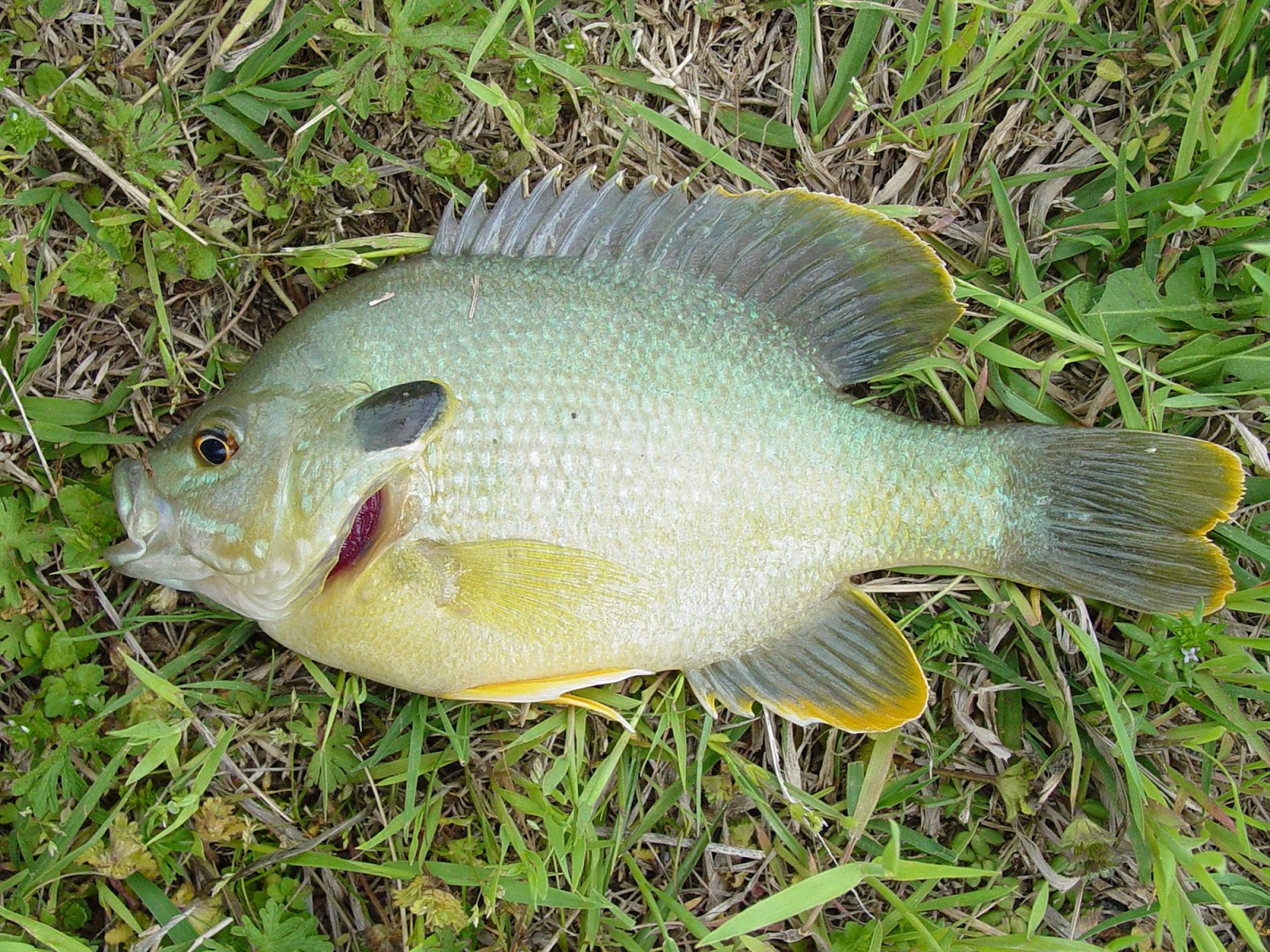
Bluegill Sunfish Lepomis macrochirus occupy all types of lacustrine and fluvial habitats.  Bluegill have a small mouth.   They have a large black spot at posterior end of soft dorsal fin.   Opercular flap is moderate or long and flexible with black margins. Coloration is blue with dark chain-like bars along the side, which may be absent.  Adults will have two blue streaks from the chin to the edge of the gill cover.   Pectoral fin is long and pointed.     
Bluegill from Lake Lanier, Georgia.  Creative Commons
Hybrid Bream -- The hybrid between the Bluegill Sunfish and the Green Sunfish is commonly produced and marketed for stocking in farm ponds.  The F1 has desirable traits such as enhanced growth and reduced fertility.  The photo below is a hybrid that has blue cheek lines of the Green Sunfish and chain-like bars of the Bluegill. 
Hybrid Bream.  Photo by MSU Extension Service/Wes Neal
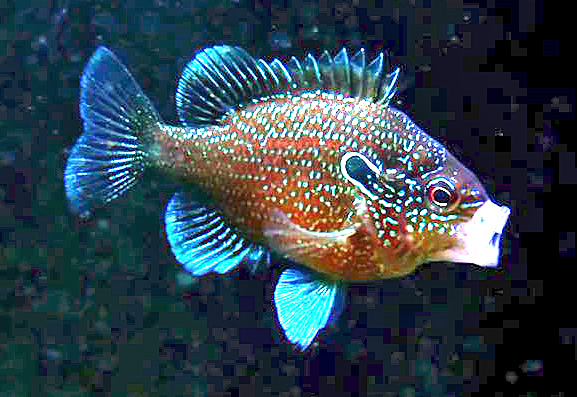
Dollar Sunfish Lepomis marginatus occur only below the fall line and inhabit swamp-like habitats in low gradient streams and beaver ponds.  They are the smallest Lepomis in Virginia, and max out at only 4 inches.  The mouth is small and there are wavy blue lines on cheek and opercle.  The opercular flap is long, flexible, black in the center and edged with lighter margins.  Coloration is dark red on back and bright orange on the belly with many blue spots on the side.    
Dollar Sunfish Lepomis marginatus  Photo by Derek Wheaton
Longear Sunfish Lepomis megalotis  inhabits pools of headwaters, creeks, and small to medium sized rivers.  Longear Sunfish have distinctive wavy blue lines on snout, cheek, and opercle.  The opercular flap is long and flexible with a black center and shite edges of equal with.  the pectoral fin is short and rounded, not reaching the eye when laid forward.   Adults are dark red above, bright orange below, and marbled and spotted with blue on the side.  Longear Sunfish vigorously attach a variety of baits and is frequently caught with spin and fly fishing.  
Longear Sunfish  Lepomis megalotis.  Photo by Brett Albanese, Georgia DNR
Redear Sunfish Lepomis microlophus inhabits ponds lakes and reservoirs and sluggish pools and backwaters of rivers. Redear Sunfish resemble Bluegill. They do not have wavy blue lines on the head.  The opercular flap is short, with black center  and bordered above and below in white margins and posteriorly with a prominent red or orange crescent.  Coloration is light gold green above with many dark connected spots on the side.  Pectoral fin is long and pointed.     It is widely stocked for sport fishing and eats snails and small bivalves, earning it the name "shellcracker."  Anglers catch Redear Sunfish with worms and other natural baits fished near the bottom.  
Redear Sunfish  Lepomis microlophus.  Photo by Kentucky Dept. of Fish & Wildlife Resources.
The fascinating sunfishes Lepomis spp. are North American treasures.   They are easy to catch, fun to watch, good to eat, and provide many opportunities for education and scientific study.   In addition to the Lepomis spp., other centrarchid fishes include the include Mud Sunfish (Acantharchus pomotis), Flier (Centrarchus macropterus), two rock basses (Ambloplites), three banded sunfishes (Enneacanthus), two crappies (Pomoxis),  and three black basses (Micropterus).    

Catching sunfish makes young ones happy.  Photo by Joseph Bartmann.  Creative Commons

Reference


Warren Jr., M.L., 2009.  Centrarchid identification and natural history.  Pages 375-533 in S.J. Cooke and D.P. Philipp, editors. Centrarchid fishes: Diversity, Biology, and Conservation.  Blackwell Publishing, Ltd., United Kingdom.
 

Friday, August 3, 2018

Eye Picking and Pebble Picking Behaviors of Cutlip Minnow, by Don Orth

Cutlip Minnow Exoglossum maxillingua is no ordinary minnow.  Two behaviors make it quite unique -- nest building and eye picking. Compared to other minnows, its movements are sluggish, staying near the bottom of clear, rocky streams. But during the spring breeding season, males become hard-working nest builders, selecting pebbles and bringing them to the nest site at a rate up to 6-10 per minute.  This eventually results in a pebble mound that can be 12 to 18 inches across and 5 to 6 inches high.   Wow!  Just consider the energy expended by nest building and tending – a 6-inch Cutlip Minnow can barely transfer a ¾ inch pebble.  Females are smaller and do not participate in the nest building.  The male stays at the nest day and night until breeding has ceased (Hankinson 1922; van Duzer 1939). 


Cutlip Minnow.  Photo by Matt Tillet

The distribution of the Cutlip Minnow ranges from Virginia to New York in streams of the mountains and piedmont provinces.   Here, the Cutlip Minnow co-occurs with many other fishes, including the Common Shiner Luxilus cornutus, Creek Chub Semotilus atromaculatus, Rosyface Shiner Notropis rubellus,  Tesselated Darter Etheostoma olmstedi, White Sucker Catostomus commersoni, and Blacknose Dace Rhinichthys atratulus.   Common Shiner and Rosyface Shiner breed on the nests built by Cutlip Minnows and their constant swimming and darting is in contrast to the behavior of the Cutlip Minnow (van Duzer 1939; Maraukis et al. 1991).  

Distribution of the Cutlip Minnow from NatureServe.


The eye-picking behavior of the Cutlip Minnows has frustrated many field biologists when collecting these fishes.  All types of fishes collected are typically placed in a large bucket until enough are collected to identify and count them all.  Collected fishes held in the bucket with the Cutlip Minnows often have missing or damaged eyes.  Antonios Pappantoniou and George Dale  (1986) discovered that the Cutlip Minnow would immediately pick at the eyes of a goldfish added to an aquarium with many Cutlip minnows.   Furthermore, the Cutlip Minnows were not fooled by the camouflage of  false eyespots or eye lines on fishes (Dale and Pappantoniou 1986).  When in crowded situations, the Cutlip Minnows like fish eyes!

Close-up, ventral view of the mouth of the Cutlip Minnow.  Photo by Brian Zimmerman.
The mouth of the Cutlip Minnow is unique in that the lower jaw consists of a central bony plate flanked by two fleshy lobes.  Only one other fish, the Tonguetied Minnow Exoglossum laurae, has this unique mouth morphology   The ventral mouth would seem to be specialized adaptation for benthic feeding on snails, insect larvae, and diatoms.  Eye-picking does not appear to be an adaptation for feeding on the eyes of other fishes.  The mouth morphology also facilitates the transport of pebbles of a particular size as seen in other nest building cyprinids (Bolton et al. 2015).

In a recent study, Bramburger et al. (2018) observed that nests of Cutlip Minnow were composed of mainly dark pigmented pebbles.  They speculated that the colorful, dark pebble might enhance mate selection by female Cutlip Minnows. Male Cutlip Minnows get darker during breeding but they do not possess secondary sexual characteristics that would serve as cues for sexual selection.   However, Bramburger et al. discovered that the substrate from nests were significantly darker and more saturated than random samples of stream substrata.  No other examples of nest substratum color selectivity has been reported in fishes.  At this stage, all one can do is speculate.   Perhaps darker substrate absorbs/conducts more heat energy (Brown 1969; Johnson 2004) that speeds embryo development.

Our not so ordinary little minnow may possess secrets that are yet to be explained.  


References
Bolton, C., B.K. Peoples, and E.A. Frimpong. 2015. Recognizing gape limitation and interannual variability in bluehead chub nesting microhabitat use in a small Virginia stream. Journal of Freshwater Ecology 30: 503-511.  
Bramburger, A. J., K.E. Moir, and M.B.C. Hickey. 2018. Preferential incorporation of dark, coloured materials into nests by a mound-nesting stream cyprinid. Journal of Fish Biology
Brown, G. W. 1969. Predicting temperatures of small streams. Water Resources Research 5:68-75. 
Dale, G. and A. Pappantoniou. 1986.  Eye picking behavior of the cutlips minnow, Exoglossum maxillingua:  Applications to studies of eye spot mimicry.  Annals of the New York Academy of Science 463:177-178.
Hankinson, T.L. 1922.  Nest of cut-lips minnow, Exoglossum maxillingua (LeSueur). Copeia 102:1-3.
Johnson, S. L. 2004. Factors influencing stream temperatures in small streams: substrate effects and a shading experiment. Canadian Journal of Fisheries and Aquatic Sciences 61(6):913-923.
Maurakis, E.G., W.S. Woolcott, and M.H. Sabaj. 1991. Reproductive behavior of Exoglossum species. Bulletin of the Alabama Museum of Natural History 10:11-16.
Pappantoniou, A., and G. Dale.  1986.  Eye-picking behavior of the cutlips minnow Exoglossum maxillingua: density relationships.   Annals of the New York Academy of Sciences. 463:206-208.
van Duzer, E.M. (1939) Observations on the Breeding Habits of the Cut-Lips Minnow, Exoglossum maxillingua. Copeia  1939:65-75.  


Thursday, June 21, 2018

Why Alligator Gar Need Floodwaters, by Don Orth

Can we save one of the largest fish in North America with floodwaters?  The Alligator Gar Atractosteus spatula is the largest of seven species of Gar found in Central America, Cuba, and North America.  The IGFA world record is 279 pounds, but larger ones have been reported indicating that that can grow up to ten feet and and 350 pounds. An 8 ft. Alligator Gar weighed 254 pounds with a girth of 44 inches was snagged in Lake Texoma and is the largest fish ever caught in Oklahoma waters. Alligator Gar are imperiled due to reduced abundance and diminished range.  In the past, little attention was paid to management or conservation of Alligator Gar. However, Alligator Gar are vulnerable to overfishing and rivers in its range are highly altered due to dams, dikes, dredging, and other forms of habitat and flow alteration.  A recent investigation reported by Robertson et al. (2018), confirmed suspicions that the Alligator Gar are dependent on seasonal flooding in large floodplain rivers.

The gar family (Lepisosteidae) have been around since the Cretaceous Period (~100 million years  ago.  Gars and bowfin are the sister group to other teleost fishes and, therefore, of interest to evolutionary biologists. The largest gars are in the genus Atractosteus, the three extant species are Alligator Gar (or Catan in Mexico), the Cuban Gar A. tristoechus or Manjuari from western Cuba, and the Tropical Gar A. tropicus (or Pejelagarto) from southern Mexico and Central America. Among these three, the Alligator Gar is most imperiled. Gar are fascinating and misunderstood creatures, and unfortunately, the influence of habitat restoration for gars has not yet been fully explored.  Efforts are now underway to restore these magnificent creatures via supplemental stocking.  It will take many years, up to 50 years, for stocked Alligator Gar to reach the potential maximum sizes.  Supplemental stocking is an uncertain and expensive short-term strategy.  Until natural spawning and rearing habitats can be restored, supplemental stocking is necessary.
Alligator Gar that weighed 108 pounds was sampled May 27, 2015 by Florida Fish and Wildlife Research Institute. Creative Commons by NC-ND-2.0. Source.
Ten-foot long Alligator Gar photographed in 1920 from Mhoon Landing, Mississippi River. Public Domain
Managers need to understand what drives populations of Alligator Gar if the species has any chance to be restored throughout its range (O'Connell et al. 2007; Buckmeier et al. 2017).  Although the effects of hydrologic modification of rivers is well document, the prevailing questions related to re-establishing ecologically sustainable flows, such as "How much?" and "How often?" remain unanswered (McManamay et al. 2013).  Fully mature Alligator Gar may produce 157,000 large eggs (2-4 mm in diameter).  These BOFFFF (= big old fat fecund female fish) need do be protected and we also need to provide habitat so that they will spawn naturally.  What is suitable habitat?  The life history of Alligator Gar is tuned to life in floodplain rivers where spawning is synchronized with the high flow pulse events (Buckmeier et al. 2017).  The Robertson et al. (2018) study examined the extent of potential spawning habitat in the Trinity River, downstream from Dallas, Texas. Trinity River is supports guided fishing for trophy size Alligator Gar and is becoming a model for Alligator Gar management elsewhere. 
Map of Spawning Habitat in Floodplains of Trinity River, Texas.  Robertson et al. (2018)
This research used hydraulic models to predict water surface elevations and digital elevation models from LIDar (Light detection and ranging) data. These fine scale models quantified the extent to which floodwaters inundated large expanses of vegetated habitats in low lying floodwaters.  Alligator Gar spawning habitat was mapped as floodwaters between 0.2 and 2 meters deep over woody vegetation and open canopy vegetation types. The plot below shows a dramatic increase in total spawning habitat available as the river flow increases enough to spill onto the floodplains. 


Plot of area of Alligator Gar spawning habitat versus river flow.  Robertson et al. (2018).
We now have the making of a 'Field of Dreams' hypothesis.  If you build it, they will come.   If floodwaters are held back in reservoirs for release at another time, Alligator Gar may not receive the cue to initiate the courtship and spawning behavior.  However, if we create large expanses of spawning habitat, will the breeding Alligator Gar come and spawn?   Amount, duration, and timing of spawning habitat appeared to correlate with years of exceptional Alligator Gar recruitment in the Trinity River (Robertson et al. 2018).  Larval Alligator Gar are only about 8 mm long upon hatching.  These fish that may grow to ten feet, yet start off as tiny fragile larvae.  Larvae must attach to substrates with an adhesive organ on the snout.  If the flood pulse is artificially shut off after spawning, recruitment will be reduced.  The longer duration of the flood pulse enhances nursery habitats for young Alligator Gar.

In 2014, Kimmel et al. (2014) witnessed spawning of Alligator Gar in floodplain habitat in the Mississippi river floodplains at St. Catherine Creek National Wildlife Refuge.  A large aggregation of Alligator Gar was observed in a flooded ditch, lined with buttonbush, shrubs, and herbaceous vegetation four miles from the main river channel.   These spawning observations help to validate the habitat suitability criteria used by Robertson et al. (2018). 
Spawning behavior displayed by Alligator Gar observed by Kimmel et al.  (2014) in floodplains of St. Catherine Creek, near Natchez, Mississippi. 
Eggs of Alligator Gar deposited in woody debris and vegetation.  Kimmel et al.(2014).
The lessons from the Trinity River study give us optimism for population restoration here and elsewhere.  The demand for water from the Trinity River is growing from population centers of Dallas-Fort Worth and Houston and flood-pulse management may provide for periodic strong Alligator Gar recruitment.  Gar production in hatcheries may help, but they provide an uncertain number of offspring (Schmidt 2015).  While many are experimenting with spawning Alligator Gar (Mendoza et al. 2002), for example the USFWS does hatchery spawning of Alligator Gar, the restoration of natural habitat when and where it is needed has the best likelihood for long-term sustainable populations. 
Larva of the Spotted Gar Lepisosteus oculatus.  Photo by Konrad P. Schmidt.
References

Buckmeier, D.L., N.G. Smith, D.J. Daugherty, and D.L. Bennett. 2017. Reproductive ecology of Alligator Gar: Identification of environmental drivers of recruitment success.  Journal of the Southeastern Association of Fish and Wildlife Agencies 4:8-17.

Kimmel, K., Y. Allen, and G. Constant. 2014. Seeing is believing: alligator gar spawning event confirms model predictions.  Website  https://lccnetwork.org/blog_entry/seeing-believing-alligator-gar-spawning-event-confirms-habitat-suitability-index  Accessed June 20, 2018.

McManamay, R. A., D.J. Orth, J. Kauffman, and M.M. Davis. 2013.  A database and meta-analysis of ecological responses to stream flow in the south Atlantic region.  Southeastern Naturalist 12(Monograph):1-36. 

Mendoza, R., C. Aguilera, G. Rodríguez, M. Gonz.lez, and R. Castro. 2002. Morphophysiological studies on alligator gar (Atractosteus spatula) larval development as a basis for their culture and repopulation of their natural habitats. Reviews in Fish Biology and Fisheries 12:133–142.

O’Connell, M. T., T. D. Shepherd, A. M. U. O’Connell, and R. A. Myers. 2007. Long-term declines in two apex predators, bull sharks (Carcharhinus leucas) and alligator gar (Atractosteus spatula), in Lake Pontchartrain, an oligohaline estuary in southeastern Louisiana. Estuaries and Coasts 30:567–574.

Robertson, C.R., K. Aziz, D.L. Buckmeier, N.G. Smith, and N. Raphelt.  2018.  Development of flow-specific floodplain inundation model to assess Alligator Gar recruitment success.  Transactions of the American Fisheries Society DOI: 10.1002/tafs.10045
 
Schmitt, K.  2015. Gar farming.  American Currents  40(4):3-9


Tuesday, June 12, 2018

Sargassum: Essential Habitat or Beach Nuisance, by Don Orth

A vacation at a beach resort near white sandy beaches and aqua blue waters was the plan.  However, the white sandy beaches and surf were covered with a thick mats of Sargassum, a brown macroalgae or 'seaweed.'  As I waded out beyond the floating seaweed, I could not see my feet in the sand, the water was that murky. The resort was along the Caribbean coastline known as the Riviera Maya, Mexico. This coastal zone is famous for its beaches and reef dependent recreation.  Tourism contributes 8.6% to the national GDP of Mexico and 45% of tourists choose the coastal zone as their destination (UNWTO 2016). Pristine beaches and associated recreational amenities are key attractions to coastal tourism worldwide (Onofrio and Nunes 2013). Hotel room prices are positively correlated to the beauty of the beach and recreation (Mendoza-González et al. 2018).  However,  'seaweed' is not part of the marketing plan for resorts.
 
Sargassum on the beach.
I know only a little about Sargassum, and that is about its role as offshore habitat for fish and invertebrates.  There are many species of Sargassum, bu  two species, Sargassum fluitans and Sargassum natans, dominate the floating mats. When trolling for pelagic fish the boat captain will seek out rafts of Sargassum, which attract numerous species (Dooley 1972). Some fishes will complete their entire lives in Sargassum, others use it for breeding, and others use it only for larval and juvenile habitats.  The Sargassumfish Histrio histrio is a frogfish (Antennariidae) that lives its entire life amidst the Sargassum (Pietsch and Grobecker 1987).  Sargassumfish are camouflaged with colors that change and weedy projections so that it blends into the floating seaweed. It dangles its esca as a fishing lure to attract small fish, shrimp and other invertebrates close enough to capture them.  
Floating raft of Sargassum photographed June 3, 2018 near Playa del Carmen, Mexico.
Sampling fishes in and around the floating Sargassum mats is a complicated process.  Therefore, I was not surprised by how few studies investigated the association of Sargassum and fishes. The studies I reviewed showed that small individuals from four or five fish families (Antenariidae, Carangidae, Monacanthidae, Syngnatidae, Tetraodontidae) typically made up over 90% of the sampled catch.  Depending the study duration and lcoation, between 36 to 110 fish species were identified (Dooley 1972; Bortone et al. 1977; Moser et al. 1998; Wells and Rooker 2004; Cassaza and Ross 2008; Moritz 2015).   Larger fishes, such as dolphinfishes, jacks, wahoo, and billfishes aggregated below the weedlines using the Sargassum for feeding habitat.  In addition to the fishes, Sargassum habitat provides feeding habitat for marine mammals, sea birds, and sea turtles (Cassaza and Ross 2008).
Fishes along Sargassum weed line near Cape Hatteras, North Carolina.  A. small planehead filefish; B. larger jacks below weed line; C. large predators, dolphinfish; D. schooling unicorn filefish; E. planehead filefish feeding on ctenophore;  and F. edge of Sagarssum weed line.  (Cassaza and Ross 2008).  
Realizing the importance of Sargassum to recruitment of many marine animals, NOAA approved a Sargassum Management Plan in 2003.  See the final rule here.  Development of this management plan was controversial over the interpretation of Sargassum as an essential habitat versus a harvestable product.  Larval and juvenile fishes of many species will be taken by Sargassum harvesters and effects of harvesting are unstudied. However, the current estimated harvest is miniscule compared with the estimated biomass of Sargassum.
Sargassum underwater near beach at Playa del Carmen, Mexico, photographed June 5, 2018. 
The Saragassum is widely distributed but the occurrence of Sargassum strandings on Caribbean beaches has become more common since 2011 (Franks et al. 2016).  Warming climate and changes in oceanic currents influence the spatial distribution and some researchers believe increases in nutrient loading may be stimulating an increase in Sargassum.  A forecast system based on satellite measurements shows promise for predicting the distribution and timing of Saragassum blooms, thereby providing localities with advance warnings of beaching events (Wang and Hu 2017).   

Locations of pelagic Sargassum and current vectors.  Franks et al. 2016. 
While, we were beach combing, my wife, Valerie, noted a small dead fish in the surf.  We began searching the recently beached Sargassum and found many others, all about 2-3 cm long.  She thought it was a pufferfish and my initial identification was incorrect.   After posting on All Fish Species Identification Group on Facebook, Pete Liptrot and Roy Hemdel identified it as Sharpose Puffer Canthigaster rostrata

Sharpnose Puffer Canthigaster rostrata and one puffer Sphoeroides sp. (bottom left) from beached Sargassum.
Sharpnose Puffer Canthigaster rostrata
Tourists in the region quickly learn that Sargassum is a common occurrence, but the quantity that reaches Caribbean beaches has increased.   The Caribbean Alliance for Sustainable Tourism and the Caribbean Hotel and Tourism Association created Sargassum: A Resource Guide for the Caribbean.   This guide examines possible impacts on beach tourism, uses of Sargassum, and management practices for beach resorts. Sargassum is an excellent medium for plant and crop growth and may become a new source of revenue.   Beach cleaning machines are available, but many resorts use manual removal in order to save costs and avoid issues with sea turtles. 

Gabriel raking Sargassum on beach.  Burying the Sargassum provides some relief to the problem.
Sargassum is a living renewable marine resource, a primary producer, and an essential habitat for many marine organisms, including highly migratory species.  For that reason, Sargassum should be managed and protected as essential habitat.  However, tourists expecting the picturesque sandy beaches will be dismayed to walk amidst the decaying Sargassum on the beaches. In the future, Caribbean beach resorts will need to adapt to changing climate conditions and the delivery of excessive amounts of Sargassum to pristine beaches. 

References

Casazzarro, T.L., and S.W. Ross. 2008. Fishes associated with pelagic Sargassum and open water lacking Sargassum in the Gulf Stream off North Carolina.  Fisheries Bulletin 106:348-363.
Dooley, J. K. 1972. Fishes associated with the pelagic Sargassum complex, with a discussion of the Sargassum community. Contributions in Marine Science 16:1–32.
Franks, J.S., D.R. Johnson, and D.S. Ko. 2016. Pelagic Sargassum in the tropical North Atlantic.   Gulf and Caribbean Research 27: SC6-11.
Mendoza-González, G., M.L. Martínez, R. Guevara, O. Pérez-Maqueo, M.C. Garza-Lagler, abd A. Howard, 2018. Towards a sustainable sun, sea, and sand tourism: The value of ocean view and proximity to the coast. Sustainability 10:1012-1026.
Moritz, T. 2015. Fishes of a stranded Sargassum meadow at Punta Cana, Dominican Republic. Bulletin of Fish Biology 15:141-146.
Moser, M.L., P.J. Auster, P.J., and J.B. Bichy. 1998. Effects of mat morphology on large Sargassum-associated fishes: observations from a remotely operated vehicle (ROV) and free-floating video cameras.    Environmental Biology of Fishes 51: 391-398.  
Onofri, L., and P.A.L.D Nunes. 2013. Beach ‘lovers’ and ‘greens’: A worldwide empirical analysis of coastal tourism. Ecological Economics 88:49–56.
Pietsch, T.W., and D.B. Grobecker.  1987. Frogfishes of the world. Stanford University Press, Stanford, CA, p 420
United Nations World Tourism Organization (UNWTO). Tourism Highlights. 2016. Available online: http://www.e-unwto.org/doi/pdf/10.18111/9789284418145 (accessed on 11 June 2018).
Wang, M. and  C. Hu. 2017. Predicting Sargassum blooms in the Caribbean Sea from MODIS observations. Geophysical Research Letters 44:3265-3273.
Wells, R.J.D., and J.R. Rooker. 2004. Spatial and temporal patterns of habitat use by fishes associated with Sargassum mats in the northwestern Gulf of Mexico.  Bulletin of Marine Sciences 74:81-99.