Sunday, April 2, 2017

Learning Lessons About Lampreys, by Don Orth

Lampreys are simple fish, but they leave me with many questions. Lampreys and hagfishes are genetically very similar and represent the oldest living groups of vertebrates. These two lineages of mobile Chordates arose well before the appearance of jawed fishes.   Lampreys and hagfish persisted through at least four of five mass extinction events on Earth. How did they survive when most marine organisms perished?    

The appearance of the cranium, eyes, pineal gland, inner ear, olfactory rosettes, lateral line, large brain, and muscular heart, were first evident in the lamprey.  The body form of lampreys is simple and essentially the same as a 360 million year old fossil lamprey described by Gess et al. (2006). Whose blood or flesh did this lamprey feed on?
Lateral views of  (a) a larval lamprey (ammocoete), (b) an adult lamprey, and (c) a hagfish. This figure was originally published in Hardisty et al. (1989). (Royal Society of Edinburgh from Transactions of the Royal Society of Edinburgh: Earth Sciences 80:241–254.
Lampreys have been around a very long time and yet we still don’t know much. The explosion of Sea Lamprey in the upper Great Lakes spurred much research aimed at developing control strategies.  See blog post.   However, there are 22 other species of lampreys in North America in the family Petromyzontidae.  How are they getting along?

The Pacific Lamprey Entosphenus tridentatus has been declining for decades after construction of eight hydroelectric dams on the lower Columbia and Snake Rivers (Close et al. 2002).   Grates that were designed to guide salmon away from the turbine intakes did not protect the weaker-swimming lampreys.  In 2003, conservation groups petitioned the USFWS to list four species of lamprey in Oregon, Washington, Idaho, and California, including the Pacific Lamprey, under the Endangered Species Act.  The petition was deemed unwarranted due to lack of information (Brown et al. 2009).   Eventually 13 stocks were placed on the Endangered Species list and Pacific Lamprey Conservation Initiative emerged.  Will the Pacific Lamprey every recover?
 
The Lost Fish movie trailer.   Full movie available here,
A common genus of lampreys in eastern USA drainages is Ichthyomyzon, which includes 6 species.  Ichthyomyzon are smaller than Sea Lampreys with a single dorsal fin that is continuous with the caudal fin.  The Ohio Lamprey Ichthyomyzon bdellium was described based on a holotype specimen collected from the Ohio River.  Adult Ohio lampreys are parasitic.  Tooth patterns and myomere counts are important traits to identify genera and species.  Are there any hotspots of Ohio Lamprey abundance left?

A major evolutionary change that occurred in the lampreys was the loss of the parasitic life stage.  Paired lamprey species are characterized by larvae that are morphologically and ecologically similar. Only after metamorphosis, can the paired species be reliably identified.   Non-parasitic Mountain Brook Lamprey, Ichthyomyzon greeleyi, likely arose from an ancestor very similar to the Ohio Lamprey; the two paired species are very similar genetically  (McCauley et al. 2015).  The paired species share mitochondrial haplotypes, suggesting a very recent divergence or ongoing gene flow.

Ichthyomyzon is confined to river systems and lakes in central and eastern North America. The distribution patterns the Ichthyomyzon species is still a mystery to all of us.  Isolation and dispersal occur regularly because of the lamprey life cycle.  The larval stage, the ammocoetes live for years in soft sediments in depositional zones found in eddies, backwaters and bends in the river.  Here the ammocetes burrow and filter feed on algae, plankton, and other organic matter.  The blind and toothless ammocoetes of the Ohio Lamprey remain in the substrate for 4 years before metamorphosing into the parasitic form in the mid to late summer.  Here they must depend on water flow through their branchial chamber.  Another key to ammocetes habitat is shade for the photophobic ammocetes.  Diatoms grow and form an incrustration on the interface between the silt and water interface (Dawson et al. 2014).  Larval lampreys are important in nutrient cycling, facilitating the conversion of nutrients derived from detritus and algae into stored biomass. 

Young ammocoetes. Photo by Wester Ross Fisheries Trust. 
Lampreys are ecosystem engineers because the burrowing and feeding activities of larval
lampreys significantly increase substrate oxygen levels (Shirakawa et al. 2013).  The long larval period and burrowing behavior presumably allows the larval lamprey to avoid many predators that would eat these worm-like filter feeders. 

The next stage is the morphological transformation to resemble an adult.  During this phase the eyes and oral sucking disc develop and the sexually immature Ohio Lamprey will then migrate downstream to encounter an abundance of potential host species.  The oral sucking disc of the Ohio Lamprey is designed to lock on to a fish, create a wound, and secrete an anticoagulant so it can feed on blood.   After growing during a parasitic phase of 1 or 2 years, the now sexually mature Ohio Lamprey will migrate upstream to breed and die.  They thereby transfer the sequestered nutrients upstream upon death.  I wonder how populations of the Ohio lamprey persist where there are so many barriers to dispersal between spawning and adult habitats.   
Oral disc of Ohio Lamprey.  Photo by Derek Wheaton.
Spawning behavior has been described for some species. Just watch the video, Lamprey Love, which shows Southern Brook Lamprey in a spawning pit. Ohio Lampreys spawn in late May or early June in shallow pits.  Both males and females use their oral sucking discs to move rocks and create a spawning pit, or redd.   That’s how they got the name stone sucker name, Petromyzon (Petro = stones and myzon= to suckle). Females may also beat fine sediments out of her redd. The female attaches to a rock and the male attaches near the female’s head so they are parallel in the current and released gametes can drift into the nest and attach to the newly prepared rocky bottom.  The nest-building activity of spawning lampreys increases streambed complexity in ways that appear to benefit other fishes and stream invertebrates  (Hogg et al. 2014).
Range of the Ohio Lamprey (NatureServe 2013).
A long period of evolutionary coexistence with large host fishes means that detrimental impact of lamprey on native fish populations is uncommon.   The parasitic adult Ohio Lamprey migrates to larger waters with numerous species of large-bodied fishes.   The occurrence of lamprey scars on these fishes is typically as low as 10%.   Watch this Silver Lamprey locked on an American Paddlefish  Specialized lamprey predators do not exist.  I wonder about the anti-predator behavior of lamprey.
Channel Catfish dorsal view showing a Chestnut Lamprey scar.  Photo by Michael J. Moore. 
The conservation status of 33 of the 44 species (75 %) has been assessed at a global scale. (Maitland et al. 2014) and at least 12 are at risk.  Jelks et al. (2008) concluded that 43% of North American lamprey species were at some level of risk.  Williams and Williams (2005) concluded that the Ohio Lamprey “declined across its range, probably related to habitat alteration through damming of large rivers and siltation of small streams, which are important reproductive and larval habitats.”  Unfortunately, the population level data on most lamprey species is not adequate for population viability assessment.   Ohio Lamprey is extirpated from many river drainages as it requires excellent water quality and low fine sediment inputs in both upstream and downstream areas of the watershed.  You can view the underwater videos of the Ohio Lamprey spawning after reading a poem on lamprey romance.

Romance for the Jaw Challenged Fishes  (Milton S. Love 2011, p. 6)

What’s the purpose at this season
That I love you without reason
Never felt this way before
As I sweep the river floor

Though your company’s such bliss
Locking lips we just can’t kiss
For mating’s driven by compulsion
Thus we shall triumph, through repulsion.

This poem reminds me that I have so much more to learn about lampreys. Lampreys are not ugly, blood suckers that kill fish. Ancient Romans considered them regal food. They are cultural icons among Native Americans in the Pacific Northwest. In Japan, lampreys were first medicine for night blindness.  Baked lamprey pie is sent to ruling monarchs of England on special occasions.  It is only in the upper Great Lakes where they deserve the invasive title.  Lamprey has become a significant new model for neuroscience investigations of spinal cord regeneration. No one has yet examined all mentions of lampreys in literature. In this Kurt Vonnegut short story lampreys were finding the Great Lakes too vile and noxious even for them. We need to restore and clean up our rivers for lamprey habitat or suffer the “wrath of the lamprey.”

References
Brown, L.R., S.D. Chase, M.G. Mesa, R.J. Beamish, and P.B. Moyle. 2009.  Biology, Management, and Conservation of Lampreys in North America. American Fisheries Society Symposium 72.  Bethesda, Maryland.
Close, D.A., M.S. Fitzpatrick, and H.W. Li. 2002.  The ecological and cultural importance of a species at risk of exinction, Pacific lamprey. Fisheries 27:19-25.
Dawson, H.A., B.R. Quintella, P.R. Almeida, A.J. Treble, and J.C. Jolley. 2014.  The ecology of larval and metamorphosing lampreys.  Pages 75-137 in M.F. Docker, Editor.   Lampreys: Biology, Conservation, and Control. Volume 1.  Fish and Fisheries Series 37. Springer.
Gess, R.W., M.I. Coates, and B.S. Rubidge. 2006. A lamprey from the Devonian period of South Africa. Nature 443:981–984.
Goodman, D.H. and S.B. Reid. 2012. Pacific Lamprey  (Entosphenus tridentatus) Assessment and Template for Conservation Measures in California. U.S. Fish and Wildlife Service, Arcata, California. 117 pp.
Jelks, H.L., and fifteen coauthors. 2011. Conservation status of imperiled North American freshwater and diadromous fishes.  Fisheries 33(8):372-407.
Hogg, R.S., S.M. Coghlan, Jr., J. Zydlewski, and K.S. Simon.  2014.  Anadromous sea lampreys (Petromyzon marinus) are ecosystem engineers in a spawning tributary.  Freshwater Biology 59:1294-1307.
Love, M.S. 2011.  Certainly more than you want to know about the fishes of the Pacific Coast: A postmodern experience.   Really Big Press, Santa Barbara, California.  650 pp.
Maitland, P.S., C.B. Renaud, B.R. Quintella, D.A. Close, and M.F. Docker.  Conservation of Native Lampreys.   2014. Pages 375-428 in M.F. Docker, Editor.   Lampreys: Biology, Conservation, and Control. Volume 1.  Fish and Fisheries Series 37. Springer.
NatureServe. 2013. Ichthyomyzon bdellium. The IUCN Red List of Threatened Species 2013: e.T202616A18234634. http://dx.doi.org/10.2305/IUCN.UK.2013-1.RLTS.T202616A18234634.en. Downloaded on 10 March 2017.
McCauley, D.W., M.F. Docker, S. Whyard, and W. Li.  2015.  Lampreys as diverse model organisms in the genomics era.  BioScience  65:1046-1056.
Shirakawa, O., S. Yanai, and A. Goto. 2013.  Lamprey larvae as ecosystem engineers: Physical and geochemical impact on the streambed by their burrowing behavior. Hydrobiologia 701:313-321.
Williams, M.G., and L.R. Williams.  2005.  Conservation Assessment. Ohio Lamprey Ichthyomyzon bdellium.  U.S. Forest Service, Eastern Region.   26 pp.    Available from: https://www.fs.usda.gov/Internet/FSE_DOCUMENTS/fsm91_054381.pdf

Thursday, February 9, 2017

Pike Killifish: A Small, Specialized Ambush Piscivore

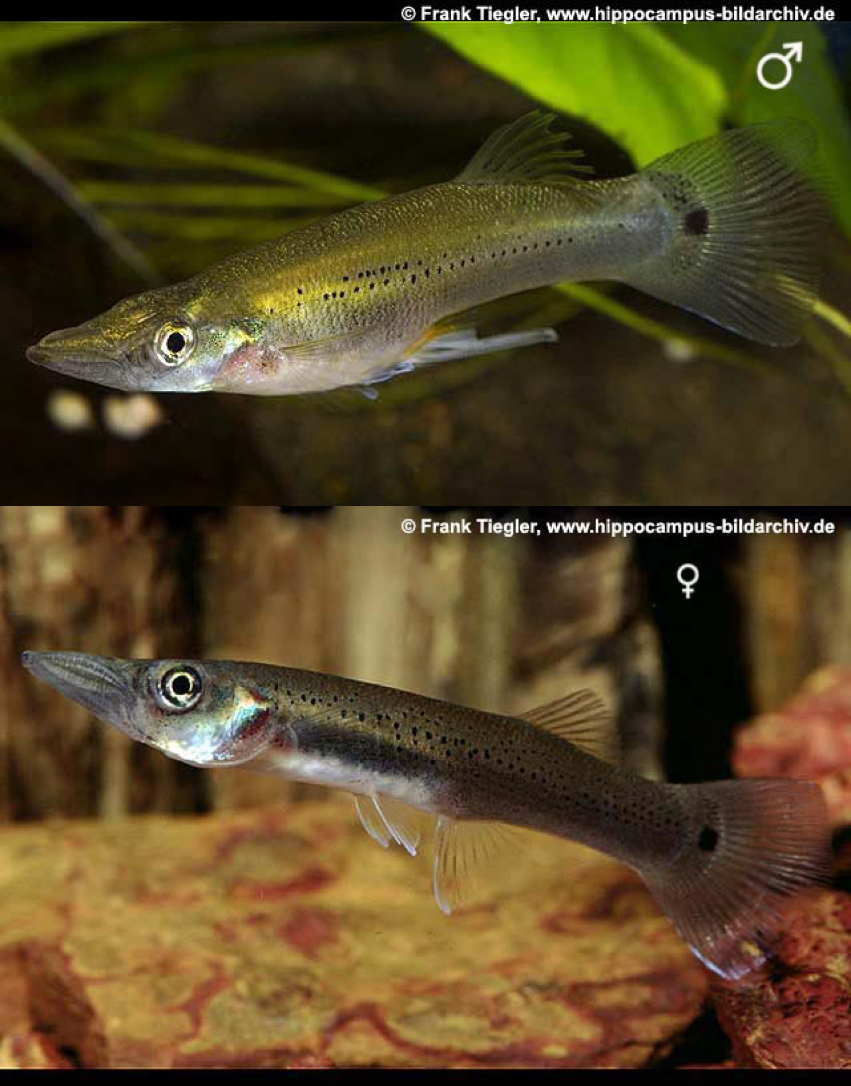
The Pike Killifish (Belonesox belizanus) is fascinating small fish. Rudolf Kner, an Austrian ichthyologist and physician, described the Pike Killifish in 1860, and created a new genus, Belonesox, for this distinctive fish.  What do you see?   How do the morphological traits translate to behavior? This distinctive, small fish has a fusiform body shape and is slightly compressed in posterior region. It has a large eye and a dorsal fin far back from the center of gravity.  Its mouth is oblique and the lower jaw is longer than the upper jaw.   This form is adapted for a surface-feeding ambush predator.  But there is much more to learn about this fascinating little fish.   
Male and Female Pike Killifish.  Photos by Frank Tiegler 
Belonesox implies a cross between a needlefish and a pike. The Latin word, belonÄ“, meaning needle, was first applied to the needlefish by Pliny the Elder in The Natural History (77-79 AD).  Esox is the genus of pikes and pickerels. The teeth and jaw protrusion abilities make the Pike Killifish a little killing machine. The Pike Killifish lies in wait for prey and ambushes, stalks or pursues its fish prey with minimal stealthy movements.  When it locates a suitable prey, it makes one explosive lunge at the prey. Greven and Brenner (2008) discovered that the prey of Pike Killifish were struck within 36 milliseconds and captured at velocities of approximately 11 body lengths per second.  The jaws are greatly enlarged for this small fish and are extended in a long pointed beak filled with canine teeth. The outer series of teeth are conical and curved backwards and smaller than the inner series of teeth. Furthermore, the maximum gape, at 44% of the head length, may be a record for similar sized fish.  The large toothy gape can hold struggling prey while the orientation of the teeth makes it easy for prey to enter, but impossible to escape. Any small, surface-dwelling fish, such as mosquitofishes, swordtails, platies, and even other Pike Killifish, are easy prey.
Note the teeth are unicuspid and have multiple orientations.  Photo of head source Photo of teeth on premaxilla from Grevner and Brenner (2008).
Pike Killifish are in the Order Cyprinodontiformes, the toothed carps, and the Family Poeciliidae.  Poeciliidae is a species-rich family with over 300 species, many of which are known by common names, such as the guppy, molly, swordtail, topminnow, and mosquitofish. Pike Killifish may reach 22 cm and females are much larger than males. The Pike Killifish is the largest species in this family and the only one with the elongated jaws.    Marchio and Piller (2013) concluded based on genetic analyses that there is only one valid species throughout Central America.   
Phylogeny of Belonesox and closest relatives (Ferry-Graham et al. 2010)
Whereas most cyprinodont fishes are micro-carnivores, or pickers, with a small gape designed for nipping, the Pike Killifish is a specialized piscivore.  Pike Killifish achieve this enlarged gape (~20mm) by a mobile premaxilla that is capable of rotating dorsally and a ventrally rotating lower jaw (Ferry-Graham et al. 2010).  While most fishes have to grow into the specialized piscivore niche, the Pike Killifish is capable of the large gape essentially from birth.
Cranial and jaw anatomy. In top diagram the maxilla and adductor mandibulae (A) are removed to show muscle insertions.  Ferry-Graham et al. (2010)
Pike Killifish live in slow-moving streams and rivers, mangrove and weedy swamps, and inlets salty bays, where they associate with abundant submersed vegetation.  They are endemic to Central America from northern Costa Rica through parts of Mexico.  Pike Killifish emerged as a small, but top carnivore, among other small poeciliid fishes many millions of years ago.  Many of these habitats were formed via dissolution of karst topography creating unique aquatic lake types (aguadas, reumideros, and cenotes) in addition to rivers, backwaters, and bays (Vega-Cendejas et al. 2013).  The Pike Killifish are tolerant of low dissolved oxygen, high salinity, and high temperature (Turner and Snelson 1984; Kerfoot et al. 2011)   
 
Range map of the Pike Killifish.  Source
Males mature at 6 cm and females at 8 cm. Breeding is year-round.  The male has a modified anal fin that serves as an intromittent sex organ, aka gonopodium.  Males repeatedly conduct ritualistic behavioral acts when in the presence of females.  The courting male fans his fins and gonopodium in her direction (Horth 2004).  Fertilization is internal and large clutches (100-300) may be produced every 6-7 weeks.  Newly born Pike Killifish are approximately 15 or 16mm at birth.   All reproductive traits contribute to a high reproductive rate.
 
Large adult Pike Killifish. Photo by Kenneth Tse Photography
From a single introduction in Miami-Dade County in 1957, the Pike Killifish became established in south Florida
(Schofield et al 2017).  Pike Killifish are common from central western Florida to the Florida Everglades.   Pike Killifish adapted to the physical conditions of Florida because of their wide tolerance for temperature, salinity, and oxygen levels. In the Everglades, the Pike Killifish persisted in several canals east of the Everglades for more than 20 years before expanding dramatically in the 1980s and 1990s; however, no coincidental changes in indigenous fishes were noted (Trexler et al. 2000).  Admittedly, few investigations have examined effects of Pike Killifish in Florida.  One challenge to evaluating the effects of fish introductions is the lack of before-introduction community data.  Greenwood (2012) examined effects of the Pike Killifish on indigenous fishes of the Tampa Bay in Florida.  Here, the Pike Killifish first occurred in 1994 and pre-invasion monitoring data were available.  Pike Killifish reduced the abundance of small resident, indigenous fishes, namely the Eastern Mosquitofish Gambusia holbrooki , Goldspotted Killifish Floridichthys carpio, Sheepshead Minnow Cyprinodon variegatus, and Sailfin Molly Poecilia latipinna.   
Trend in the biomass of Pike Killifish in the Everglades (Trexler et al. 2000)
It is likely the Pike Killifish will persist and spread.  Perhaps it will be accommodated without major effects. It’s too early to know if the Frankenstein Effect (i.e., new invasions are likely to have unexpected consequences) will emerge.  Though most successfully invasive fish are euryphagous, the feeding behavior of the Pike Killifish, though optimized for specialized feeding on fishes, is just as effective for capturing a variety of elusive prey. If there are no fish prey, the Pike Killifish switches to shrimp prey (Harms and Turingan 2012).  

Ornamental and aquaria are growing industries. Photo by Dan Woudenberg/LuCorp Marketing
Florida is home to more non-indigenous fishes than any state due to historic practices. Tropical ornamentals industry contributes $28M per year to Florida’s economy, and ornamental fish farms must be licensed by the Florida Department of Agriculture and Consumer Services.  Best practices can and do minimize the escape, if implemented (Tuckett et al. 2016), and that can reduce the likelihood of invasion success.      

References
Ferry-Graham LA, Hernandez LP, Gibb AC, Pace C, 2010. Unusual kinematics and jaw morphology associated with piscivory in the poeciliid, Belonesox belizanus. Zoology  113:140-147.
Greenwood, M.F.D.  2012.  Assessing the effects of the nonindigenous pike killifish on indigenous fishes in Tampa Bay, Florida, using a weighted-evidence approach.  Transactions of the American Fisheries Society 14(1):84-99
Greven, H., and M. Brenner. 2008. Further notes on dentition and prey capture of the Pike killifish Belonesox belizanus (Poeciliidae). Bulletin of Fish Biology 10(1/2):97-103.
Harms, C.A., and R.G. Turingan. 2012.  Dietary flexibility despite behavioral stereotypy contributes to successful invasion of the pike killifish, Belonesox belizanus, in Florida, USA.  Aquatic Invasions 7:547-553.
Horth, L, 2004. A brief description of the courtship display of male pike killifish (Belonesox belizanus). Florida Scientist 67:159-165.
Kerfoot, J.R., Jr. 2012. Thermal tolerance of the invasive Belonesox belizanus, pike killifish, throughout ontogeny. Journal of Experimental Zoology Part A: Ecological Genetics and Physiology 317(5):266-274. http://onlinelibrary.wiley.com/journal/10.1002/(ISSN)1932-5231/issues
Kerfoot J.R., J.J. Lorenz, and R.G. Turingan RG, 2011. Environmental correlates of the abundance and distribution of Belonesox belizanus in a novel environment. Environmental Biology of Fishes 92:125-139.
Kerfott, J.R., and R.G. Turingan.  2011.  Similarity and disparity in prey-capture kinematics between the invasive pike killifish (Belonesox belizanus) and the native Florida largemouth bass (Micropterus floridanus).  Florida Scientist 74:137-150
Marchio, E.A., and K.R. Piller. 2013. Cryptic diversity in a widespread live-bearing fish (Poeciliidae: Belonesox). Biological Journal of the Linnean Society 109:848-860.
Schofield, P.J., L. Nico, and M. Neilson 2017. Belonesox belizanus.  USGS Nonindigenous Aquatic Species Database, Gainesville, Florida.   Website https://nas.er.usgs.gov/queries/FactSheet.aspx?speciesID=843 [accessed 8 February 2017]
Trexler J.C., W.F. Loftus, F. Jordan, J.J. Lorenz, J.H. Chick, and R.M.Kobza. 2000. Empirical assessment of fish introductions in a subtropical wetland: an evaluation of contrasting views. Biological Invasions 2:265-277.
Tuckett, Q.M., J.L. Ritch, K.M. Lawson, and J.E. Hill. 2016. Implementation of best management practices for Florida ornamental aquaculture with an emphasis on non-native species. North American Journal of Aquaculture 78: 113-124.
Turner, J.S., and F.F. Snelson. 1984. Population structure, reproduction and laboratory behavior of the introduced Belonesox belizanus (Poeciliidae) in Florida. Environmental Biology of Fishes 10:89-100.
Vega-Cendejas, M.E., M.H. de Santillana,  and S. Norris. 2013. Habitat characteristics and environmental parameters influencing fish assemblages of karstic pools in southern Mexico. Neotropical Ichthyology 11(4):859-870.

Tuesday, January 31, 2017

Puzzling Over Large Aggregations of Sharks, by Don Orth


Ecological principles should guide the wise use and management of fisheries. However, occasionally it appears at first glance that some principles don't apply. My example today is the extreme inverted pyramid.  Animal ecologist, Charles S. Elton,  introduced the pyramid of numbers in 1927 and coined the term “food chain.”  Later we would adopt the term “food webs” (May 1983).  But Eltonian pyramids would remain as characteristics of ecosystems. Pyramids of numbers and biomass were replaced by energy pyramids (Lindeman 1942) where organism biomass is constrained into rigidly delineated trophic levels. Early work by Elton and Lindeman did not include coral reef ecosystems; however, recently investigators have revealed the shapes of pyramids in coral reef ecosystems where shark are apex predators.
Gray Reef Shark Carcharhinus amblyrynchos was one of several sharks studied by Mourier et al. (2016). Photo by Albert Kok  Source
Basically, energy pyramids graphically depict the declining energy as one moves up the trophic levels in a community.  The producers derive and transfer energy from nonliving sources into the biotic community. 
(i) Bottom-heavy pyramids of numbers (N), (ii) bottom-heavy pyramid of biomass (B), and  (iii)   inverted biomass pyramid.  From Tribelco et al. (2013).
Elton observed a strong relation between the trophic level organisms in food chains and their body sizes.   Consequently, we would expect to see a decline in biomass (abundance) with corresponding increase in body mass.  This is called the biomass size spectrum. It makes intuitive sense and complies with the laws of thermodynamics.  Numerous investigators have explored the application of the biomass spectrum to identify constraints on the structure of aquatic communities and as an indicators of perturbation (Jung and Houde 2005; Sprules and Barth 2016).      
Example biomass size spectrum    Source
A recent investigation of a biosphere reserve located in French Polynesia, largely protected from human influences, revealed a unique energy pyramid and size spectrumInvestigators used a series of video-assisted underwater visual census surveys across the entire shark school to provide precise estimates of shark numbers.  Here the density of apex predator, the Gray Reef Shark, averaged of 600 reef sharks, two to three times the biomass per hectare documented for any other reef shark aggregations!  Imagine 14 to 40 sharks per hectare.  It is unexpected for the largest apex predators to be so abundant. 
 
Gray Reef Shark aggregations in Fakarava Pass, in the Tuamotu Archipelago of French Polynesia.   Source: Mourier et al. (2016).
So, how is it that we observe cases of extreme inverted pyramids?  The extreme reef shark densities do not make ecological sense.  The observation was made in a biosphere reserve where human impact was negligible.  Is this what we expect in pristine reefs?

This large shark aggregation would need 147-350 kg of fish per day --  that is 91 tonnes per year. Yet, the fish production is only 17 tonnes per year.  The math doesn't work here.  The extreme inverted pyramid is a paradox.  It cannot exist, unless there is a subsidy from outside the area.  Either the sharks move out of the area to feed or else fish enter the area from elsewhere and become shark food.   Investigators tagged the sharks and tracked their movements.  Predators typically make foraging excursions to enable them to feed on multiple pyramids.  However, that was not the whole story.
Examples of shark foraging in the pass at night on the Camouflage Grouper Epinephelus polyphekadion (A, B, and C) and the Whitemargin Unicorn fish Naso annulatus (D).  Source:  Mourier et al. (2016)
What Mourier et al. (2016) discovered were large aggregations of groupers (17,000 were counted in one aggregation) that moved into the area during the grouper spawning season.  This migration brought in 31 tonnes of shark food that was produced elsewhere.  Other fish also migrate in large aggregations, thereby transferring fish production from elsewhere.  These spawning aggregations provide the energy subsidies needed to support large aggregations of sharks.  When the spawning aggregations became scarcer, the sharks shifted to making foraging excursions.  For a quick video review of this work, click here

The full potential of the size spectrum theory approach linked to energy pyramids has yet to be realized as more studies must be done from a wide range of ecosystems (Tribelco et al. 2013).  It is a data-hungry approach, but few worthwhile scientific investigations are data free.  Our challenge is finding study regions not heavily influenced by the removal of the top predators. 

This story about super abundant shark aggregations and their reliance on spawning aggregations of groupers for energy subsidies is an important discovery for fisheries management.  It illustrates the futility of single species fisheries management.  Sharks cannot be managed via harvest regulations alone.  Even if no sharks were harvested from this population, the population may decline depending on conditions for other fishes outside the biosphere reserve. Conservation of fish spawning aggregations, which are often targets of exploitation (Sadovy and Domeier 2005), can help conserve shark populations, especially if combined with shark fishing bans.  Simpfendorfer and Heupel (2016) emphasized the critical need for managers to protect the areas over which the sharks disperse to feed, which requires a better understanding of the movement patterns to inform management plans.  Fisheries managers cannot draw boundaries in open ecosystems without knowing the actual movement patterns of all elements of the community.    

References
Elton, C. S. 1927. Animal Ecology. The Macmillan Company, New York. 260 pp.
Jung, S., and E.D. Houde. 2005.    Fish biomass size spectra in Chesapeake Bay. Estuaries 28:226-240.
Lindeman, R. L., 1942. The trophodynamic aspect of ecology. Ecology 23: 399–418.
May, R. M. 1983. The structure of food webs. Nature 301: 566–568.
Mourier, J., J. Maynard, V. Parravicini, L. Ballesta, E. Clua, M.L. Domeier, and S. Planes.  2016.  Extreme inverted trophic pyramid of reef sharks supported by spawning groupers.  Current Biology 26(15):2011-2016.  DOI: http://dx.doi.org/10.1016/j.cub.2016.05.058
Sadovy, Y., and M. Domeier. 2005.  Are aggregation-fisheries sustainable? Reef fish fisheries as a case study. Coral Reefs 24:254. doi:10.1007/s00338-005-0474-6
Simpfendorfer, C.A., and M.R. Heupel.  2016.  Ecology: The upside-down world of coral reef predators.  Current Biology 26:R701–R718,
Sprules, W.G., and L.E. Barth. 2016.  Surfing the biomass size spectrum: some remarks on history, theory, and application.  Canadian Journal of Fisheries and Aquatic Sciences 73(4): 477-495, 10.1139/cjfas-2015-0115
Trebilco, R., J.K. Baum, A.K. Salomon, and N.K. Dulvy.   2013.  Ecosystem ecology: size-based constraints on the pyramids of life.  Trends in Ecology & Evolution 28(7):423-431.