Tuesday, July 12, 2016

Watch That Fish Move! By Don Orth

Fishes have an amazing variety of body forms, each of which is uniquely adaptive. In many cases, the best way to understand the significance of the adaptation is to watch the fish in action. Here are a few video clips that demonstrate that form follows function.

The Tangerine Darter Percina aurantiaca  is a large darter that is common in the Tennessee River drainage.   It darts among the spaces between boulders and cobbles that form the streambed.  Watch as the Tangerine Darter makes short darting movements in this underwater video (video courtesy of  Ed Scott).  

Tangerine darter Percina aurantiaca Photo by Brett Albanese.  Source
The tail-slap

Thresher sharks (Alopias spp) use their long tail to daze, smash, or kill schooling prey fish, such as sardines.  Watch this Thresher shark hunt with its tail!   Click here for the video.  Simon Oliver and his co-investigators at the School of Ocean Sciences, Bangor University, videotaped thresher sharks and discovered that the tail-slap can be administered either sideways or overhead, depending on the alignment of the sardine bait ball.  After the tail-slap, the thresher shark turned 180 degrees and consumed the dead and/or stunned sardines.  The sequence occurs quickly, lasting only 1.13 to 3.40 seconds.  During the strike, the average speed of the tip of the thresher shark tail was 14 meters per second!
Sequence of still images of thresher shark body movements throughout the tail-slap. Photos from Oliver et al. (2013).
The Ambush

In contrast to the active tail-slap hunting strategy, gars (Lepisosteidae) are sit-and-wait predators that passively wait and then ambush prey.  This video from the clear springs of Florida show the coloration of the Florida Gar Lepisosteus platyrhincus and its dominant behavior, the sit and wait posture.   Most of the time the gar lies motionless near the water surface.  When a prey fish is nearby it will slowly stalk until its head is positioned laterally to the prey fish.  They then use a rapid sideways lunge of the head during the strike and impale the prey on the numerous sharp teeth. . This lateral lunge lasts only 25-40 milliseconds (Porter and Moto 2004). 

Florida Gar Lepisosteus platyrhincus  Source
The Jump

Fish have both a sustained and burst swimming mode. One unusual behavior is the jump, where a fish uses the burst swimming mode to leap clear from the water.  Many times I have seen the jumping behavior of Common Carp Cyprinus carpio.  However, I have no satisfactory answer to “why do carp jump?”  My favorite hypothesis is that the jumping behavior forces more oxygen over the gills. But no one really knows.  But look at that carp jump! 

Tambaqui Colossoma macropomum jump for a different reason.  In the flooded forest of the Amazon the Tambaqui jumps to eat tree fruits and nuts.  The Tamaqui deposits the tree seed after passage through the gut, thereby dispersing the seed.  Watch the Tamaqui jump to capture a fruit from a tree. 

The Camouflage Carpet

Wobegong, or carpet sharks (family Orectolobidae), are named for the ornate pattern that resembles a carpet.  Like a swimming carpet, the well-camouflaged Wobegong Carpet Shark moves along the bottom.  Watch the slow swimming camouflaged carpet shark! When it holds a single position the wobegong becomes an ambush predator and swallows prey whole.  Watch the swallower.

The Mimick
Ornate Ghost pipefish Solenostomus paradoxusmimicks soft corals, hydroids, whip corals and gorgonian corals.  The small protrusions that cover the animal's body help break outline so it blends with its complex microhabitat. Watch that pipefish!  It’s not so much the movement as the mimicry.
Ornate Ghost pipefish Solenostomus paradoxus  Source
The Beach Burrower

California grunion, Leuresthes tenuis, and the Gulf grunion Leurestheses sardinas provide a easy-to-observe beach burrowing behavior at high tide during their breeding.  You have to watch that fish.  Watch as the female grunions burrow into the sand to deposit their eggs. 
 
Grunion life cycle is synchronized by the lunar cycle where breeding occurs at high tides.  Illustration by Greg Martin
So watch the fish and learn more about their unique adaptations.   Share your observations and videos with others.

References

Oliver SP, Turner JR, Gann K, Silvosa M and D'Urban Jackson T  2013.  Thresher sharks use tail-slaps as a hunting strategy. PLoS ONE, 8 (7): e67380.http://dx.doi.org/10.1371/journal.pone.0067380

Porter, H.T. and P.J. Moto 2004. A comparison of strike and prey capture kinematics of three species of piscivorous fishes: Florida gar (Lepisosteus platyrhincus), redfin needlefish (Strongylura notata), and great barracuda (Sphyraena barracuda). Marine Biology 145:989-1000.  http://link.springer.com/article/10.1007/s00227-004-1380-0

Tuesday, June 14, 2016

When Pretty Hurts: Dragonet's Coloration Makes Them a Target, by Evie Gillis

In the tropical waters of the Western Pacific, Malaysia, Indonesia, the Philippines, and Austrailia there hiding amongst the broken coral you can find perhaps the most distinctively marked fish in the sea, the Mandarin dragonet or Synchiropus splendidus, Recognized and sought by many due to its unparalleled coloring, the Mandarinfish is a difficult fish to maintain in an aquarium environment due to its feeding habits and selective mating. Such a beautiful fish faces overwhelming odds to survive outside of their natural habitat and will continue to be obtained by inadequate owners simply because of their beauty.

The name for the Mandarin dragonet was given to them because of their bright and extreme colors and patterns, which were thought to resemble the robes of an Imperial Chinese officer called a mandarin (Diving with Mandarinfish 2012). Sometimes called psychedelic fish due to their intense coloration, they are primarily blue with green, orange, purple, and yellow stripes swirling around their bodies (Diving with Mandarinfish 2012). Aside from their very distinctive coloring, the Mandarinfish is also recognizable through its swimming habits by rapidly pulsing their fins giving them the appearance that they are hovering much like a hummingbird. They are not a very large fish, generally reaching only around six centimeters, with the males growing larger than the females. In addition to being larger than females, the males also have a very elongated first dorsal spine which the females lack (Diving with Mandarinfish 2012).
 
A beautiful Mandarinfish (Synchiropus splendidusSource licensed by CC 4.0


During mating season, which happens over a period of several months during the year, females will select a male to mate with, preferring bigger and stronger males to smaller ones. The female will rest on the male’s pelvic fin and then they will align themselves to be stomach-to-stomach and rise slowly about one meter in the water column above the reef. At the top of their ascent, the fish will release a cloud of sperm and eggs and then disappear abruptly seeking refuge once again in the coral below (Wittenrich 2010). The females are specific in choosing their mating partners, making these fish difficult to breed in captivity.

The Mandarinfish does not have scales but instead has a mucous-coated skin that not only protects it from parasites and other such skin diseases, but it also repels predators due to its bad taste. Their extreme coloration also serves as a visual warning to predators that they are not a tasty snack. For its own diet, the Mandarin dragonet is very picky preferring copepods, protozoans, and other small invertebrates in abundance making them difficult to feed in captivity (Diving with Mandarinfish 2012). Unfortunately, Mandarinfish are sought after by many divers and marine fish collectors due to their inexplicable beauty.

Aquariums are beautiful places, full of exotic fish that most people will never have the opportunity to see in the wild. According the World Wildlife Fund – Philippines, “approximately 20 million tropical saltwater fish are sold annually, about 11 million of which are bought in the United States” (Rose 2014). Out of those 20 million fish, up to 80 percent of specific marine fish can die before they are sold. Casualties are high for a variety of reasons including “harmful methods of capture, improper holding conditions, unsatisfactory shipping methods, and stress related illnesses” (Rose 2014).  Of the remaining fish that do survive transport, an estimated 90 percent die within the first year of capture due to inexperienced handlers (Rose 2014).

Mandarin dragonets are no exception to the casualties of the aquarium trade mainly due to their extremely finicky diet. As stated previously, Mandarinfish prefer to eat live copepods and other small invertebrates which are hard to keep in an aquarium especially at the large numbers that Mandarinfish require. Most dragonets will starve to death before ever making it to their aquarium destination and those who do not die in the journey arrive in emaciated condition and rarely recover (Wittenrich 2010).

Trying to breed Mandarinfish in captivity is very difficult and even if the owner does have two dragonets of different sexes in the same aquarium, they will still most likely not mate. Mandarinfish prioritizes food above reproducing and will refuse to mate if they are in poor condition (Wittenrich 2010). If the fish are well fed they may not mate if the male is smaller than the female, as studies of them in their natural habitat show that females prefer the larger males. Smaller males will often be bullied by the females and in some cases, the females will attack the males and chase them away (Wittenrich 2010). However there has been recent success on captive breeding. If the fish are healthy and the female finds the male a suitable mating partner, they will spawn and it has been found that their offspring will eat captive fish food rather than only live copepods (Wittenrich 2010). This is very exciting considering that the Mandarinfish is grossly over-targeted for their beautiful colors and their habitats are shrinking more and more every year with the use of trawling (Rose 2014). Perhaps there is a future in captive bred dragonets, sparing the non-captive ones the painful side-effects of aquarium life.

For being such a stunning creature full of vibrant blues, greens, oranges, yellows, and purples the Mandarin dragonet faces a hard life in captivity. Highly sought after for their aesthetics and cute movements, the Mandarinfish most likely faces a life of starvation ahead of them in a tank with inexperienced caretakers and inadequate mates. If tighter restrictions were placed on Mandarinfish and they were only sold to aquariums with notable reputations and specialized caretakers, it would help ensure that there is a little beauty left for everyone to enjoy both in captive and natural habitats.


References
Dive the World. "Diving with Mandarinfish." Creature Feature. Dive the World.com.        http://www.dive-the-world.com/creatures-mandarinfish.php  (accessed April 1, 2016).
Rose, Alex. "The Saltwater Aquarium Hobby: Why Wild Caught?" The Saltwater Aquarium Hobby: Why Wild Caught? Fish Channel. http://www.fishchannel.com/sustainable-reefkeeper/why-wild-caught.aspx (accessed April 1, 2016).
Wittenrich, Matthew L.  Breeding Mandarins (Full Article). Tropical Fish Magazine. http://www.tfhmagazine.com/details/articles/breeding-mandarins-full-article.htm (accessed April 1, 2016).


The Sinuous Salamanderfish, by Derek Wheaton

-->A bit of an enigma in the fish world, the Salamanderfish (Lepidogalaxias salamandroides Mees 1961) is a small fish (up to about 70mm in length) endemic to the coastal scrub and peat flats of southwestern Australia(Pusey 1990). What may initially appear to most as a small, brown, boring little fish is actually incredibly remarkable for a variety of reasons, once a bit more is understood. The most obviously strange thing about this fish, which happens to be the driver for all its other unusual traits, is the fish’s habitat. This fish is found exclusively in small temporary pools that dry up in the middle of summer(Berra and Allen 1989). Indeed, for those of us familiar with the ecology of “vernal pools” here in the US, these water bodies are unique and valuable for having a lack of fish that allows various other creatures to utilize them. This is not so in Australia, where the Salamanderfish thrives in a seemingly impossible habitat through the benefits of its very strange adaptations. The ability to burrow to survive dry spells, breathe through its skin, perform internal fertilization, and several bone modifications are a bit like fishy superpowers, allowing this strange fish to thrive in a hostile world. 
Salamanderfish Lepidogalaxias salamandroides (Mees 1961) Photo by Gerry Allen
-Burrowing & Aestivation
In order to utilize a habitat that dries out, a fish must have a way of getting through this hostile period until wetter times arrive. This ability is not unheard of in the fish world: some killifish, for instance, lay eggs that can survive (and may even require) a period of dormancy in dry conditions. Others, like the large familiar lungfishes, burrow into the ground and aestivate. The Salamanderfish falls into this second category. These remarkable little fish move below the surface of the sand and leaf litter in search of substrate hydrated by ground water, and, remarkable for a fish of this size, they have been recovered up to 60cm (about 2 feet) below the surface! Interestingly they are incredibly quick to re-emerge, and when their habitat was experimentally rehydrated with water from a fire truck, fish were captured as little as 8 minutes later (Berra and Allen 1989). The ability to survive dry periods and rapidly resume normal activity is of huge benefit to a fish that inhabits such a seasonally hostile environment.  
Salamanderfish in process of burrowing.   Photo by Auscape.
 -Cutaneous respiration
Another incredible adaptation, related to aestivation but significant enough to mention separately, is the ability of this species to perform cutaneous respiration. In what must have been a delicate task, researchers separated the head and gill structures from the rest of the body by putting a “collar” around the fish and measured oxygen and CO2 levels while the fish was out of water. They were able to determine that L. salamandroides is capable of considerable gas exchange through the skin. Surprisingly, however, they also determined that when out of water, this fish does not produce extra mucous or have any other apparent mechanism to prevent dessication, so while they can breathe out of water, they must stay moist in order to survive any prolonged period on land or in the substrate (Martin et al. 1993). Another interesting aspect of this is that, unlike many other aestivating fish species, the Salamanderfish does not have the ability to survive hypoxic water conditions (Berra & Allen, 1995) and has no accessory breathing apparatus in the swim bladder or gills (Berra et al. 1989). The reason for this may be because the typical habitat of this fish is physically predisposed to gas exchange, being relatively shallow pools of water with relatively large surface area. Except under the influence of extreme amounts of microbial oxygen usage, water in this situation would likely contain plenty of dissolved oxygen by default. One possible benefit of cutaneous respiration when the fish is not able to maintain water balance, may be forays above the waterline to forage on insects. This has not yet been studied in this species, but it is within the realm of possibility, as the Mangrove Killifish (Kryptolebias marmoratus Poey 1880), a small estuarine species of similar habitat and ability, has been shown to actively feed above the waterline (Pronko et al. 2013).
-Internal fertilization
Back in the water, in good conditions at the appropriate time of year, it’s time for the Salamanderfish to breed. In yet another plot twist, this fish defies the odds yet again by practicing internal fertilization. Lepidogalaxias salamandroides males possess a modified anal fin with a scaly sheath that serves as an intromittent organ, while females have ciliated ducts connecting to the ovaries and are capable of storing sperm. Strangely, there has not been observed to be any courtship display, but instead the male approaches a female and rolls her so he can position his anal fin and scaly sheath adjacent to her vent. The scaly sheath structure apparently secretes a kind of adhesive mucous that connects the mating pair (with a researcher even noting that when lifted from the water they remained attached!)(Pusey and Stewart 1989). The function or history of internal fertilization can only be theorized at this point. This species has undergone dramatic changes in taxonomic placement, most recently being placed in the basal position of euteleosts (Li et al. 2010), and therefore it is difficult to make connections to where this may have arose in the evolution of this species. Its mode of fertilization is quite unlike any other teleost (Pusey and Stewart 1989), making it difficult to ascertain the origin. It has been theorized that internal fertilization evolved as a response to the often highly acidic conditions in which this species lives, which is a hostile environment for sperm, or that this (and the mucous adhesion which subsequently serves to form a “plug”) arose as a result of sperm competition (Pusey and Stewart 1989). This subject requires additional study to elucidate the evolutionary details of this process.
-Bone and skull adaptations – neck bending
 When one first observes the Salamanderfish, most of these interesting facets are not readily apparent. One thing that does, however, immediately grasp the attention is this fish’s amazing (in the fish world) ability to turn its head. This fish is capable of moving its skull directionally both side-to-side and up-and-down as much as 90 degrees (Berra and Allen 1989). This is possible because the distance between the back of the skull and the cervical vertebrae is relatively large, allowing an enhanced degree of flexibility. Besides this increased flexibility potentially aiding in the ability to burrow, this fish lacks typical musculature surrounding the eye, preventing the Salamanderfish from moving the eye within its socket (Mcdowall and Pusey 1983). Thus, the ability to bend the neck may be of crucial importance during foraging and feeding, allowing the fish to lie nearly motionless on the bottom while scanning the environment for prey. Despite being such a small fish, L. salamandroides has a formidable array of teeth, which may assure the consumption of any prey captured by the fish. The reinforced, wedge-shaped skull and largely reduced ribs may be adaptations that additionally enhance burrowing by decreasing drag and increasing flexibility, aiding in travel through the substrate (Berra and Allen 1989)For a demonstration of the neck-bending ability of this fish, see video.
Neck bending Salamanderfish.  Photo by Tim Berra
With a huge variety of specialized adaptations, the Salamanderfish (Lepidogalaxias salamandroides Mees 1961) is a truly fascinating example of a fish living where a fish shouldn’t really be. A curious suite of characters have led this species to drive taxonomists crazy, with its placement on the evolutionary tree changing often since its discovery as ichthyologists struggle to determine where it belongs. This animal has proven intensely fascinating some researchers who continue to unravel the mysteries of its uniqueness. In the meantime, while we are struggling to understand it, the Salamanderfish will continue to eke out a living in one of the most hostile environments known to fish-kind.
References
Berra, T., and G. Allen. 1989. Burrowing, emergence, behavior, and functional morphology of the Australian salamanderfish, Lepidogalaxias salamandroides. Fisheries 2415(May 2014):37–41.
Berra, T. M., D. M. Sever, and G. R. Allen. 1989. Gross and Histological Morphology of the Swimbladder and Lack of Accessory Respiratory Structures in Lepidogalaxias salamandroides , an Aestivating Fish from Western Australia.  Copeia  1989(4):850–856.
Li, J., R. Xia, R. M. McDowall, J. A. Lopez, G. Lei, and C. Fu. 2010. Phylogenetic position of the enigmatic Lepidogalaxias salamandroides with comment on the orders of lower euteleostean fishes. Molecular Phylogenetics and Evolution 57(2):932–936.
Martin, A. K. L. M., T. M. Berra, and G. R. Allen. 1993. Cutaneous Aerial Respiration during Forced Emergence in the Australian Salamanderfish, Lepidogalaxias salamandroides. Copeia 1993(3):875–879.
Mcdowall, R. M., and B. J. Pusey. 1983. Lepidogalaxias Salamandroides Mees – a Redescription, With Natural History Notes. Records of the Western Australian Museum 11(1):11.
Pronko, A. J., B. M. Perlman, and M. a Ashley-Ross. 2013. Launches, squiggles and pounces, oh my! The water-land transition in mangrove rivulus (Kryptolebias marmoratus). The Journal of Experimental Biology 216(Pt 21):3988–95.
Pusey, B. J. 1990. Seasonality, aestivation and the life history of the salamanderfish Lepidogalaxias salamandroides (Pisces: Lepidogalaxiidae). Environmental Biology of Fishes 29(1):15–26.
Pusey, B. J., and T. Stewart. 1989. Internal fertilization in Lepidogalaxias salamandroides mees (Pisces: Lepidogalaxiidae). Zoological Journal of the Linnean Society 97(1):69–79.


Common Sense to Reduce Bycatch Sharks, by Kati Wright

 Sharks are apex predators that occupy a variety of different niches in the ocean. They have an amazing sensory system, consisting of vision, hearing, lateral line, chemoreception, and electroreception. However, they make up a large amount of bycatch in the fisheries industry.  These accidental catches normally result in death.  Sharks can get caught in almost any type of fishing gear, like longlines, gillnets, and trawls. Therefore, it is important to find mechanisms to reduce the bycatch of these apex predators. Currently, there are net size limits and excluder devices that attempt to reduce the bycatch on almost every fishing gear (Jordan et al. 2013).  Therefore, this is an analysis of the sensory mechanisms, such as chemical, mechanical, visual, and electrical, in their attempt to reduce the bycatch of sharks and the successfulness of each mechanism. 
 
Sharks caught as bycatch are generally discarded at se and are rarely recorded in commercial fishery landings statistics.  Photo source
Sharks, like many fish, are sensitive to chemicals involved in taste and smell, using both the olfactory and lateral line system (Jordan et al. 2013). Many chemicals have been tested to repel sharks, like rotenone, metals, chlorine, irritants, and ink, but none have been successful. Previously, scientists thought that rotten shark flesh containing copper and acetate, along with copper acetate and dye, were effective, but recent studies show that copper acetate is actually ineffective. However, dyes have proven promising. Studies show that toxins, like paradaxin proteins, tend to either inhibit feeding or trigger retreat responses. Unfortunately, these chemicals are difficult to produce in high concentrations to actually work efficiently (Hart and Collin 2015). Necromones have also shown potential to repel sharks, but it seems to be species specific. The most effective chemical shark repellant is sodium dodecyl sulfate (SDS) and lithium dodecyl sulfate (LDS) at concentrations of 83 to 175 ppm. It is the most effective because the sharks do not habituate to the chemical, but it is not extremely practical due to the high concentration needed (Hart and Collin 2015). Unfortunately, there are numerous challenges with chemical mechanisms, like dispersion rates and how to isolate the chemicals that are non-toxic but effective at low concentrations (Jordan et al. 2013; Collin and Hart 2015).
Mechanical mechanisms include those involved with hearing and water flow.  Sharks hear using their mechanosensory system and skin receptors.  They are sensitive to sounds ranging from 20 to 1000 Hz, but are specifically attracted to low-frequency, irregular sound pulses between 25 and 50 Hz (Jordan et al. 2013).  However, sudden, high-intensity sounds at 10 m with rapid increases in loudness and medium frequency pure tones tend to repel sharks, but habituation does occur (Jordan et al. 2013; Collins and Hart 2015).  Infrasound can repel sharks as well, but it is fairly expensive and large (Hart and Collin 2015). Acoustic pingers have proven useful, yet hearing damage is a major possibility (Jordan et al. 2013). The only auditory mechanical device being used today is the Sharkstopper, which is used for both personal protection and to repel sharks from fishing gear. This portrays pulsing sounds ranging from 30-500 Hz or 200-1500 Hz, but sharks do habituate to this too so it must be used for short periods of time (Hart and Collin 2015). Water flow is detected using mechanosensory systems as well.  A sharks lateral line can detect frequencies less than 200 Hz.  Unfortunately, this sensory system is not well understood. However, in the past, water jets on trawls have proven effective at repelling sharks (Jordan et al. 2013). In the end, mechanical mechanisms of sounds do not seem to be very practical in repelling sharks.
 
 Sensory-based deterrents attached to fishing gear. (A) Illuminated gill net (photograph credit Jesse Senko). (B) Beam trawl fitted with electric pulse generator, electrodes, and raised groundrope (Hovercran shrimp pulse trawl, photograph credit ILVO, Belgium). (C) Longline gear with lanthanide metal secured near hook (photograph credit Kieran Smith). Source: Jordan et al. (2013).
Vision is a dominant sensory system in sharks.  Recent studies have shown that sharks are attracted to specific colors and have large visual fields.  Sharks are sensitive to light wavelengths ranging from 480 nm to 561 nm (Jordan et al. 2013). Visual repellants can be the most effective. The Shark Screen, one of the most efficient visual repellants, is a large impermeable bag with inflating devices to keep it afloat and open at the top. It hides the swimmer visually, does not emit bodily chemicals, and does not portray body movements. Interestingly, sharks are less attracted to low reflectance blue and black colors and more attracted to high reflectance white and silver colors. Therefore, cryptic or camouflaged patterns may also repel sharks. Another effective visual repellant is a barrier of vertical kelp-like pipes combined with magnets. Bubble curtains are currently being tested and look fairly promising, but are most likely species specific (Hart and Collin 2015).  Flicker frequencies, which changing light speeds, can also be used to deter sharks. Sharks tend to be sensitive to flicker frequencies between 16 and 25 Hz, and using flicker frequencies around 30 Hz should not attract sharks. Increasing the visibility of the fishing gear has been proven to successfully repel sharks. Ultimately, visual mechanisms seem to be very helpful in reducing the bycatch of sharks (Jordan et al. 2013). 
All sharks have Ampullae of Lorenzini, which is their electrosensory system that is extremely sensitive to electrical pulses. For instance, research shows that sharks can detect below 1 nV/cm from 40 cm away.  Sharks can detect many different types of electrical stimuli, like currents, geomagnetism, cables, and bioelectric fields.  Magnets, metals, and powered electrical devices can produce a strong enough electrical signal to over-stimulate the sharks system and repel them (Jordan et al. 2013). Active electrical repellants use a power source, like the Shark Shield, which consists of a battery with electrodes, but this tends to be very species specific. The SharkPOD (Protective Oceanic Device) uses an electrical waveform generator with electrodes that is widely used today. Anti-shark electrical cables have been attempted, but they end up being expensive with hard upkeep. Passive electrical repellents include electropositive metals and permanent magnets. Electropositive metals excite the shark’s electroreceptors, but hungry sharks tended to ignore these devices. Permanent magnets can either be ceramic or of the rare-earth type, but both have inconsistent findings. A device called SMART (Selective Magnetic and Repellent-Treated) hooks use electricity and magnets to successfully repel sharks (Hart and Collin 2015).  However, these electrical deterrents have been found to work best in coastal, benthic areas (Jordan et al. 2013).  Many things can affect these repellants, like type, sensitivity, shark biomass, and hunger level (Hart and Collin 2015). Unfortunately, there are economic and logistical challenges that need to be overcome before these tactics become fully feasible (Jordan et al. 2013). Metals are expensive, potentially toxic, and must be reapplied often (Hart and Collin 2015). 
Clearly more studies need to be done to determine which sensory mechanism is the most successful and efficient. From reading these articles, visual mechanisms seem to be the best at preventing shark bycatch. However, if more research is done, both chemical and electrical mechanisms could be very helpful when improved (Jordan et al. 2013). The most effective solution is to combine multiple repellent devices that affect different shark sensory systems, like using both visual and auditory stimuli (Hart and Collin 2015). 


References

Hart, N. S. and S. P. Collin. 2015. Shark senses and shark repellents. Integrative Zoology 10:38-64.
Jordan, L. K. et al. 2013. Linking sensory biology and fisheries bycatch reduction in elasmobranch fishes: a review with new directions for research. Conservation Physiology 1.
 

Wolffish: Preying for Help, by Rachel Villalobos

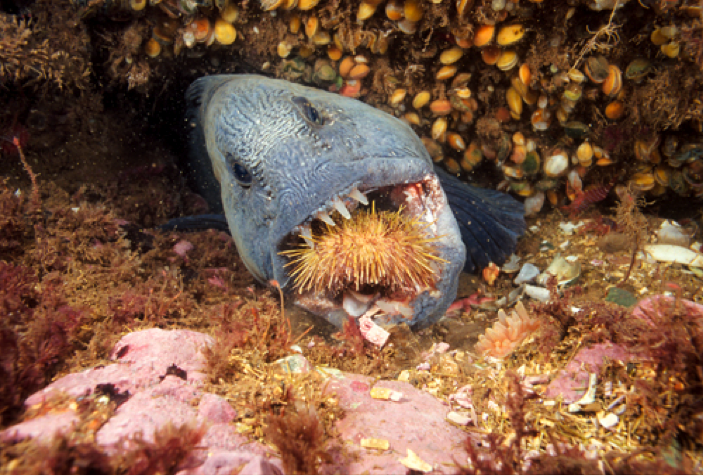
You would think having a name like “wolffish” would mean to stay away at all costs, but the Atlantic Wolffish (Anarhichas lupus) is actually not aggressive towards people and generally sedentary in nature. Their name can be attributed to the large canine teeth that protrude from their powerful jaws, used for hunting and eating hard-bodied invertebrates, including crabs, sea urchins, and snails (Figure 1). Consequently, wolffish play a vital role in the regulation of these prey species, namely sea urchins and green crab. Because the Atlantic Wolffish is generally sedentary, they prefer specific rocky habitats that allow them to hide and catch prey (Keith and Nitschke, 2008). 
 
Figure 1. Atlantic Wolffish (Anarhichas lupus) eating a sea urchin. Source 
 The fish are historically found in the deep, cold waters of the north Atlantic Ocean, and in U.S. waters throughout the Gulf of Maine and as far south as New Jersey (Rountree, 2002). Unfortunately, the range of habitat has diminished greatly over the past few decades due to habitat destruction, and the Wolffish is now only found clustered in three different areas of refuge in the Gulf of Maine, Georges Bank, and the Great South Channel (Nelson and Ross, 1992). Despite this fact, many conservation organizations and agencies list the conservation status of the Atlantic Wolffish under least concern. NOAA has denied the addition of the species onto the Endangered Species Act due to their high numbers in Canadian waters (Cosgrove, 2009). However, this is due to the fact that Canada began protecting the Atlantic Wolffish several years ago under their Species at Risk Act. Shouldn’t the U.S. then list the Atlantic Wolffish under the Endangered Species Act? Regardless of what these organizations and agencies say about the status of the Wolffish, there is solid evidence of a need for protection that is not being met by the U.S. The Atlantic Wolffish should be listed under the Endangered Species Act because it plays a vital role in the marine ecosystem and the population has been in steady decline for the past 30 years.

Although it may not be the most widely known fish in the sea, the Atlantic Wolffish is considered by many ecologists as a keystone species in the north Atlantic Ocean food webs (Dowdell, 2015). When left unchecked, sea urchins, a major prey of wolffish (Keats, 1986), create what’s known as an urchin barren. An urchin barren is an area that was once a flourishing kelp bed or kelp forest that has been grazed bare and results in hundreds of sea urchins left on the rocky platform (Andrews, 2013). Once the sea urchin population has reached this size, it’s much harder to regulate and reverse the damage that has been done, so it’s best to control the numbers before they can cause an issue as damaging as an urchin barren. By keeping the sea urchin population low, kelp forests can thrive which provides numerous benefits to marine life (Just, 2012). Many species seek shelter in the kelp forests and feed on the seaweed. Kelp also is very important to carbon sequestration, the regulation of CO2, not only in the ocean but in the atmosphere as well (Weatherall, 2014). In the face of climate change and rising atmospheric carbon dioxide levels, we can’t afford to lose such beneficial seaweed. However, if the Atlantic Wolffish population is unable to prey upon sea urchins and control their population size, kelp forests will be wiped out and negatively impact the surrounding marine world. In order to keep this from happening, the wolffish needs to be properly protected and thus should be listed under the Endangered Species Act. 
 
Figure 2. U.S. Wolffish landings from 1950-2011  Source
The Atlantic Wolffish has found itself in the middle of a sadly ironic situation; not only are humans the key to the population’s stability, but we are also the main cause of its decline. Over 1,200 metric tons (900,000 lbs) of wolffish were caught in 1983, which was the peak for U.S. landings of the Atlantic Wolffish (Figure 2). Since then, U.S. landings have decreased 97% to about 31.6 metric tons. Although there has been such a large decline in the commercial catch of wolffish, they still face a large threat by being unintentionally caught as bycatch, primarily in the otter trawl fishery (Keith and Nitschke, 2008).  They are also impacted by trawling and dredging, which tears up the seafloor and destroys their rocky habitat (Anderson, 2009). This specific habitat is important for hunting and protection for their young. Eggs are hidden in clusters under rocks and guarded by the male for 9-10 months (Fairchild, 2013). Without this specific rocky habitat they are susceptible to predation and have a decreased chance of survival. It was even estimated that practically every inch of the seafloor off the coast of New England was impacted by this form of modern fishing gear between 1984 and 1990 (Barth, 2009). While it is prohibited from being brought to shore and sold, the Atlantic Wolffish is still caught as bycatch and often thrown back into the water dead and uncounted (Keledjian, 2014). Despite being classified as a Species of Concern in 2004, and a total ban on the possession of Atlantic Wolffish by the New England Fishery Management Council (Anderson, 2009), populations are still declining due to bycatch and habitat destruction.

The only chance the Atlantic Wolffish has for survival is if the government decides to take matters into their own hands. They have allowed the decline of such an important species to go on for far too long, and it’s time that they took some responsibility for it. Current population estimates do not exist, and without stock structure studies our ability to manage the declining population is significantly impaired (Dowdell, 2015). Why there is a lack of current data on the population size is truly baffling. All we have to go on is how often the species is caught in trawl surveys, which has steadily been declining since the 1980s (Figure 3 and Figure 4). 
 
Figure 3. Decline in number of Wolffish caught in trawl surveys of the Western Gulf of Maine.  Source
If the Atlantic Wolffish population continues to decline, as last seen in 2009, then the negative impacts will become too big to ignore. The sea urchin population will exponentially increase, kelp forests will be depleted and CO2 levels will rise, just to name a few. Without more strict governmental regulations, the wolffish will continue to be affected by modern fishing techniques, specifically otter trawls, to a point that recovery may no longer be viable. There is no longer a question of whether or not the Atlantic Wolffish is a species of concern or if it should be listed under the Endangered Species Act. With all the evidence that surrounds us, we can’t ignore the foreseeable outcome as to the fate of this keystone species. The Atlantic Wolffish needs to be listed under the Endangered Species Act due to the crucial role it plays in the north Atlantic Ocean food web and the fact that population numbers have been steeply declining over the past couple decades.
 
Figure 4. Positive tows (Wolffish caught) from NEFSC bottom trawl surveys in the fall. Source.


References

Anderson, J., et all. 2009. Status Review of Atlantic Wolffish (Anarhichas lupus). National Marine Fisheries Service. NOAA.
Andrews, K. 2013. Sea urchins and  biodiversity. Explore the Seafloor. ABC Science and Integrated Marine Observing System (IMOS).  http://exploretheseafloor.net.au/the-science/urchins-biodiversity/  {accessed June 13, 2016}

Barth, B. 2009. Federal Officials Begin Official Review of Endangered Listing for Atlantic Wolffish: Announcement Marks Major Step Forward in Protection for One of New England’s Most Threatened Species. Conservation Law Foundation. http://www.clf.org/newsroom/federal-officials-begin-official-review-of-endangered-listing-for-atlantic-wolffish-announcement-marks-major-step-forward-in-protection-for-one-of-new-englands-most-threatened-fish-species/ {accessed June 13, 2016}
Cosgrove, S. 2009. Wolffish Protection Delayed is Wolffish Protection Denied. Conservation Law Foundation. http://www.clf.org/blog/wolffish-protection-delayed-is-wolffish-protection-denied/  {accessed June 13, 2016}
Dowdell, S. 2015. Fish Friday: The Atlantic Wolffish – Antifreeze Included. New England, Ocean Odyssey. http://newenglandoceanodyssey.org/fish-friday-the-atlantic-wolffish-antifreeze-included/ {accessed June 13, 2016}
Fairchild, E., et al. 2013. Spring feeding of Atlantic wolffish (Anarhichas lupus) on Stellwagen Bank, Massachusetts. Fishery Bulletin 113:191-201
Just, R. 2012. Atlantic Wolffish: A Face only a Mother Could Love? New England, Ocean Odyssey. Conservation Law Foundation.http://newenglandoceanodyssey.org/atlantic-wolffish-a-face-only-a-mother-could-love/ {accessed June 13, 2016}
Keats, D., et all. 1986.  Atlantic wolffish (Anarhichas lupus L.; Pisces: Anarhichidae) predation on green sea urchins (Strongylocentrotus droebachiensis). Canadian Journal of Zoology 64(9): 1920-1925
Keith, C. and P. Nitschke. 2008. Atlantic wolffish. Northeast Data Poor Stocks Working Group Meeting, Northeast Fisheries Science Center. http://www.nefsc.noaa.gov/publications/crd/crd0902/wolffish/origwolffish.pdf {accessed June 13, 2016}
Keledjian, A., et all. 2014. Wasted Catch: Unsolved Problems in U.S. Fisheries. Oceana, Inc.
Nelson, G. A., and M. R. Ross. 1992. Distribution, growth and food habits of the Atlantic wolffish (Anarhichas lupus) from the Gulf of Maine-Georges Bank region. Journal of the Northwest Atlantic Fishery Science 13:53-61.
Rountree, R. A. 2002. Wolffishes: Family Anarhichadidae. In Bigelow and Schroeder’s fishes of the Gulf of Maine. Smithsonian Inst. Press, Washington D.C.
Weatherall, G. 2014. Ocean Plants Part 3: Kelp and Climate. New England, Ocean Odyssey. Conservation Law Foundation. http://newenglandoceanodyssey.org/ocean-plants-part-3-kelp-and-climate/  {accessed June 13, 2016}